
BuddhistCatholicContemplativeEvangelicalGeneral ChristianHinduJewishLatter-day SaintMuslimNew VisionsProgressive Christian
Beliefs
- Buddhist
- Catholic
- Contemplative
- Evangelical
- General Christian
- Hindu
- Jewish
- Latter-day Saint
- More Voices
- Muslim
- New Visions
- Pagan
- Progressive Christian
Topics
- Religion News
- Food and Religion
- Sports and Religion
- Religious Art
- Religious Music and Entertainment
- Religious Events
- History and Religion
- Style and Religion
- Politics and Religion
- Women in Religion
- Recreation Outdoors and Religion
- Business Finance and Religion
- Careers Workplace and Religion
- Education and Religion
- Family Parenting and Religion
- Health Fitness and Religion
- Home and Religion
- Relationships and Religion
- Technology and Religion
- Travel and Religion
Columnists
- Buddhist Columnists
- Business Finance and Religion Columnists
- Careers Workplace and Religion Columnists
- Catholic Columnists
- Contemplative Columnists
- Education and Religion Columnists
- Evangelists Columnists
- Family Parenting and Religion Columnists
- General Christian Columnists
- Health Fitness and Religion Columnists
- Hindu Columnists
- History and Religion Columnists
- Home and Religion Columnists
- Jewish Columnists
- More Voices Columnists
- Latter Day Columnists
- Muslim Columnists
- New Visions Columnists
- Nonreligious Columnists
- Pagan Columnists
- Politics and Religion Columnists
- Progressive Columnists
- Recreation Outdoors and Religion Columnists
- Relationships and Religion Columnists
- Religion News Columnists
- Religious Art Columnists
- Religious Events Columnists
- Religious Music and Entertainment Columnists
- Sports and Religion Columnists
- Style and Religion Columnists
- Technology and Religion Columnists
- Travel and Religion Columnists
- Women in Religion Columnists
Resource Library
- 2026 Calendar
- Library of World Religions
- The 100 Most Holy Places on Earth
- Patheos Answers
- Podcasts
- Videos
- Faith Leaders Database
- Anglican Episcopalian
- Bahai
- Baptist
- Buddhism
- Christianity
- Confucianism
- Eastern Orthodoxy
- Hinduism
- Holiness and Pentecostal
- ISKCON
- Islam
- Judaism
- Lutheran
- Methodist
- The Church of Jesus Christ of Latter-day Saints
- New Age
- Paganism
- Presbytarian and Reformed
- Protestantism
- Religion Behind the Scenes
- Roman Catholic
- Scientology
- Shia Islam
- Sikhism
- Sufism
- Sunni Islam
- Taoism
- Zen
- See all religions
Research Tools
 Ad-Free & Subscriber Log-In Subscription Support
Ad-Free & Subscriber Log-In Subscription Support
Follow Patheos 

- Trending:
- Forgiveness
- |
- Marriage
- |
- Consciousness
- |
- Death Penalty
- |
- Election
- |
- Halloween
Catholic
"The Hiding Place": No Pit So Deep
April 13, 2011 by Julie Davis
There is no pit so deep that God's love is not deeper still. ~ Corrie ten Boom
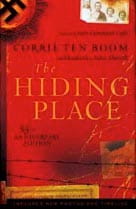 The Hiding Place
By Corrie ten Boom with John Sherrill and Elizabeth Sherrill
272 pages
Chosen Press
$12.99
It is appropriate that during Lent, when the depth of God's love is the lesson made plain to us, The Hiding Place came to my attention; it contains vivid examples of God's deep love set in a story of man's inhumanity to man.
I read The Hiding Place in high school, so it was with a sense of nostalgia for an excellent "holocaust survival autobiography" and the vague memory of a few key inspirational passages that I downloaded it as the free April audiobook from christianaudio.com. In fact, I believed I remembered it so well that I only began listening from curiosity, to see how the narration sounded.
I soon realized my memory was severely at fault as the honest and beautiful story unfolded. I was completely absorbed, and listened in every spare moment.
The Hiding Place begins in 1937, in Haarlem, Holland, with preparations for the one hundredth anniversary celebration of the ten Boom family's clock shop. The story is told by Corrie ten Boom who is the then-45-year-old youngest daughter of the family. She and her sister, Betsie, who is seven years older, are spinsters living with their elderly father. As such, they make an unlikely pair of heroines but God does not see with our eyes, as their tale tells.
The early pages of the book reveal a family truly living a Christian life, with a soup kettle always bubbling to feed the poor, numerous foster-children raised, and a challenging extended family borne with patiently. Corrie's father, Casper, keeps Christ at the center of their lives. His gentleness, rooted in strength and wisdom, serves as a Christ-like example. Several instances of her father's guidance become touchstones throughout Corrie's life, as in this childhood recollection:
And so seated next to my father in the train compartment, I suddenly asked, "Father, what is sex-sin?"
He turned to look at me, as he always did when answering a question, but to my surprise he said nothing. At last he stood up, lifted his traveling case off the floor and set it on the floor.
"Will you carry it off the train, Corrie?" he said.
I stood up and tugged at it. It was crammed with the watches and spare parts he had purchased that morning.
"It's too heavy," I said.
"Yes," he said, "and it would be a pretty poor father who would ask his little girl to carry such a load. It's the same way, Corrie, with knowledge. Some knowledge is too heavy for children. When you are older and stronger, you can bear it. For now you must trust me to carry it for you."
Corrie's sister, Betsie, is often a source of much needed Christ-like perspectives. When Corrie is troubled by a premonition of being taken from Haarlem against her will, she consults Betsie, who tells her:
If God has shown us bad times ahead, it's enough for me that He knows about them. That's why He sometimes shows us things, you know -- to tell us that this too is in His hands.
That trust is soon tested as the Nazis conquer Holland. When a well-dressed woman with a suitcase in hand appears at the shop's front door saying that she is a Jew afraid of being arrested, she is welcomed by Casper, "In this household, God's people are always welcome."
Thus begins the ten Boom family's surprising involvement in the Dutch underground.
Corrie soon finds herself the leader of one of the largest resistance groups in the city, centered at their home. She shares engrossing details about how the family eluded detection, managing to feed and house Jewish refugees until they could be spirited to safety. However, such a large operation made it inevitable that there would be a slip-up, and eventually the family is arrested.
From that point, the story reads like Dante's descent into the circles of Hell. The two middle-aged sisters are moved from one prison to another, each worse than the one before. It is during this point, however, that God makes His presence unmistakably known. As Corrie says in the movie made from the book, "God does not have problems. Only plans."
Article Continued On Next Page
Page: 1 of 2
4/13/2011 4:00:00 AM
Catholic
A Free Mind
History
Holocaust
Jews
Memoir
Nazism
Sacred Texts
Christianity
Roman Catholicism
more at patheos
1
INNER CIRCLE: All Raised. All Reconciled.
2

Reply to Anglican Sean Luke on Denominationalism
3

Meet Lay Dominican Catholic Writer Sarah Greydanus
4

When Strength Collapses: Finding the Inner Krishna

About Julie Davis
Julie Davis blogs about it at Happy Catholic and discusses both books and movies at A Good Story is Hard to Find podcast. Her new book is Happy Catholic, published by Servant Publishing. Follow Julie on Twitter and Facebook
Patheos Explore the world's faith through different perspectives on religion and spirituality! Patheos has the views of the prevalent religions and spiritualities of the world.
Ad-Free & Subscriber Log-In Subscription Support
- About Us
- 2026 Calendar
- Videos
- Podcasts
- Library of World Religions
- Faith In Media Tracker
- Advertise With Us
- Write for Us
- Privacy Policy
- Terms of Service
- Do Not Sell My Data
- Contact Us
- Radiant Digital
- Manage Newsletter Subscriptions
- Unsubscribe From Notifications
- Sitemap
Copyright 2008-2026, Patheos. All rights reserved.
Subscription Support Ad-Free & Subscriber Log-In
Follow Patheos