
BuddhistCatholicContemplativeEvangelicalGeneral ChristianHinduJewishLatter-day SaintMuslimNew VisionsProgressive Christian
Beliefs
- Buddhist
- Catholic
- Contemplative
- Evangelical
- General Christian
- Hindu
- Jewish
- Latter-day Saint
- More Voices
- Muslim
- New Visions
- Pagan
- Progressive Christian
Topics
- Religion News
- Food and Religion
- Sports and Religion
- Religious Art
- Religious Music and Entertainment
- Religious Events
- History and Religion
- Style and Religion
- Politics and Religion
- Women in Religion
- Recreation Outdoors and Religion
- Business Finance and Religion
- Careers Workplace and Religion
- Education and Religion
- Family Parenting and Religion
- Health Fitness and Religion
- Home and Religion
- Relationships and Religion
- Technology and Religion
- Travel and Religion
Columnists
- Buddhist Columnists
- Business Finance and Religion Columnists
- Careers Workplace and Religion Columnists
- Catholic Columnists
- Contemplative Columnists
- Education and Religion Columnists
- Evangelists Columnists
- Family Parenting and Religion Columnists
- General Christian Columnists
- Health Fitness and Religion Columnists
- Hindu Columnists
- History and Religion Columnists
- Home and Religion Columnists
- Jewish Columnists
- More Voices Columnists
- Latter Day Columnists
- Muslim Columnists
- New Visions Columnists
- Nonreligious Columnists
- Pagan Columnists
- Politics and Religion Columnists
- Progressive Columnists
- Recreation Outdoors and Religion Columnists
- Relationships and Religion Columnists
- Religion News Columnists
- Religious Art Columnists
- Religious Events Columnists
- Religious Music and Entertainment Columnists
- Sports and Religion Columnists
- Style and Religion Columnists
- Technology and Religion Columnists
- Travel and Religion Columnists
- Women in Religion Columnists
Resource Library
- 2026 Calendar
- Library of World Religions
- The 100 Most Holy Places on Earth
- Patheos Answers
- Podcasts
- Videos
- Faith Leaders Database
- Anglican Episcopalian
- Bahai
- Baptist
- Buddhism
- Christianity
- Confucianism
- Eastern Orthodoxy
- Hinduism
- Holiness and Pentecostal
- ISKCON
- Islam
- Judaism
- Lutheran
- Methodist
- The Church of Jesus Christ of Latter-day Saints
- New Age
- Paganism
- Presbytarian and Reformed
- Protestantism
- Religion Behind the Scenes
- Roman Catholic
- Scientology
- Shia Islam
- Sikhism
- Sufism
- Sunni Islam
- Taoism
- Zen
- See all religions
Research Tools
 Ad-Free & Subscriber Log-In Subscription Support
Ad-Free & Subscriber Log-In Subscription Support
Follow Patheos 

- Trending:
- Forgiveness
- |
- Marriage
- |
- Consciousness
- |
- Death Penalty
- |
- Election
- |
- Halloween
Catholic
Why St. Patrick's Day Matters, for Everybody
March 15, 2011 by Pat McNamara
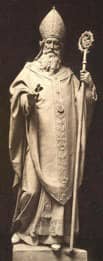 When George Washington took office in 1789, there were 30,000 Catholics in America. John Adams said they were "scarce as earthquakes." But by 1850, Catholics had become—and remain, today—the country's largest religious denomination. One factor explains this growth: immigration. Since the Irish were the first immigrants to significantly impact Catholic American life, and with St. Patrick's Day approaching, this week offers a good moment to examine their experiences and their impact.
Perhaps no immigrant group has been a greater force on American Catholicism, both in numbers and leadership. Irish immigration had been steady since colonial times, but until the 1840s it was mainly Protestant. By 1800, about 80 percent of Ireland was Catholic, but before the infamous "Penal Laws" were removed, they couldn't vote or hold office, and many professions were closed to them.
Between 1780 and 1840, Ireland's population nearly doubled. Even in the pre-Famine years, poverty was widespread. The social reformer Frederick Douglass visited in 1845. A former slave, he commented: "of all the places to witness human misery, ignorance, degradation, filth and wretchedness, an Irish hut is preeminent." The peasant diet consisted almost entirely of potatoes, a fairly nutritious food.
But when a fungus struck in 1845, the potatoes putrefied and decayed almost instantly. The entire crop was destroyed. At first the British government tried to help, but it was soon faced with a financial crisis at home and an Irish uprising. These combined to end, Charles Morris writes, "even the pretense of official concern . . . for all practical purposes, Ireland was left to die on its own."
In 1847, an eyewitness described conditions: "walking skeletons—the men gaunt and haggard, stamped with the livid mark of hunger—the children crying with pain—the women in some of the cabins too weak to stand." One woman said there was "nothing for us but to lie down and die."
One million Irish died of starvation. There being little future in remaining, many felt they had little choice but emigration.
That too was a sad event. Families would hold a gathering for the emigrants, who might never return, called "the American wake." (No matter how well the Irish did abroad, many considered themselves "exiles.") Nor was the trip itself easy. Many didn't make it. For 50-60 days, they had no food but what they brought, no beds, no toilets. Aboard crowded ships, cholera and typhoid killed thousands.
When they arrived, they settled in east coast cities, mainly because they couldn't afford to go any further. They lived in crowded, filthy tenements, which one observer described as "hell with the lid off." They found jobs on which they were barely able to subsist. But they clung to the hope of a better life for their children.
They certainly received no welcome from white Anglo-Saxon Protestants, who organized anti-Catholic groups like the "Know-Nothings" whose members were bound to secrecy, claiming they "knew nothing" when violence broke out. It was common to see notices reading, "Neither Irish nor Catholic Need Apply," or "No Irish Need Apply," at businesses and in newspaper ads.
Hatred ran deep:
The Irish . . . dump themselves down in large villages and towns, crowding the meaner sort of tenements and filling them with wretchedness, filth and disease . . . what are they but mere marketable cattle?
But they had tough leaders. After churches were burned in Philadelphia, Bishop John ("Dagger John") Hughes promised New York's mayor that ten Protestant churches would burn for every Catholic, and he placed armed men around his parishes.
One reason the Irish stuck so closely to Catholicism was they had little but their faith to sustain them amid poverty, disease, and prejudice. Over decades they assumed leadership roles in business, politics, and the Church, but it must be noted that, at times, some Irish were less than welcoming to newcomers. In 1880s New York, Bernard Lynch, a prominent layman, asked whether Italians would ever assimilate. In Minnesota, Archbishop John Ireland's treatment of Eastern Rite Catholics led to massive defections (some call him the founder of the Orthodox Church in America.) In 1897, a group of Poles broke off from the "Irish Roman Catholic Church" to create the Polish National Catholic Church.
Article Continued On Next Page
Page: 1 of 2
3/15/2011 4:00:00 AM
Catholic
In Ages Past
History
Holidays
Immigration
Ritual
Christianity
Roman Catholicism
more at patheos
1

2

Where “Boys Being Boys” Gets Us
3
Beyond the Altar: Why the Church is Failing at Discipleship
4

Sister Letty belongs in America, ethnic-cleansing doesn't

About Pat McNamara
Dr. Pat McNamara is a published historian. He blogs about American Catholic History at McNamara's Blog.
Patheos Explore the world's faith through different perspectives on religion and spirituality! Patheos has the views of the prevalent religions and spiritualities of the world.
Ad-Free & Subscriber Log-In Subscription Support
- About Us
- 2026 Calendar
- Videos
- Podcasts
- Library of World Religions
- Faith In Media Tracker
- Advertise With Us
- Write for Us
- Privacy Policy
- Terms of Service
- Do Not Sell My Data
- Contact Us
- Radiant Digital
- Manage Newsletter Subscriptions
- Unsubscribe From Notifications
- Sitemap
Copyright 2008-2026, Patheos. All rights reserved.
Subscription Support Ad-Free & Subscriber Log-In
Follow Patheos