
BuddhistCatholicContemplativeEvangelicalGeneral ChristianHinduJewishLatter-day SaintMuslimNew VisionsProgressive Christian
Beliefs
- Buddhist
- Catholic
- Contemplative
- Evangelical
- General Christian
- Hindu
- Jewish
- Latter-day Saint
- More Voices
- Muslim
- New Visions
- Pagan
- Progressive Christian
Topics
- Religion News
- Food and Religion
- Sports and Religion
- Religious Art
- Religious Music and Entertainment
- Religious Events
- History and Religion
- Style and Religion
- Politics and Religion
- Women in Religion
- Recreation Outdoors and Religion
- Business Finance and Religion
- Careers Workplace and Religion
- Education and Religion
- Family Parenting and Religion
- Health Fitness and Religion
- Home and Religion
- Relationships and Religion
- Technology and Religion
- Travel and Religion
Columnists
- Buddhist Columnists
- Business Finance and Religion Columnists
- Careers Workplace and Religion Columnists
- Catholic Columnists
- Contemplative Columnists
- Education and Religion Columnists
- Evangelists Columnists
- Family Parenting and Religion Columnists
- General Christian Columnists
- Health Fitness and Religion Columnists
- Hindu Columnists
- History and Religion Columnists
- Home and Religion Columnists
- Jewish Columnists
- More Voices Columnists
- Latter Day Columnists
- Muslim Columnists
- New Visions Columnists
- Nonreligious Columnists
- Pagan Columnists
- Politics and Religion Columnists
- Progressive Columnists
- Recreation Outdoors and Religion Columnists
- Relationships and Religion Columnists
- Religion News Columnists
- Religious Art Columnists
- Religious Events Columnists
- Religious Music and Entertainment Columnists
- Sports and Religion Columnists
- Style and Religion Columnists
- Technology and Religion Columnists
- Travel and Religion Columnists
- Women in Religion Columnists
Resource Library
- 2026 Calendar
- Library of World Religions
- The 100 Most Holy Places on Earth
- Patheos Answers
- Podcasts
- Videos
- Faith Leaders Database
- Anglican Episcopalian
- Bahai
- Baptist
- Buddhism
- Christianity
- Confucianism
- Eastern Orthodoxy
- Hinduism
- Holiness and Pentecostal
- ISKCON
- Islam
- Judaism
- Lutheran
- Methodist
- The Church of Jesus Christ of Latter-day Saints
- New Age
- Paganism
- Presbytarian and Reformed
- Protestantism
- Religion Behind the Scenes
- Roman Catholic
- Scientology
- Shia Islam
- Sikhism
- Sufism
- Sunni Islam
- Taoism
- Zen
- See all religions
Research Tools
 Ad-Free & Subscriber Log-In Subscription Support
Ad-Free & Subscriber Log-In Subscription Support
Follow Patheos 

- Trending:
- Forgiveness
- |
- Marriage
- |
- Consciousness
- |
- Death Penalty
- |
- Election
- |
- Halloween
Evangelical
Opposing the Use of Force in Libya
March 23, 2011 by Jonathan Fitzgerald
Ross Douthat at The New York Times called the conflict in Libya a "very liberal intervention." Joe Carter at First Things, considering whether the word "war" is rightly applied to the situation, settled on "military intervention." Others simply call it a "conflict." For his part, Moammar Gaddafi promised that it would be a "long, drawn out war."
No matter what we call it, Christians should oppose the use of force in Libya.
Two thousand years ago, that claim would have been uncontroversial. In the early church, before Constantine wed Christianity to the Roman Empire, followers of Jesus Christ took seriously the crazy things he said about turning the other cheek, loving the enemy, and living and dying by the sword. They were hard teachings then, as now, but to the oppressed early church it was clear that the Kingdom Jesus came to establish could only be truly advanced by nonviolent means.
Whenever I tell someone that I am a Christian pacifist, there are several questions I always hear. I wrote about these in depth years ago at the Burnside Writers' Collective; they range from the highly personal: "What if someone attacked your loved one?" to the quasi-political exclamation: "Hitler!?!" But they all start from a place of power. That is, both the questioner and I have the luxury of power. We in the United States cannot hear the words of Jesus in the same way his disciples did. Is it any wonder that the most recent examples of active nonviolent resistance come from oppressed people—Gandhi, Martin Luther King, Jr., and, most recently, the people of Egypt who overthrew Mubarak without bloodshed?
As a junior in college, four short months after 9/11, I had the opportunity to study abroad at Daystar University, a Christian college in Nairobi, Kenya. Although my thoughts on war and peace were still in formation, I knew that the language of revenge that erupted from the White House and the news media sounded nothing like Jesus' language of peace and justice.
With these thoughts swirling in my head, I enrolled at Daystar in "Christian Perspectives on War and Peace," taught by Ahmed Ali Haile, a Somali who had lost his right leg. Here was a man who had been shot by a rocket and was practically exiled from his home country, but who believed very deeply in the Gospel message of peace. As it turns out, Professor Haile was also a Mennonite and introduced me and my classmates—students from all over Africa, including several Sudanese refugees—to the writings of the Christian pacifist John Howard Yoder. It is difficult to see Jesus' call to lay down one's life for another as metaphorical in the presence of a man who did it for real. Likewise, it seemed impossible to justify a violent response to 9/11 while sitting in a classroom full of students who, in the face of genocide, still chose peace.
It has been nearly ten years since I first came to understand how I should respond to the clear call to pacifism in the Gospels. In many ways my perspective has deepened. I've come to more fully understand the way in which peace is a central teaching of the Gospel because it's a central part of the Kingdom to come. But, this does not make accepting or implementing it any easier. In fact, in the time since I graduated college in 2003, it has only grown more difficult.
For instance, I joined the crowds of people around the world who took to the streets on February 15, 2003, to oppose the impending war in Iraq. Opposing a unilateral attack on a country that had not provoked the United States, however, was far easier than answering what should be done in the face of a maniacal leader who showed no mercy in taking the lives of his own people.
In my moments of weakness, I want to join author and blogger Rachel Held Evans, who recently admitted to shouting at the television, "Can't we just take this Gadhafi clown out?" But this is precisely why I know that pacifism is a divine calling, as opposed to a personal disposition. The fact is, we probably can just take him out, and in the United States we know that using our power to do so is politically a viable solution. It's what we did in Iraq.
There are certainly plenty of earnest Christians who believe that in order to protect the people of Libya, this may be the best solution. We hear a lot of talk about the lesser of two evils. But I don't see any room in the Gospels for this position. It is from a position of power that one can make the decision between the lesser of two evils; people who are subject to power must choose between right and wrong.
Article Continued On Next Page
Page: 1 of 2
3/23/2011 4:00:00 AM
Evangelical
In Progress
Violence
Libya
Military
Pacifism
Christianity
Evangelicalism
more at patheos
1
I'll Never Forget What Americans Did, for Money
2

Permanent Daylight Saving Time: What the New Bill Means
3

When ‘Too Good to Be True’ Hardens Our Hearts
4
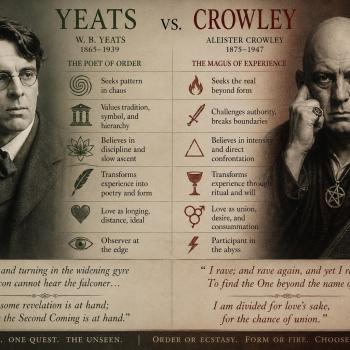
Yeats vs. Crowley: Poetry, Magick and Desire

About Jonathan Fitzgerald
Jonathan D. Fitzgerald is the managing editor of Patrolmag.com, and writes on the various manifestations of Christianity in culture. Follow him on Twitter or at his website, www.jonathandfitzgerald.com.
Patheos Explore the world's faith through different perspectives on religion and spirituality! Patheos has the views of the prevalent religions and spiritualities of the world.
Ad-Free & Subscriber Log-In Subscription Support
- About Us
- 2026 Calendar
- Videos
- Podcasts
- Library of World Religions
- Faith In Media Tracker
- Advertise With Us
- Write for Us
- Privacy Policy
- Terms of Service
- Do Not Sell My Data
- Contact Us
- Radiant Digital
- Manage Newsletter Subscriptions
- Unsubscribe From Notifications
- Sitemap
Copyright 2008-2026, Patheos. All rights reserved.
Subscription Support Ad-Free & Subscriber Log-In
Follow Patheos