
BuddhistCatholicContemplativeEvangelicalGeneral ChristianHinduJewishLatter-day SaintMuslimNew VisionsProgressive Christian
Beliefs
- Buddhist
- Catholic
- Contemplative
- Evangelical
- General Christian
- Hindu
- Jewish
- Latter-day Saint
- More Voices
- Muslim
- New Visions
- Pagan
- Progressive Christian
Topics
- Religion News
- Food and Religion
- Sports and Religion
- Religious Art
- Religious Music and Entertainment
- Religious Events
- History and Religion
- Style and Religion
- Politics and Religion
- Women in Religion
- Recreation Outdoors and Religion
- Business Finance and Religion
- Careers Workplace and Religion
- Education and Religion
- Family Parenting and Religion
- Health Fitness and Religion
- Home and Religion
- Relationships and Religion
- Technology and Religion
- Travel and Religion
Columnists
- Buddhist Columnists
- Business Finance and Religion Columnists
- Careers Workplace and Religion Columnists
- Catholic Columnists
- Contemplative Columnists
- Education and Religion Columnists
- Evangelists Columnists
- Family Parenting and Religion Columnists
- General Christian Columnists
- Health Fitness and Religion Columnists
- Hindu Columnists
- History and Religion Columnists
- Home and Religion Columnists
- Jewish Columnists
- More Voices Columnists
- Latter Day Columnists
- Muslim Columnists
- New Visions Columnists
- Nonreligious Columnists
- Pagan Columnists
- Politics and Religion Columnists
- Progressive Columnists
- Recreation Outdoors and Religion Columnists
- Relationships and Religion Columnists
- Religion News Columnists
- Religious Art Columnists
- Religious Events Columnists
- Religious Music and Entertainment Columnists
- Sports and Religion Columnists
- Style and Religion Columnists
- Technology and Religion Columnists
- Travel and Religion Columnists
- Women in Religion Columnists
Resource Library
- 2026 Calendar
- Library of World Religions
- The 100 Most Holy Places on Earth
- Patheos Answers
- Podcasts
- Videos
- Faith Leaders Database
- Anglican Episcopalian
- Bahai
- Baptist
- Buddhism
- Christianity
- Confucianism
- Eastern Orthodoxy
- Hinduism
- Holiness and Pentecostal
- ISKCON
- Islam
- Judaism
- Lutheran
- Methodist
- The Church of Jesus Christ of Latter-day Saints
- New Age
- Paganism
- Presbytarian and Reformed
- Protestantism
- Religion Behind the Scenes
- Roman Catholic
- Scientology
- Shia Islam
- Sikhism
- Sufism
- Sunni Islam
- Taoism
- Zen
- See all religions
Research Tools
 Ad-Free & Subscriber Log-In Subscription Support
Ad-Free & Subscriber Log-In Subscription Support
Follow Patheos 

- Trending:
- Forgiveness
- |
- Marriage
- |
- Consciousness
- |
- Death Penalty
- |
- Election
- |
- Halloween
Catholic
"No Party but Mankind!": Orestes A. Brownson
March 08, 2011 by Pat McNamara
The middle class is always a firm champion of equality when it concerns a class above it; but it is the inveterate foe when it concerns elevating a class below it. ~ "The Laboring Classes," 1840
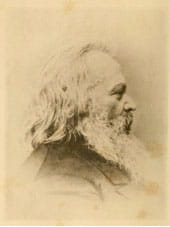 In 1937, New York City police investigated a vandalism case on West 104th Street and Riverside Drive, where teenagers had toppled and defaced a statue dedicated to Orestes A. Brownson (1803-1876). After extensive investigation, police couldn't find anyone that knew who Brownson was.
It turned out that he had a loose connection with Fordham University in the Bronx, so the statue was sent there. But many years later, one Jesuit recalls, students still "hadn't the vaguest idea" who he was.
The irony is that Orestes Augustus Brownson was one of the previous century's foremost intellectuals, involved in every major debate of the time: political, religious, intellectual, with strong opinions on all. (His collected writings number twenty volumes.) A seeker after truth, he joined several churches before finding Catholicism. In time he forged a place for himself as Catholic America's first great lay intellectual.
Brownson was largely self-educated. Born to a poor Vermont family and raised Presbyterian, at 20 he converted to Universalism, returned to Presbyterianism, and reconverted to Universalism -- all in a single year. Ordained in 1826, he ministered in New England. Religiously speaking, the New York Herald commented, "Brownson has blown from all points of the compass." Peers wondered "what direction his mind would take next." The one constant, a close friend recalled, was a "passion for truth."
By the 1830s, he was a Unitarian pastor in Boston. In a time of great political and economic unrest, Brownson believed Christianity must lead the fight for social justice, and he publicly declared Jesus "the prophet of the workingman." In 1838, he started Brownson's Quarterly Review as an organ for his views. Its motto was "We Know No Party but Mankind." (Foes suggested, "We Know No Party but Brownson.")
A brief foray into political campaigning disillusioned Brownson, who concluded that human action, alone, was incapable of transforming society. "No Church, no reform" was his new motto. He was looking specifically for a Church that would unify, not divide, society. It should offer communion rather than the disunity he saw among various Christian denominations. In short, he wanted a Church that was "catholic," in the universal sense.
Brownson could not immediately decide whether he should join the Roman or Anglican Church. Through reading and prayer, he came to view Rome as the fullness of revelation and hope for true reform. Ultimately he saw conversion as a matter of "saving my soul." In early 1844, he began receiving religious instruction from a bishop in Boston, and in October he was formally received. He remained a Catholic for the rest of his life.
As a husband and father of eight, Brownson was ineligible for priesthood, but he found other ways to preach, through his magazine and public lectures. (He remained his own editor because he couldn't "bear mutilation by any hand but my own.") He called upon American Catholics to engage the day's major intellectual and religious issues. "The responsibility of Catholics," he wrote, "is greater than that of any other class of citizens."
Brownson saw American democracy as a model for the world. Although he supported the separation of church and state, he insisted that religion had an important role to play in public dialogue. Democracy, he believed, needed a moral basis that only religion could provide. Long before TV and the internet, he warned: "The greatest danger to American society is that we are rapidly becoming a nation of isolated individuals." Catholicism with its communal emphasis provided a powerful antidote.
At a time when many questioned whether Catholics could be good Americans, Brownson argued boldly that Catholicism was the nation's best hope:
The Catholic Church comes not to destroy, but to fulfill: to purify, elevate, direct, and invigorate. And as our country is the future hope of the world, so is Catholicity the future hope of our country.
Brownson's conservatism grew more pronounced with time. But, his biographer Patrick Carey notes, this didn't mean he "favored the status quo or that he rejected progress and reform." He was increasingly convinced that the major philosophical issue of the time was the secularization of the Western mind -- a notion that may explain the renewed interest in some of Brownson's ideas among modern conservative thinkers.
Brownson was unafraid to venture his opinion on any issue; philosophy, science, politics, literature, religion: he addressed it all. He considered Charles Dickens' popularity "one of the worst symptoms of the age." Charles Darwin, he wrote, was someone to whom "we should refuse even to bid good-day." He dismissed suffragettes in the belief that a woman was "created to be a wife and a mother." And while he opposed slavery in principle, he was sadly as racist as his times, writing: "We cannot alter the fact of Negro inferiority."
Article Continued On Next Page
Page: 1 of 2
3/8/2011 5:00:00 AM
Catholic
In Ages Past
History
politics
Christianity
Roman Catholicism
more at patheos
1
The Gospel of Matthew: The House of Yosef
2

The Second Sunday of Easter - Commentary for April 12
3

Exchanges on 1 Corinthians 3:10-15 & Purgatory
4

EKKL Launches: A Brand-New Faith-Focused Entertainment Hub

About Pat McNamara
Dr. Pat McNamara is a published historian. He blogs about American Catholic History at McNamara's Blog.
Patheos Explore the world's faith through different perspectives on religion and spirituality! Patheos has the views of the prevalent religions and spiritualities of the world.
Ad-Free & Subscriber Log-In Subscription Support
- About Us
- 2026 Calendar
- Videos
- Podcasts
- Library of World Religions
- Faith In Media Tracker
- Advertise With Us
- Write for Us
- Privacy Policy
- Terms of Service
- Do Not Sell My Data
- Contact Us
- Radiant Digital
- Manage Newsletter Subscriptions
- Unsubscribe From Notifications
- Sitemap
Copyright 2008-2026, Patheos. All rights reserved.
Subscription Support Ad-Free & Subscriber Log-In
Follow Patheos