
BuddhistCatholicContemplativeEvangelicalGeneral ChristianHinduJewishLatter-day SaintMuslimNew VisionsProgressive Christian
Beliefs
- Buddhist
- Catholic
- Contemplative
- Evangelical
- General Christian
- Hindu
- Jewish
- Latter-day Saint
- More Voices
- Muslim
- New Visions
- Pagan
- Progressive Christian
Topics
- Religion News
- Food and Religion
- Sports and Religion
- Religious Art
- Religious Music and Entertainment
- Religious Events
- History and Religion
- Style and Religion
- Politics and Religion
- Women in Religion
- Recreation Outdoors and Religion
- Business Finance and Religion
- Careers Workplace and Religion
- Education and Religion
- Family Parenting and Religion
- Health Fitness and Religion
- Home and Religion
- Relationships and Religion
- Technology and Religion
- Travel and Religion
Columnists
- Buddhist Columnists
- Business Finance and Religion Columnists
- Careers Workplace and Religion Columnists
- Catholic Columnists
- Contemplative Columnists
- Education and Religion Columnists
- Evangelists Columnists
- Family Parenting and Religion Columnists
- General Christian Columnists
- Health Fitness and Religion Columnists
- Hindu Columnists
- History and Religion Columnists
- Home and Religion Columnists
- Jewish Columnists
- More Voices Columnists
- Latter Day Columnists
- Muslim Columnists
- New Visions Columnists
- Nonreligious Columnists
- Pagan Columnists
- Politics and Religion Columnists
- Progressive Columnists
- Recreation Outdoors and Religion Columnists
- Relationships and Religion Columnists
- Religion News Columnists
- Religious Art Columnists
- Religious Events Columnists
- Religious Music and Entertainment Columnists
- Sports and Religion Columnists
- Style and Religion Columnists
- Technology and Religion Columnists
- Travel and Religion Columnists
- Women in Religion Columnists
Resource Library
- 2026 Calendar
- Library of World Religions
- The 100 Most Holy Places on Earth
- Patheos Answers
- Podcasts
- Videos
- Faith Leaders Database
- Anglican Episcopalian
- Bahai
- Baptist
- Buddhism
- Christianity
- Confucianism
- Eastern Orthodoxy
- Hinduism
- Holiness and Pentecostal
- ISKCON
- Islam
- Judaism
- Lutheran
- Methodist
- The Church of Jesus Christ of Latter-day Saints
- New Age
- Paganism
- Presbytarian and Reformed
- Protestantism
- Religion Behind the Scenes
- Roman Catholic
- Scientology
- Shia Islam
- Sikhism
- Sufism
- Sunni Islam
- Taoism
- Zen
- See all religions
Research Tools
 Ad-Free & Subscriber Log-In Subscription Support
Ad-Free & Subscriber Log-In Subscription Support
Follow Patheos 

- Trending:
- Forgiveness
- |
- Marriage
- |
- Consciousness
- |
- Death Penalty
- |
- Election
- |
- Halloween
Catholic
From Columbus to Cabrini: America's Italian Catholics
March 22, 2011 by Pat McNamara
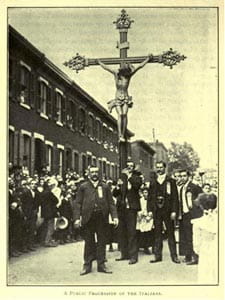 From the start, Italian Catholics have played key roles in American history: Christopher Columbus, John Cabot, Giovanni da Verrazzano, Amerigo Vespucci. But it was a long time before Italians came here in large numbers. In 1851, the City of New York had seventy-four Italian residents; by the turn of the century it had more than Genoa, Florence, and Venice combined. By then Italian immigrants were arriving at Ellis Island at the rate of 100,000 a year.
To understand why, we must look back to Italy, which had just moved from a series of independent kingdoms into a united nation. (The popes, who for centuries ruled central Italy, opposed it.) When Italian troops entered Rome on September 20, 1870, unification became official. In a fit of anger, Pope Pius IX banned Catholics from participating in national politics. The ban lasted for decades.
But poverty was widespread in southern Italy, the mezzogiorno, and it would get worse. After visiting this largely rural area, Booker T. Washington, a former slave, commented: "The Negro is not the man farthest down." High taxes didn't help, nor did economic unrest, rising prices, and growing unemployment. Immigration seemed to be the only choice.
But to get to America, many needed help—a patron (padrone) who paid their passage and got them a job. Often immigrants themselves, these provided room and board, collected wages, and gave workers an allowance. They also exploited immigrants through a system that wasn't fully eradicated until well into the 1900s.
The newcomers didn't call themselves Italian, but Neapolitan, Calabrese, Genoan, or Abruzzese. While early Italian immigration was mainly northern, after 1880 it was almost completely southern. Cultural differences ran deep. A priest from Tuscany, assigned to a largely Sicilian parish, asked in exasperation what manner of people his parishioners were.
The men came first. Most planned to return once they made enough money. Like the Irish, they settled mainly in cities where they found work. (Some immigrants assumed that New York was a very religious place, since the street signs read "Ave.") "Little Italies" formed in cities nationwide, but also in some unexpected places, like Salt Lake City, Omaha, Tontitown, Arkansas and Morgantown, West Virginia.
America changed Italians in more ways than one. Ellis Island clerks, unable to pronounce or spell their names, changed them arbitrarily on the paperwork. A Benedetto became a Bennett, Pascuzzi was rechristened Pascoe, and Randazesse was renamed Randa. One clerk renamed a young man O'Neill. He later studied law and became a judge in Philadelphia, where his "Irish" connections played a factor in his rise.
Local Catholic reaction to newcomers was mixed. New York's archbishops made outreach a priority. In Manhattan, Sister Catherine Seton, daughter of the first American-born saint, studied Italian in her 80s to better help them. In the Bronx, Father Daniel Burke, fluent in Italian, started St. Philip Neri Church. In Greenwich Village, heiress Annie Leary kept Our Lady of Pompeii Church afloat during its early years.
But there was also Bernard Lynch, who in 1888 wrote an article for the Catholic World complaining that his neighborhood was "invaded" by "dark-eyed, olive tinted men and women." He asked whether they could ever assimilate. There was Paul Boyton in Coney Island, who asked his bishop to replace the Italian pastor with an "American." And there were Irish priests who relegated Italians to the basement, the chiesa inferiore.
Much of the Irish-Italian conflict was based on different religious styles. One stressed institutional affiliation, while the other simply emphasized being a Cristiano. Although clergy bemoaned their lack of formal religious education, Italians had a definite religious worldview. One scholar calls it a "distillation of the lives of saints, stories of miracles, and some prayers, along with protective incantations, passed down from generation to generation."
Nowhere was their religious life more publicly expressed than at their festivals. Food, games, and music attracted thousands, but these were incidentals. Ultimately, the purpose was to honor the saints who guided and protected the people. In his 1943 memoir Mount Allegro, Jere Mangione writes:
A guardian saint was like a friend in court. He had special access to God's ear. If you took care to remember the saint with prayers and an occasional candle, you could usually count on him to remain loyal and carry out your wishes.
In New Orleans, once home to a large Sicilian community, the Feast of St. Joseph (March 19th) is still a major event. Neapolitan immigrants began Manhattan's San Gennaro Festival (September 19th). Each summer, New York City hosts three separate festivals for Our Lady of Mount Carmel (July 16th). Its founders, Robert Orsi writes, wanted to honor the Madonna who "consoled them during the trials— both physical and spiritual—of immigration."
Article Continued On Next Page
Page: 1 of 2
3/22/2011 4:00:00 AM
Catholic
In Ages Past
History
Italians
Christianity
Roman Catholicism
more at patheos
1
Was the "Sinful Woman" in Luke Really a Prostitute?
2

Is 'Separation of Church and State' Really a Myth?
3

4
Overstaying a Visa Isn't a Crime. Here's Why It Matters

About Pat McNamara
Dr. Pat McNamara is a published historian. He blogs about American Catholic History at McNamara's Blog.
Patheos Explore the world's faith through different perspectives on religion and spirituality! Patheos has the views of the prevalent religions and spiritualities of the world.
Ad-Free & Subscriber Log-In Subscription Support
- About Us
- 2026 Calendar
- Videos
- Podcasts
- Library of World Religions
- Faith In Media Tracker
- Advertise With Us
- Write for Us
- Privacy Policy
- Terms of Service
- Do Not Sell My Data
- Contact Us
- Radiant Digital
- Manage Newsletter Subscriptions
- Unsubscribe From Notifications
- Sitemap
Copyright 2008-2026, Patheos. All rights reserved.
Subscription Support Ad-Free & Subscriber Log-In
Follow Patheos