
BuddhistCatholicContemplativeEvangelicalGeneral ChristianHinduJewishLatter-day SaintMuslimNew VisionsProgressive Christian
Beliefs
- Buddhist
- Catholic
- Contemplative
- Evangelical
- General Christian
- Hindu
- Jewish
- Latter-day Saint
- More Voices
- Muslim
- New Visions
- Pagan
- Progressive Christian
Topics
- Religion News
- Food and Religion
- Sports and Religion
- Religious Art
- Religious Music and Entertainment
- Religious Events
- History and Religion
- Style and Religion
- Politics and Religion
- Women in Religion
- Recreation Outdoors and Religion
- Business Finance and Religion
- Careers Workplace and Religion
- Education and Religion
- Family Parenting and Religion
- Health Fitness and Religion
- Home and Religion
- Relationships and Religion
- Technology and Religion
- Travel and Religion
Columnists
- Buddhist Columnists
- Business Finance and Religion Columnists
- Careers Workplace and Religion Columnists
- Catholic Columnists
- Contemplative Columnists
- Education and Religion Columnists
- Evangelists Columnists
- Family Parenting and Religion Columnists
- General Christian Columnists
- Health Fitness and Religion Columnists
- Hindu Columnists
- History and Religion Columnists
- Home and Religion Columnists
- Jewish Columnists
- More Voices Columnists
- Latter Day Columnists
- Muslim Columnists
- New Visions Columnists
- Nonreligious Columnists
- Pagan Columnists
- Politics and Religion Columnists
- Progressive Columnists
- Recreation Outdoors and Religion Columnists
- Relationships and Religion Columnists
- Religion News Columnists
- Religious Art Columnists
- Religious Events Columnists
- Religious Music and Entertainment Columnists
- Sports and Religion Columnists
- Style and Religion Columnists
- Technology and Religion Columnists
- Travel and Religion Columnists
- Women in Religion Columnists
Resource Library
- 2026 Calendar
- Library of World Religions
- The 100 Most Holy Places on Earth
- Patheos Answers
- Podcasts
- Videos
- Faith Leaders Database
- Anglican Episcopalian
- Bahai
- Baptist
- Buddhism
- Christianity
- Confucianism
- Eastern Orthodoxy
- Hinduism
- Holiness and Pentecostal
- ISKCON
- Islam
- Judaism
- Lutheran
- Methodist
- The Church of Jesus Christ of Latter-day Saints
- New Age
- Paganism
- Presbytarian and Reformed
- Protestantism
- Religion Behind the Scenes
- Roman Catholic
- Scientology
- Shia Islam
- Sikhism
- Sufism
- Sunni Islam
- Taoism
- Zen
- See all religions
Research Tools
 Ad-Free & Subscriber Log-In Subscription Support
Ad-Free & Subscriber Log-In Subscription Support
Follow Patheos 

- Trending:
- Forgiveness
- |
- Marriage
- |
- Consciousness
- |
- Death Penalty
- |
- Election
- |
- Halloween
Catholic
A Catechism Lesson: Forgiving "As" Jesus Did
March 30, 2011 by Pat Gohn
I have trouble with resentment. Actually, I've got resentment down pretty well. It's the letting go of resentment and the loosening of its grip on my heart that is the struggle. Resentment usually signals my refusal to forgive.
Regardlessof how I may justify the reasons for resentment, I know I don't want to be this way. Thankfully, through the Sacrament of Reconciliation and pastoral counseling, I have made healthy strides in the forgiveness-recovery department.
One little word in The Lord's Prayer, plus a few paragraphs in the Catechism of the Catholic Church, became catalysts for my deeper conversion. By God's grace, I have found release and have better-learned to "let go."
And I'm talking about forgiveness in areas of life-long hurt, as well as the petty annoying trespasses that come our way.
Observe the little word in the line of the Lord's Prayer that gets to the heart of it all: "Forgive us our trespasses, as we forgive those who trespass against us."
This petition is astonishing . . . according to the second phrase, our petition will not be heard unless we have first met a strict requirement. Our petition looks to the future, but our response must come first, for the two parts are joined by the single word "as" (Catechism of the Catholic Church, par. 2838).
That little word is AS-tonishing! No getting around it. It's the stickler, the caveat, the tipping point, for the truth of this teaching. How many times have I asked God's forgiveness for something, when I really had no clue that I was to extend it to others first? Often, I just rattled off the words of prayer, not paying attention to what they meant.
The Lord desires my true conversion, so I had to get it straight: "Our response must come first." Then the Lord "hears" my prayer.
With bold confidence, we began praying to our Father. In begging him that his name be hallowed, we were in fact asking him that we ourselves might be always made more holy. But though we are clothed with the baptismal garment, we do not cease to sin, to turn away from God. Now, in this new petition, we return to him like the prodigal son and, like the tax collector, recognize that we are sinners before him. Our petition begins with a "confession" of our wretchedness and his mercy. Our hope is firm because, in his Son, "we have redemption, the forgiveness of sins" [Eph. 1:7-8; Col. 1:13-14] (Catechism of the Catholic Church, par. 2839).
Bold confidence is exactly what is needed to acknowledge my failures. But sometimes, it takes an even bolder confidence in God for me to accept his mercy! This becomes easier when we understand the dignity we have as children of God. By virtue of our baptism, we have a holy standing before God, not because of anything we have done, but because of the redemption we have in Christ! Indeed, St. Paul says, the Father has "qualified us to share in the inheritance of the saints in light" (Col. 1:12).
He has delivered us from the dominion of darkness and transferred us to the kingdom of his beloved Son, in whom we have redemption, the forgiveness of sins(Col. 1:13-14).
Thankfully, hardness of heart does not have to be a life sentence. But it takes work to keep an open heart.
Now—and this is daunting—this outpouring of mercy cannot penetrate our hearts as long as we have not forgiven those who have trespassed against us. Love, like the Body of Christ, is indivisible; we cannot love the God we cannot see if we do not love the brother or sister we do see. In refusing to forgive our brothers and sisters, our hearts are closed and their hardness makes them impervious to the Father's merciful love; but in confessing our sins, our hearts are opened to his grace (Catechism of the Catholic Church, par. 2840).
Mercy "cannot penetrate our hearts" if we lack forgiveness. Ouch.
The question for me becomes, why wait? Why hold on to something painful for so long?When I unlock my heart's unforgiving resentment, I fling the door open for grace and mercy.
In the "Our Father," Jesus taught us to act as he does when it comes to forgiveness. And if we look carefully at his other words in scripture, we find the astonishing little word "as" in numerous places in the gospel. This "as" is not unique in Jesus' teaching:
You, therefore, must be perfect, as your heavenly Father is perfect (Mt. 5:48).
Be merciful, even as your Father is merciful (Lk. 6:36).
A new commandment I give to you, that you love one another, even as I have loved you, that you also love one another (Jn. 13:34).
It is impossible to keep the Lord's commandment by imitating the divine model from outside; there has to be a vital participation, coming from the depths of the heart, in the holiness and the mercy and the love of our God. Only the Spirit by whom we live can make "ours" the same mind that was in Christ Jesus [Cf. Gal. 5:25; Phil. 2:1,5]. Then the unity of forgiveness becomes possible and we find ourselves "forgiving one another, as God in Christ forgave" us [Eph. 4:32] (Catechism of the Catholic Church, 2842).
Article Continued On Next Page
Page: 1 of 2
3/30/2011 4:00:00 AM
Catholic
A Word in Season
Forgiveness
Prayer
Penance
Sacraments
Sacred Texts
Christianity
Roman Catholicism
more at patheos
1

2

3
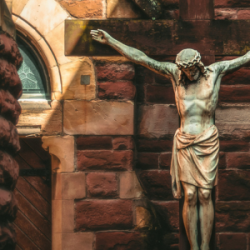
A Shift In Imagery From Shepherd to Crucified
4

What Is Hell Really Like? The Reality of Eternal Loneliness

About Pat Gohn
Pat Gohn is a Catholic writer, speaker, and the host of the Among Women Podcast and blog. Her book Blessed, Beautiful and Bodacious: Celebrating the Gift of Catholic Womanhood is published by Ave Maria Press.
Patheos Explore the world's faith through different perspectives on religion and spirituality! Patheos has the views of the prevalent religions and spiritualities of the world.
Ad-Free & Subscriber Log-In Subscription Support
- About Us
- 2026 Calendar
- Videos
- Podcasts
- Library of World Religions
- Faith In Media Tracker
- Advertise With Us
- Write for Us
- Privacy Policy
- Terms of Service
- Do Not Sell My Data
- Contact Us
- Radiant Digital
- Manage Newsletter Subscriptions
- Unsubscribe From Notifications
- Sitemap
Copyright 2008-2026, Patheos. All rights reserved.
Subscription Support Ad-Free & Subscriber Log-In
Follow Patheos