
BuddhistCatholicContemplativeEvangelicalGeneral ChristianHinduJewishLatter-day SaintMuslimNew VisionsProgressive Christian
Beliefs
- Buddhist
- Catholic
- Contemplative
- Evangelical
- General Christian
- Hindu
- Jewish
- Latter-day Saint
- More Voices
- Muslim
- New Visions
- Pagan
- Progressive Christian
Topics
- Religion News
- Food and Religion
- Sports and Religion
- Religious Art
- Religious Music and Entertainment
- Religious Events
- History and Religion
- Style and Religion
- Politics and Religion
- Women in Religion
- Recreation Outdoors and Religion
- Business Finance and Religion
- Careers Workplace and Religion
- Education and Religion
- Family Parenting and Religion
- Health Fitness and Religion
- Home and Religion
- Relationships and Religion
- Technology and Religion
- Travel and Religion
Columnists
- Buddhist Columnists
- Business Finance and Religion Columnists
- Careers Workplace and Religion Columnists
- Catholic Columnists
- Contemplative Columnists
- Education and Religion Columnists
- Evangelists Columnists
- Family Parenting and Religion Columnists
- General Christian Columnists
- Health Fitness and Religion Columnists
- Hindu Columnists
- History and Religion Columnists
- Home and Religion Columnists
- Jewish Columnists
- More Voices Columnists
- Latter Day Columnists
- Muslim Columnists
- New Visions Columnists
- Nonreligious Columnists
- Pagan Columnists
- Politics and Religion Columnists
- Progressive Columnists
- Recreation Outdoors and Religion Columnists
- Relationships and Religion Columnists
- Religion News Columnists
- Religious Art Columnists
- Religious Events Columnists
- Religious Music and Entertainment Columnists
- Sports and Religion Columnists
- Style and Religion Columnists
- Technology and Religion Columnists
- Travel and Religion Columnists
- Women in Religion Columnists
Resource Library
- 2026 Calendar
- Library of World Religions
- The 100 Most Holy Places on Earth
- Patheos Answers
- Podcasts
- Videos
- Faith Leaders Database
- Anglican Episcopalian
- Bahai
- Baptist
- Buddhism
- Christianity
- Confucianism
- Eastern Orthodoxy
- Hinduism
- Holiness and Pentecostal
- ISKCON
- Islam
- Judaism
- Lutheran
- Methodist
- The Church of Jesus Christ of Latter-day Saints
- New Age
- Paganism
- Presbytarian and Reformed
- Protestantism
- Religion Behind the Scenes
- Roman Catholic
- Scientology
- Shia Islam
- Sikhism
- Sufism
- Sunni Islam
- Taoism
- Zen
- See all religions
Research Tools
 Ad-Free & Subscriber Log-In Subscription Support
Ad-Free & Subscriber Log-In Subscription Support
Follow Patheos 

- Trending:
- Forgiveness
- |
- Marriage
- |
- Consciousness
- |
- Death Penalty
- |
- Election
- |
- Halloween
Catholic
Pitre Responds to Reviewers Questions
February 25, 2011 by Elizabeth Scalia
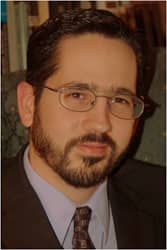 In the course of our two-week discussion on Jesus and the Jewish Roots of the Eucharist, two of our reviewers asked specific questions, to which author Brant Pitre has very graciously responded.
In Braving Rabbinic Waters to Reveal Body and Blood, Max Lindenman asked:
Pitre's book, simply by being so accessible, forced me to consider questions I'd thought unanswerable. If first-century Jews weren't expecting a military Messiah, but someone very much like Jesus, why did intellectuals receive Him so coolly? Oughtn't they have connected the dots? Did their human qualities—perhaps their attachment to the status quo—prevent their doing so? Did Jesus' claim of divinity kill the deal by itself? Or could Jesus have confounded expectations in some way Pitre hasn't considered?
Pitre responds:
Great question. My students frequently ask me something similar: If Jesus actually fulfilled Jewish expectations in Scripture and tradition about a new exodus, a new Moses, the new Manna, and the Bread of the Presence, how is it that the Jewish leaders rejected him as Messiah?
A whole book needs to be written on this, but two points should suffice here. First, it is critical to stress that, contrary to what Christians often assume, not all of the Jewish leaders rejected Jesus. To the contrary, the Gospels are quite clear that even members of the Jerusalem Sanhedrin—think here of Nicodemus and Joseph of Arimathea—became Jesus' disciples (Mk 15:43; Jn 19:38-39).
Moreover, although the fact is frequently overlooked, the Acts of the Apostles is equally explicit about the partial success of Christian mission in Jerusalem: shortly before Stephen's martyrdom, "the number of the disciples multiplied greatly in Jerusalem, and a great many of the priests were obedient to the faith" (Acts 6:7). This is extremely important: according to Acts, many, not just some, of the Jewish priests converted to Christianity. Hence, the caricature that none of the Jewish leaders who knew the Scriptures accepted Jesus as Messiah is without foundation. It is contradicted by the first-century evidence in the New Testament itself.
Second, with that said, we still need to explain why the vast majority of Jewish priests and "the intellectual classes" as you put it, rejected him. On one level, we can only speculate, but the New Testament evidence suggests that at least three factors were operative.
(1) According to the Gospel of John, there was apparently skepticism toward the Scripture itself among some of these leaders. Jesus says to some of the Jewish leaders: "If you believed Moses, you would believe me, for he wrote of me. But if you do not believe his writings, how will you believe my words?" (Jn 6:46). In this passage, Jesus identifies faith in Scripture as a prerequisite to faith in his own teaching. Believing Scripture has always been a stumbling block, even in the first century A.D. (see Lk 24:25).
(2) Second, if you've spent any time among the "intellectual" classes, as you put it, then you know that intellectual pride is an ever-present danger, and all too often a reality. (I speak here of what I know; think of the modern-day academy, which, while populated by many wonderful, humble people, can be a breeding ground for gigantic egos.) It is very easy to be dismissive toward anyone without academic credentials, and the Gospels make very clear again that Jesus was spoken against because he had "never studied" (Jn 7:15)—i.e., he was without formal rabbinic training. What academic conference today would give the podium to or take seriously an unlettered carpenter from backwater Galilee?
(3) Third and finally, and most important of all, as I stressed in Chapter 4 (on the Manna), Jesus himself explicitly states that the gift of supernatural faith is necessary to recognize the truth of his divine identity and his eucharistic presence. After the disciples say that Jesus' Eucharistic words are "a hard teaching" he responds with this rebuttal: "This is why I told you that no one can come to me unless it is granted him by the Father (Jn 6:65). It is not as if one can pile up enough arguments to empirically prove that Jesus is the divine Son of God or that he is really present in the Eucharist. Rather, the Jewish prophecies and traditions are, to use the language of the First Vatican Council, "motives of credibility" that lay the foundations for faith. But they are not the same thing as faith. That is a supernatural gift from God.
Article Continued On Next Page
Page: 1 of 2
2/25/2011 5:00:00 AM
Catholic
Book Club
Brant Pitre
Eucharist
Roman Catholicism
Judaism
more at patheos
1

Does AI Write Better Than Students?
2

Christmas and Easter: Four Holidays?
3

4

Why Faith Never Closes the Loop

About Elizabeth Scalia
Elizabeth Scalia is a weekly columnist at First Things.
Patheos Explore the world's faith through different perspectives on religion and spirituality! Patheos has the views of the prevalent religions and spiritualities of the world.
Ad-Free & Subscriber Log-In Subscription Support
- About Us
- 2026 Calendar
- Videos
- Podcasts
- Library of World Religions
- Faith In Media Tracker
- Advertise With Us
- Write for Us
- Privacy Policy
- Terms of Service
- Do Not Sell My Data
- Contact Us
- Radiant Digital
- Manage Newsletter Subscriptions
- Unsubscribe From Notifications
- Sitemap
Copyright 2008-2026, Patheos. All rights reserved.
Subscription Support Ad-Free & Subscriber Log-In
Follow Patheos