
BuddhistCatholicContemplativeEvangelicalGeneral ChristianHinduJewishLatter-day SaintMuslimNew VisionsProgressive Christian
Beliefs
- Buddhist
- Catholic
- Contemplative
- Evangelical
- General Christian
- Hindu
- Jewish
- Latter-day Saint
- More Voices
- Muslim
- New Visions
- Pagan
- Progressive Christian
Topics
- Religion News
- Food and Religion
- Sports and Religion
- Religious Art
- Religious Music and Entertainment
- Religious Events
- History and Religion
- Style and Religion
- Politics and Religion
- Women in Religion
- Recreation Outdoors and Religion
- Business Finance and Religion
- Careers Workplace and Religion
- Education and Religion
- Family Parenting and Religion
- Health Fitness and Religion
- Home and Religion
- Relationships and Religion
- Technology and Religion
- Travel and Religion
Columnists
- Buddhist Columnists
- Business Finance and Religion Columnists
- Careers Workplace and Religion Columnists
- Catholic Columnists
- Contemplative Columnists
- Education and Religion Columnists
- Evangelists Columnists
- Family Parenting and Religion Columnists
- General Christian Columnists
- Health Fitness and Religion Columnists
- Hindu Columnists
- History and Religion Columnists
- Home and Religion Columnists
- Jewish Columnists
- More Voices Columnists
- Latter Day Columnists
- Muslim Columnists
- New Visions Columnists
- Nonreligious Columnists
- Pagan Columnists
- Politics and Religion Columnists
- Progressive Columnists
- Recreation Outdoors and Religion Columnists
- Relationships and Religion Columnists
- Religion News Columnists
- Religious Art Columnists
- Religious Events Columnists
- Religious Music and Entertainment Columnists
- Sports and Religion Columnists
- Style and Religion Columnists
- Technology and Religion Columnists
- Travel and Religion Columnists
- Women in Religion Columnists
Resource Library
- 2026 Calendar
- Library of World Religions
- The 100 Most Holy Places on Earth
- Patheos Answers
- Podcasts
- Videos
- Faith Leaders Database
- Anglican Episcopalian
- Bahai
- Baptist
- Buddhism
- Christianity
- Confucianism
- Eastern Orthodoxy
- Hinduism
- Holiness and Pentecostal
- ISKCON
- Islam
- Judaism
- Lutheran
- Methodist
- The Church of Jesus Christ of Latter-day Saints
- New Age
- Paganism
- Presbytarian and Reformed
- Protestantism
- Religion Behind the Scenes
- Roman Catholic
- Scientology
- Shia Islam
- Sikhism
- Sufism
- Sunni Islam
- Taoism
- Zen
- See all religions
Research Tools
 Ad-Free & Subscriber Log-In Subscription Support
Ad-Free & Subscriber Log-In Subscription Support
Follow Patheos 

- Trending:
- Forgiveness
- |
- Marriage
- |
- Consciousness
- |
- Death Penalty
- |
- Election
- |
- Halloween
Catholic
Before Thomas Merton: Gethsemani Abbey, 1848-1948
February 15, 2011 by Pat McNamara
 In 1948, the book world's surprise hit was The Seven Storey Mountain, the autobiography of a Trappist monk named Thomas Merton. That year also marked the centennial of his monastery, Our Lady of Gethsemani Abbey. Over the next few years, Merton's writings would attract unprecedented numbers of applicants to the monastery. As the year closed, Merton praised "the great sea of graces that was flowing down on Gethsemani."
But during the abbey's early years, its survival seemed doubtful. Lack of funds and vocations, natural disasters and scandals threatened to end America's first Trappist experiment. (The first three abbots all resigned.) Merton himself notes, "The devil . . . has spent a hundred years trying to interfere with Gethsemani—and in the early days the battle was not altogether to his disadvantage."
The Trappists are a branch of the Cistercian monks, a centuries old order. Over time, some Cistercians felt the order's rule was being inadequately observed. Beginning in 1664, Normandy's La Trappe Abbey hosted a reform movement. (The Trappists' official title is "Cistercians of the Strict Observance.") The monastic day, beginning at 2 a.m. and finishing at 7 p.m., consisted of prayer, reading, and labor. Silence was part of the daily regime, and they developed their own sign language.
As the French Revolution targeted the Church, many Trappists left the country. Some tried to make a fresh start in America, but for several reasons (mostly financial) they didn't get far. In the 1840s, however, Trappists at France's Melleray Abbey decided to try again. They purchased a piece of property in Kentucky for five thousand dollars from a group of nuns.
In November 1848, Father Eutropius Proust started off with forty-four monks. He envisioned them working in "the forests of North America, among the tigers and panthers and wolves of Kentucky." When they arrived, there were no tigers, but there were plenty of other challenges. To attract local support, he built a school, a rare commodity on the frontier. Gethsemani College's opening in 1851 as a boarding school had long-term consequences, not all of them positive.
In the first thirty years only eight men entered, and they all left. One was a Civil War veteran named Joseph Dutton who worked with Hawaiian lepers for decades. The first to stay was a Texas cowboy named John Hanning. Others came less willingly, troubled priests sent by their bishops to live a "life of penance and prayer." Over the years, Gethsemani had to work hard to overcome its reputation as a clerical penitentiary.
In 1859, Father Eutropius returned to France for health reasons. His successor, Dom Benedict Berger, led Gethsemani for thirty years. ("Dom" is the official title for the abbey head.) A capable administrator, he held it together during the Civil War. The monks supported themselves through their own labor. (One local proclaimed their cider "superior to the best wine I ever drank.") For a few years, a group of Franciscan nuns ran a boarding school, but financial difficulties led to an early closing.
When Dom Benedict resigned in 1889, he was in a wheelchair. He had been a stickler for the monastic rule, but his successor took a milder approach. Dom Edward Chaix-Bourbon's short tenure, Merton writes, "almost ruined" the abbey. It started when he hired an Englishman named Darnley Beaufort as the college headmaster. Claiming all sorts of qualifications, including noble ancestry, Beaufort charmed the guileless abbot, but the monks distrusted him. It turned out they had good reason, for Beaufort was sexually abusing the boys at the school.
Paralyzed by shock and indecision, Dom Edward took no action. The monks lost confidence in him, forcing his return to France. Beaufort was arrested for fraud and embezzlement (but not sexual misconduct). The news made the front pages, and Beaufort ended up in jail. But the whole affair cost the monastery dearly. Merton comments that it was doubtful whether Gethsemani "would be able to endure for fifty years more."
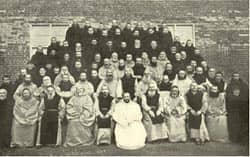 In 1898, there arrived the man who would revitalize Gethsemani. He was Dom Edmond Obrecht (1852-1935), the last French-born abbot, a larger than life figure. He previously worked in New York as the order's fundraiser. A sophisticated diplomat whose collection of medieval manuscripts was one of the world's largest, he was also a born leader who knew how to get things done.
In 1920 he made it a policy not to take any more "penitent" priests, and he started retreats for laymen. In 1912, the college burned down, but the monks weren't greatly distressed. Most, Merton writes, "felt that God had done them a favor." When alumni tried to raise money to rebuild the schools, Dom Edmond promptly returned their donations. After his passing, Frederic Dunne (1874-1948) became the first American to head a Trappist monastery.
Article Continued On Next Page
Page: 1 of 2
2/15/2011 5:00:00 AM
Catholic
In Ages Past
Gethsemani Abbey
History
Monastery
Thomas Merton
Trappist
Christianity
Roman Catholicism
more at patheos
1

On Appalachia, Generational Poverty, and the Siders Family
2
3

The Sea of Galilee: Exploring the Lake of Jesus
4

Loving Our World Through Justice

About Pat McNamara
Dr. Pat McNamara is a published historian. He blogs about American Catholic History at McNamara's Blog.
Patheos Explore the world's faith through different perspectives on religion and spirituality! Patheos has the views of the prevalent religions and spiritualities of the world.
Ad-Free & Subscriber Log-In Subscription Support
- About Us
- 2026 Calendar
- Videos
- Podcasts
- Library of World Religions
- Faith In Media Tracker
- Advertise With Us
- Write for Us
- Privacy Policy
- Terms of Service
- Do Not Sell My Data
- Contact Us
- Radiant Digital
- Manage Newsletter Subscriptions
- Unsubscribe From Notifications
- Sitemap
Copyright 2008-2026, Patheos. All rights reserved.
Subscription Support Ad-Free & Subscriber Log-In
Follow Patheos