
BuddhistCatholicContemplativeEvangelicalGeneral ChristianHinduJewishLatter-day SaintMuslimNew VisionsProgressive Christian
Beliefs
- Buddhist
- Catholic
- Contemplative
- Evangelical
- General Christian
- Hindu
- Jewish
- Latter-day Saint
- More Voices
- Muslim
- New Visions
- Pagan
- Progressive Christian
Topics
- Religion News
- Food and Religion
- Sports and Religion
- Religious Art
- Religious Music and Entertainment
- Religious Events
- History and Religion
- Style and Religion
- Politics and Religion
- Women in Religion
- Recreation Outdoors and Religion
- Business Finance and Religion
- Careers Workplace and Religion
- Education and Religion
- Family Parenting and Religion
- Health Fitness and Religion
- Home and Religion
- Relationships and Religion
- Technology and Religion
- Travel and Religion
Columnists
- Buddhist Columnists
- Business Finance and Religion Columnists
- Careers Workplace and Religion Columnists
- Catholic Columnists
- Contemplative Columnists
- Education and Religion Columnists
- Evangelists Columnists
- Family Parenting and Religion Columnists
- General Christian Columnists
- Health Fitness and Religion Columnists
- Hindu Columnists
- History and Religion Columnists
- Home and Religion Columnists
- Jewish Columnists
- More Voices Columnists
- Latter Day Columnists
- Muslim Columnists
- New Visions Columnists
- Nonreligious Columnists
- Pagan Columnists
- Politics and Religion Columnists
- Progressive Columnists
- Recreation Outdoors and Religion Columnists
- Relationships and Religion Columnists
- Religion News Columnists
- Religious Art Columnists
- Religious Events Columnists
- Religious Music and Entertainment Columnists
- Sports and Religion Columnists
- Style and Religion Columnists
- Technology and Religion Columnists
- Travel and Religion Columnists
- Women in Religion Columnists
Resource Library
- 2026 Calendar
- Library of World Religions
- The 100 Most Holy Places on Earth
- Patheos Answers
- Podcasts
- Videos
- Faith Leaders Database
- Anglican Episcopalian
- Bahai
- Baptist
- Buddhism
- Christianity
- Confucianism
- Eastern Orthodoxy
- Hinduism
- Holiness and Pentecostal
- ISKCON
- Islam
- Judaism
- Lutheran
- Methodist
- The Church of Jesus Christ of Latter-day Saints
- New Age
- Paganism
- Presbytarian and Reformed
- Protestantism
- Religion Behind the Scenes
- Roman Catholic
- Scientology
- Shia Islam
- Sikhism
- Sufism
- Sunni Islam
- Taoism
- Zen
- See all religions
Research Tools
 Ad-Free & Subscriber Log-In Subscription Support
Ad-Free & Subscriber Log-In Subscription Support
Follow Patheos 

- Trending:
- Forgiveness
- |
- Marriage
- |
- Consciousness
- |
- Death Penalty
- |
- Election
- |
- Halloween
Catholic
To Be Pickering in a Henry Higgins World
January 28, 2011 by Joseph Susanka
 When George Bernard Shaw first learned of the creative licenses taken in an effort to make the ending of his play Pygmalion more marketable, he was outraged. Confronted by Sir Herbert Beerbohm Tree's claim that "My ending makes money, you ought to be grateful," he responded (with his trademark sharpness of wit and tongue): "Your ending is damnable; you ought to be shot."
Two years later, still stinging from the change, he penned a 5,000-word essay—"Sequel: What Happened Afterwards"—in which he emphatically (and bitingly) defended his original ending. In it, he argued that any version that returns the transformed Eliza Doolittle to Professor Henry Higgins' home is undermining the very core of the play's message, tossing away the power and relevance of his modernized myth for the sake of a cheapened and shallow emotional payoff.
Interestingly, neither big screen version of Shaw's most famous work features his intended ending. In both 1938's Pygmalion(made with the approval and assistance of Shaw himself) and My Fair Lady (the famous musical version from 1964), Higgins and Doolittle are reunited in the film's final scene. Yet despite the fact that much of the two films' language is identical, Lerner and Loewe's version manages to avoid the cheap and shallow finale, while Pygmalion, despite its undeniable charms and wonderful performances, is rooted in Shaw's aforementioned "damnable" territory.
The most obvious reason for this dramatic difference is the contrast between the two actresses playing Eliza: Wendy Hiller and Audrey Hepburn. Both bring a wonderful vivacity and charm to the role; both are clearly at ease with Shaw's nimble, sharp-edged dialogue; and both serve as the perfect foil to their respective Higginses. Yet the unique aspects of their performances are striking, dramatically altering the tone and focus of the two films.
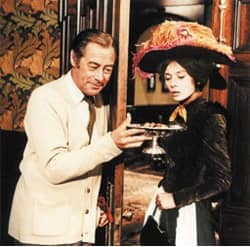 When Rex Harrison lobbied My Fair Lady's producers to allow his stage co-star, Julie Andrews, to play Eliza, he suggested that Hepburn's background—her mother was a Dutch baroness—made her unfit to play the early, draggle-tailed guttersnipe stages of the story's heroine. And while Harrison subsequently recanted his view, proclaiming Hepburn to be his favorite leading lady, his reservations are at least partially born out: Hepburn belongs in the high society to which Professor Higgins elevates her. Her Eliza is a diamond-in-the-rough; Higgins' relentless cutting and polishing brings out her full luster, producing a lady that would make any finishing school proud. Even the famous Ascot Race Track scene, where Eliza reveals herself to be unprepared for high society in the most spectacular fashion, underscores her grace and charm. In the midst of such an overwhelming, surreal display of British ostentatiousness, her slip is more amusing than it is damaging, and the audience finds itself easily overlooking the indelicate reminder of her low-class roots in the face of her undeniable magnetism.
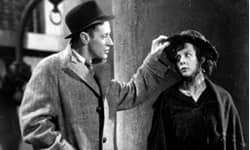 Hiller, on the other hand, is a hard-working, undereducated-but-overachieving flower girl, not a diamond. Her Eliza is better suited to her original lowly condition than her "creator" realizes, and the professor's efforts on her behalf feel much more like the construction of an elaborate facade than they do the revelatory polishing of a fine jewel. She does not belong in the world of bright lights, flowing gowns, and high society into which her Higgins (Leslie Howard) so self-indulgently places her, and when she arrives at her final triumphant test, the Embassy Ball, Heller radiates terror, not confidence. Her tearful appraisal that, "I sold flowers, I didn't sell myself. Now you've made a lady of me, I'm not fit to sell anything else" rings true. Higgins has created a fish-out-of-water, a woman problematically altered by his efforts to reshape her in the latest socially-acceptable image rather than simply elevated and transformed.
In the "Tea with Mrs. Higgins" scene, with dialogue later used by Lerner and Loewe in the Ascot Race Track setting, Eliza is allowed to make a spectacle of herself in the very surroundings most unsuited to her. Rather than a charming young girl whose social faux pas are masked by the high-hatted spectacle of the race track, we have the inescapable simplicity of Mrs. Higgins' parlor, where Eliza's errors are far more obvious and Professor Higgins' indifference to (and even amusement in) her discomfort far more damning.
Article Continued On Next Page
Page: 1 of 2
1/28/2011 5:00:00 AM
Catholic
Through a Lens Darkly
Media
Movies
Christianity
Roman Catholicism
more at patheos
1

Trump's Algae Manifests His Arrogance
2

What does it mean that Scripture is inspired? 2 Timothy 3:16
3

17 Church Fathers on Purgatory (Esp. 1 Cor 3:10-15)
4


About Joseph Susanka
Joseph Susanka has been doing development work for institutions of Catholic higher education since his graduation from Thomas Aquinas College in 1999. He blogs at Crisis Magazine, where he also contributes feature articles on a variety of topics.
Patheos Explore the world's faith through different perspectives on religion and spirituality! Patheos has the views of the prevalent religions and spiritualities of the world.
Ad-Free & Subscriber Log-In Subscription Support
- About Us
- 2026 Calendar
- Videos
- Podcasts
- Library of World Religions
- Faith In Media Tracker
- Advertise With Us
- Write for Us
- Privacy Policy
- Terms of Service
- Do Not Sell My Data
- Contact Us
- Radiant Digital
- Manage Newsletter Subscriptions
- Unsubscribe From Notifications
- Sitemap
Copyright 2008-2026, Patheos. All rights reserved.
Subscription Support Ad-Free & Subscriber Log-In
Follow Patheos