
BuddhistCatholicContemplativeEvangelicalGeneral ChristianHinduJewishLatter-day SaintMuslimNew VisionsProgressive Christian
Beliefs
- Buddhist
- Catholic
- Contemplative
- Evangelical
- General Christian
- Hindu
- Jewish
- Latter-day Saint
- More Voices
- Muslim
- New Visions
- Pagan
- Progressive Christian
Topics
- Religion News
- Food and Religion
- Sports and Religion
- Religious Art
- Religious Music and Entertainment
- Religious Events
- History and Religion
- Style and Religion
- Politics and Religion
- Women in Religion
- Recreation Outdoors and Religion
- Business Finance and Religion
- Careers Workplace and Religion
- Education and Religion
- Family Parenting and Religion
- Health Fitness and Religion
- Home and Religion
- Relationships and Religion
- Technology and Religion
- Travel and Religion
Columnists
- Buddhist Columnists
- Business Finance and Religion Columnists
- Careers Workplace and Religion Columnists
- Catholic Columnists
- Contemplative Columnists
- Education and Religion Columnists
- Evangelists Columnists
- Family Parenting and Religion Columnists
- General Christian Columnists
- Health Fitness and Religion Columnists
- Hindu Columnists
- History and Religion Columnists
- Home and Religion Columnists
- Jewish Columnists
- More Voices Columnists
- Latter Day Columnists
- Muslim Columnists
- New Visions Columnists
- Nonreligious Columnists
- Pagan Columnists
- Politics and Religion Columnists
- Progressive Columnists
- Recreation Outdoors and Religion Columnists
- Relationships and Religion Columnists
- Religion News Columnists
- Religious Art Columnists
- Religious Events Columnists
- Religious Music and Entertainment Columnists
- Sports and Religion Columnists
- Style and Religion Columnists
- Technology and Religion Columnists
- Travel and Religion Columnists
- Women in Religion Columnists
Resource Library
- 2026 Calendar
- Library of World Religions
- The 100 Most Holy Places on Earth
- Patheos Answers
- Podcasts
- Videos
- Faith Leaders Database
- Anglican Episcopalian
- Bahai
- Baptist
- Buddhism
- Christianity
- Confucianism
- Eastern Orthodoxy
- Hinduism
- Holiness and Pentecostal
- ISKCON
- Islam
- Judaism
- Lutheran
- Methodist
- The Church of Jesus Christ of Latter-day Saints
- New Age
- Paganism
- Presbytarian and Reformed
- Protestantism
- Religion Behind the Scenes
- Roman Catholic
- Scientology
- Shia Islam
- Sikhism
- Sufism
- Sunni Islam
- Taoism
- Zen
- See all religions
Research Tools
 Ad-Free & Subscriber Log-In Subscription Support
Ad-Free & Subscriber Log-In Subscription Support
Follow Patheos 

- Trending:
- Forgiveness
- |
- Marriage
- |
- Consciousness
- |
- Death Penalty
- |
- Election
- |
- Halloween
Latter-day Saint
A Landmark Achievement
January 12, 2011 by Rosalynde Welch
 Understanding the Book of Mormon
By Grant Hardy
368 pp.
Oxford Press, March 2010
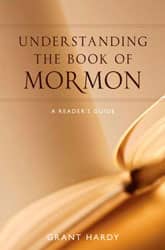 Criticisms of the Book of Mormon generally fall into one of two categories: objections to its historical claims on the one hand, and on the other, critiques of its literary style. The two prongs are often combined in a single attack, for instance in the suggestion that the awkward style of the book reflects the naïve voice of an unlettered youngster. For their part, the book's defenders also tend to elide the two categories, arguing that passages of inelegant prose are better understood as latent Hebraisms laboring under English syntax. Most of the time, of course, devout readers of the Book of Mormon simply ignore the book's style altogether.
Grant Hardy, in his new book Understanding the Book of Mormon (Oxford Press*,* 2010) wants to uncouple the problems of historicity and literary merit. He brackets the first, setting aside the apologetic debates that have dominated Book of Mormon studies over the past four decades. Instead, he turns his attention to the content of the book, and in particular to its peculiar stylistic qualities. On this matter if not an apologist he is nevertheless a bit apologetic, conceding the book's literary deficiencies but pleading on its behalf that, to borrow a Twainism, the Book of Mormon is "better than it sounds" (p. 273).
Hardy seeks to rehabilitate the literary reputation of the Book of Mormon by drawing attention to what he calls its "organizing principle": "the fact that it presents itself as the work of narrators with distinct voices and perspectives" (p. 268). Because the Book of Mormon is structured as the product of three discrete narrative voices—Nephi's, Mormon's, and Moroni's—and because, according to its own internal claims, the three narrative voices work with a variety of earlier sources, the text is always inhabited by at least two minds, Joseph's and, say, Mormon's, and often by three or even four. This textual complexity offers an entrée for a kind of literary analysis that moves beyond the manifest deficiencies of the book's prose style.
As an interpretive strategy, his approach is shown to be stunningly fruitful, though I suspect that a reader as intelligent, attentive, and sensitive as Hardy could fruitfully read the back of a cereal box. Hardy devotes a section of the book to each of the Book of Mormon's three primary narrators, and in so doing he provides a roughly chronological and nearly comprehensive sustained reading of the text. It is a tour de force and I am tempted to call it virtuosic, though occasionally the breadth of achievement is obscured by the thick texture of his very close reading.
But if Hardy has an ambitious exegetical aim—and that bell rings on every page—he also has an important social objective. He offers not only a new reading of the Book of Mormon, but a new way of reading the Book of Mormon; that is, he offers a new discourse that he hopes will charter a new kind of inquiry undertaken by readers of all tribes. As Hardy puts it, he seeks to demonstrate "a mode of literary analysis by which all readers, regardless of their prior religious commitments . . . can discuss the book in useful and accurate ways" (xvii). He seeks, in short, to establish a new interpretive community, blessedly free from the entrenched allegiances that distort other discussions of the Book of Mormon.
For Hardy's bracketing of the historical question is neither caprice nor cowardice, as it often is in defensive treatments of the Book of Mormon, but rather a legitimate sequel to his hermeneutic approach. Hardy enters the text by way of the motivations, personalities, and perceptions of its narrators, and therein lies his justification for avoiding, at least temporarily, the historical questions and the epistemological commitments they entail. Whether one regards the Book of Mormon as 19th-century folk pulp or as the authentic translation of an ancient document, one can attend to the text's self-presentation as the work of three narrators—Nephi, Mormon, and Moroni or "Nephi," "Mormon," and "Moroni"—and thus read the text narratologically. "After all," Hardy reminds us, "narrative is a mode of communication employed by both historians and novelists" (xvi).
Article Continued On Next Page
Page: 1 of 2
1/12/2011 5:00:00 AM
Mormon
Salt and Seed
History
literature
Mormonism
more at patheos
1

Patheos August 2026 Featured Writer: David Schloss
2

'Young Washington': Thrilling Founding Father Biopic Review
3
Catholic USAF Couples Celebrate Marriage Enrichment Retreat
4

Redefining Success: The 2nd Act of a California Beachcomber

About Rosalynde Welch
Rosalynde Welch is an independent scholar who makes her home in St. Louis, Missouri, with her husband and four children.
Patheos Explore the world's faith through different perspectives on religion and spirituality! Patheos has the views of the prevalent religions and spiritualities of the world.
Ad-Free & Subscriber Log-In Subscription Support
- About Us
- 2026 Calendar
- Videos
- Podcasts
- Library of World Religions
- Faith In Media Tracker
- Advertise With Us
- Write for Us
- Privacy Policy
- Terms of Service
- Do Not Sell My Data
- Contact Us
- Radiant Digital
- Manage Newsletter Subscriptions
- Unsubscribe From Notifications
- Sitemap
Copyright 2008-2026, Patheos. All rights reserved.
Subscription Support Ad-Free & Subscriber Log-In
Follow Patheos