
BuddhistCatholicContemplativeEvangelicalGeneral ChristianHinduJewishLatter-day SaintMuslimNew VisionsProgressive Christian
Beliefs
- Buddhist
- Catholic
- Contemplative
- Evangelical
- General Christian
- Hindu
- Jewish
- Latter-day Saint
- More Voices
- Muslim
- New Visions
- Pagan
- Progressive Christian
Topics
- Religion News
- Food and Religion
- Sports and Religion
- Religious Art
- Religious Music and Entertainment
- Religious Events
- History and Religion
- Style and Religion
- Politics and Religion
- Women in Religion
- Recreation Outdoors and Religion
- Business Finance and Religion
- Careers Workplace and Religion
- Education and Religion
- Family Parenting and Religion
- Health Fitness and Religion
- Home and Religion
- Relationships and Religion
- Technology and Religion
- Travel and Religion
Columnists
- Buddhist Columnists
- Business Finance and Religion Columnists
- Careers Workplace and Religion Columnists
- Catholic Columnists
- Contemplative Columnists
- Education and Religion Columnists
- Evangelists Columnists
- Family Parenting and Religion Columnists
- General Christian Columnists
- Health Fitness and Religion Columnists
- Hindu Columnists
- History and Religion Columnists
- Home and Religion Columnists
- Jewish Columnists
- More Voices Columnists
- Latter Day Columnists
- Muslim Columnists
- New Visions Columnists
- Nonreligious Columnists
- Pagan Columnists
- Politics and Religion Columnists
- Progressive Columnists
- Recreation Outdoors and Religion Columnists
- Relationships and Religion Columnists
- Religion News Columnists
- Religious Art Columnists
- Religious Events Columnists
- Religious Music and Entertainment Columnists
- Sports and Religion Columnists
- Style and Religion Columnists
- Technology and Religion Columnists
- Travel and Religion Columnists
- Women in Religion Columnists
Resource Library
- 2026 Calendar
- Library of World Religions
- The 100 Most Holy Places on Earth
- Patheos Answers
- Podcasts
- Videos
- Faith Leaders Database
- Anglican Episcopalian
- Bahai
- Baptist
- Buddhism
- Christianity
- Confucianism
- Eastern Orthodoxy
- Hinduism
- Holiness and Pentecostal
- ISKCON
- Islam
- Judaism
- Lutheran
- Methodist
- The Church of Jesus Christ of Latter-day Saints
- New Age
- Paganism
- Presbytarian and Reformed
- Protestantism
- Religion Behind the Scenes
- Roman Catholic
- Scientology
- Shia Islam
- Sikhism
- Sufism
- Sunni Islam
- Taoism
- Zen
- See all religions
Research Tools
 Ad-Free & Subscriber Log-In Subscription Support
Ad-Free & Subscriber Log-In Subscription Support
Follow Patheos 

- Trending:
- Forgiveness
- |
- Marriage
- |
- Consciousness
- |
- Death Penalty
- |
- Election
- |
- Halloween
Catholic
Wes Anderson: Themes on Broken Fatherhood
December 16, 2010 by Joseph Susanka
The Darjeeling Limited, the story of three brothers and their quest to find "spiritual enlightenment" set against the exotic and unfamiliar setting of modern-day India, deals less with an actual father figure than with the carnage left behind by an absent one. Gradually, as the three struggle to understand both what they have lost and how to avoid visiting the same mistakes they have experienced upon their loved ones, the true meaning of fatherhood comes into sharper focus. (Interestingly, it is one of the rare violent moments in an Anderson film that serves to hasten their understanding, as an incidental character's response to his family's tragedy underscores what it is they have been seeking all along.)
But it is in The Royal Tenenbaums and The Life Aquatic with Steve Zissou that Anderson most directly addresses the role of fatherhood and the dangers of refusing to accept that role. Not coincidentally, these are also the only two films in Anderson's filmography named after specific individuals—in both cases, the father figure. But the similarities between the two stories run far deeper.
In Tenenbaums, an aging patriarch, Royal, battles to win back his family—a battle made necessary by his previous refusal to treat his children as anything other than amusing accessories. Royal must first recognize the many ways he has damaged his children through his failures as a father, and atone for them as best he can. And while he tries a number of easier (and funnier) approaches to the problem of his family, it is only once he begins to act like a true father—once he begins to love unconditionally—that the family can begin to heal. (As an aside, Fantastic Mr. Fox seems like a true oddity among Anderson's films, until one realizes that it can be best understood as "the Royal Tenenbaums for Children.")
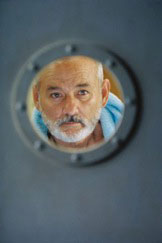 The Life Aquatic with Steve Zissou is, in many ways, the culmination of Anderson's artistic style and philosophical content. It is a film about a film, which is always a bit mind-bending; but more importantly, it is a film about one man's lifelong attempts to escape from fatherhood, and about his eventual acceptance of that very role. Zissou, a world-renowned oceanographer and documentary filmmaker, has lost his touch: His films are boring and scripted, and he grows increasingly unpleasant and unapproachable.
As he prepares to set out on an Ahab-like voyage of vengeance, he suddenly finds himself confronted by an unknown son. But rather than accept his new role as father, Zissou holds the young man at bay, including him in the filmmaking operations but refusing to acknowledge his own paternity. In one of the film's expository moments, a pregnant magazine reporter accompanying Team Zissou on their journey remarks that she "needs to find a baby for this father." Zissou understands her to have misspoken, but her "mistake" is absolutely correct when applied to Zissou himself. Many of the tribulations plaguing his declining years are brought into focus through the rejection of his paternal role; the solution to his struggles is directly before him, but his selfishness prevents him from seeing what is so clear to everyone else. Once again, it is an unusual moment of violence that precipitates Zissou's change of heart; and while Zissou's refusal to accept his role until it's too late is truly tragic, the fact that he accepts it at last cannot be overlooked.
The important thing about both Royal and Zissou is not just that they are broken but that they know it. Both realize that their selfishness and lack of interest in those they hold dear has cost them much, but both ultimately set out to mend their ways. For Royal, his reformation is rewarded by living out his old age in happiness. For Zissou, his change of heart comes too late to salvage his relationship with his son, but it clearly influences the way he will act henceforth: He is a man who has clearly learned his lesson and has resolved to amend his ways.
Royal and Zissou are both clearly altered by their experiences, and it is that very change—and their subsequent galvanization into action—that is so essential when trying to understand Anderson's world. Self-knowledge is not without merit, but acting on that knowledge is vital to his characters' redemption. Contrition is not simply a matter of identification; it is an embracing of the command to "go forth, and sin no more." That understanding of self and willingness to change is the ultimate message of Anderson's films.
The question of whether that message is sufficient to justify Anderson's mode remains a difficult one. No matter the answer, however, there is something encouraging in his repeated efforts to grapple with the need for redemption, particularly as it relates to modern paternity. Highlighting our society's troubling failures in the realm of fatherhood might be a worthwhile (if depressing) enterprise in itself; but recognizing not only that we have failed, but that we can, in fact, atone for our failures is not just worthwhile, it's fundamentally and profoundly hopeful.
Note: Anderson's films are populated by pervasive language, mature themes, and occasional sexual material—except for Fantastic Mr. Fox, which features nothing more objectionable than pervasive Roald Dahlism.
Page: 2 of 2
12/16/2010 5:00:00 AM
Catholic
Media
Movies
Parenting
Christianity
Roman Catholicism
more at patheos
1

WWND? (What would Nebuchadnezzar do?)
2

3
4

The Shared Struggle Against Antisemitism And Islamophobia

About Joseph Susanka
Joseph Susanka has been doing development work for institutions of Catholic higher education since his graduation from Thomas Aquinas College in 1999. He blogs at Crisis Magazine, where he also contributes feature articles on a variety of topics.
Patheos Explore the world's faith through different perspectives on religion and spirituality! Patheos has the views of the prevalent religions and spiritualities of the world.
Ad-Free & Subscriber Log-In Subscription Support
- About Us
- 2026 Calendar
- Videos
- Podcasts
- Library of World Religions
- Faith In Media Tracker
- Advertise With Us
- Write for Us
- Privacy Policy
- Terms of Service
- Do Not Sell My Data
- Contact Us
- Radiant Digital
- Manage Newsletter Subscriptions
- Unsubscribe From Notifications
- Sitemap
Copyright 2008-2026, Patheos. All rights reserved.
Subscription Support Ad-Free & Subscriber Log-In
Follow Patheos