
BuddhistCatholicContemplativeEvangelicalGeneral ChristianHinduJewishLatter-day SaintMuslimNew VisionsProgressive Christian
Beliefs
- Buddhist
- Catholic
- Contemplative
- Evangelical
- General Christian
- Hindu
- Jewish
- Latter-day Saint
- More Voices
- Muslim
- New Visions
- Pagan
- Progressive Christian
Topics
- Religion News
- Food and Religion
- Sports and Religion
- Religious Art
- Religious Music and Entertainment
- Religious Events
- History and Religion
- Style and Religion
- Politics and Religion
- Women in Religion
- Recreation Outdoors and Religion
- Business Finance and Religion
- Careers Workplace and Religion
- Education and Religion
- Family Parenting and Religion
- Health Fitness and Religion
- Home and Religion
- Relationships and Religion
- Technology and Religion
- Travel and Religion
Columnists
- Buddhist Columnists
- Business Finance and Religion Columnists
- Careers Workplace and Religion Columnists
- Catholic Columnists
- Contemplative Columnists
- Education and Religion Columnists
- Evangelists Columnists
- Family Parenting and Religion Columnists
- General Christian Columnists
- Health Fitness and Religion Columnists
- Hindu Columnists
- History and Religion Columnists
- Home and Religion Columnists
- Jewish Columnists
- More Voices Columnists
- Latter Day Columnists
- Muslim Columnists
- New Visions Columnists
- Nonreligious Columnists
- Pagan Columnists
- Politics and Religion Columnists
- Progressive Columnists
- Recreation Outdoors and Religion Columnists
- Relationships and Religion Columnists
- Religion News Columnists
- Religious Art Columnists
- Religious Events Columnists
- Religious Music and Entertainment Columnists
- Sports and Religion Columnists
- Style and Religion Columnists
- Technology and Religion Columnists
- Travel and Religion Columnists
- Women in Religion Columnists
Resource Library
- 2026 Calendar
- Library of World Religions
- The 100 Most Holy Places on Earth
- Patheos Answers
- Podcasts
- Videos
- Faith Leaders Database
- Anglican Episcopalian
- Bahai
- Baptist
- Buddhism
- Christianity
- Confucianism
- Eastern Orthodoxy
- Hinduism
- Holiness and Pentecostal
- ISKCON
- Islam
- Judaism
- Lutheran
- Methodist
- The Church of Jesus Christ of Latter-day Saints
- New Age
- Paganism
- Presbytarian and Reformed
- Protestantism
- Religion Behind the Scenes
- Roman Catholic
- Scientology
- Shia Islam
- Sikhism
- Sufism
- Sunni Islam
- Taoism
- Zen
- See all religions
Research Tools
 Ad-Free & Subscriber Log-In Subscription Support
Ad-Free & Subscriber Log-In Subscription Support
Follow Patheos 

- Trending:
- Forgiveness
- |
- Marriage
- |
- Consciousness
- |
- Death Penalty
- |
- Election
- |
- Halloween
Catholic
"The Prisoner of the Vatican": Pope Pius IX and the 19th Century
December 07, 2010 by Pat McNamara
On December 8th, Catholics worldwide celebrate the Feast of the Immaculate Conception. Although the Church has long held that Mary was conceived without sin, it wasn’t formally declared a point of doctrine until the year 1854 by Blessed Pius IX (1846-1878). One of history’s most colorful and controversial popes, Pius is most famous for declaring papal infallibility at the First Vatican Council. In 1864, an English journalist in Rome wrote:
Few Roman Catholics would be disappointed with the appearance of Pius the Ninth. His figure is tall, his features handsome, and his face alight with kindness . . . we recognize a prince as he walks. There is a fascination in his smile, which is ever rising, and his eye is large and bright, which seem to mirror the smile.
Born Giovanni Mastai-Ferretti in 1792 to the nobility, he began priestly studies early, but epilepsy interrupted his training. When he was ordained, it was with the condition that another priest always be present to concelebrate Mass. In 1823, he was sent on a diplomatic mission to Latin America, an experience that gave him a greater awareness of Catholicism’s universality. Four years later, he was named a bishop, and a cardinal in 1840.
This was the age of the Risorgimento, as Italy moved from a series of independent states to a united nation. For over a millennium, the Papal States presided over central Italy. As ruler, the arch-conservative Pope Gregory XVI (1831-1846) so opposed modernization that he even condemned railways. Although he opposed unification, some nationalists actually envisioned a pope leading the movement.
After Gregory’s death, many cardinals felt he’d gone too far right, and a moderate was needed. Mastai-Ferretti seemed ideal. His first actions were encouraging: declaring political amnesty, appointing a lay prime minister, easing restrictions on the Jewish community, persuading Austria to withdraw troops from northern Italy. Crowds shouted: “Viva Italia! Viva Pio Nono!” Americans praised him as “liberal and enlightened, a fearless advocate of the rights of man.”
But the honeymoon ended in 1848, the year of revolutions, when Pius refused to sanction war with Austria and declined to participate in the unification movement. Overnight, historian Eamon Duffy writes, he went “from being the most popular man in Italy . . . [to] the most hated.” When revolution reached Rome, he was forced to flee incognito. Only in 1850, with the aid of French troops (sent by a president catering to Catholic voters) was he able to return to Rome.
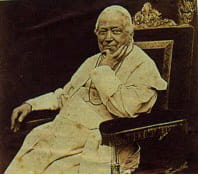 Pius was no disillusioned liberal; his first encyclicals revealed a committed conservative. After 1848, he was more convinced than ever of the need for his political independence as essential to his spiritual rule. After the Kingdom of Italy was proclaimed in 1861, he remained the last obstacle to unification. But Pius was no monarch, and the Papal States were widely known to be corrupt and inefficient, on last legs. One observer wrote: “You can prop up a corpse, but to make it walk is impossible.”
Some popes are gifted administrators, other diplomats, still others teachers. Pius IX’s gifts were pastoral. After 1850, he left administration to others and focused on spiritual matters. In 1864, he published the famous Syllabus of Errors, which listed his pet peeves with modernity, such as Bible Societies, freedom of the press, separation of Church and state, and public schools. Last but not least, he condemned the proposition that the pope should “come to terms with progress, liberalism and modern civilization.”
For all that he championed the Church’s rights, Pius ignored those of other religions. A famous example is the Mortara affair, where a Jewish child in the Papal States was forcibly taken from his family and raised Catholic. After the Catholic housemaid had baptized the child during an illness, papal police removed him from the home, citing a law that forbade non-Catholic parents raising Catholic children. Even after the case became an international human rights issue, Pius refused to budge.
His pontificate climaxed with the convening of the First Vatican Council in December 1869. Nine months later it produced a formal declaration that the pontiff is infallible when speaking on matters of faith and morals. Like the Immaculate Conception, this idea was long held but never formally articulated. Some bishops, however, felt the timing was “inopportune” and would widen the gap with the modern world. Nonetheless, it passed with only two dissenting votes (one from a bishop in Arkansas).
Article Continued On Next Page
Page: 1 of 2
12/7/2010 5:00:00 AM
Catholic
In Ages Past
History
Papacy
Roman Catholicism
more at patheos
1
Does God's Unfailing Love Give A Blanket Approval For Sin?
2
3

What Leaders Lose When They Hide Gen AI Truths
4

About Pat McNamara
Dr. Pat McNamara is a published historian. He blogs about American Catholic History at McNamara's Blog.
Patheos Explore the world's faith through different perspectives on religion and spirituality! Patheos has the views of the prevalent religions and spiritualities of the world.
Ad-Free & Subscriber Log-In Subscription Support
- About Us
- 2026 Calendar
- Videos
- Podcasts
- Library of World Religions
- Faith In Media Tracker
- Advertise With Us
- Write for Us
- Privacy Policy
- Terms of Service
- Do Not Sell My Data
- Contact Us
- Radiant Digital
- Manage Newsletter Subscriptions
- Unsubscribe From Notifications
- Sitemap
Copyright 2008-2026, Patheos. All rights reserved.
Subscription Support Ad-Free & Subscriber Log-In
Follow Patheos