
BuddhistCatholicContemplativeEvangelicalGeneral ChristianHinduJewishLatter-day SaintMuslimNew VisionsProgressive Christian
Beliefs
- Buddhist
- Catholic
- Contemplative
- Evangelical
- General Christian
- Hindu
- Jewish
- Latter-day Saint
- More Voices
- Muslim
- New Visions
- Pagan
- Progressive Christian
Topics
- Religion News
- Food and Religion
- Sports and Religion
- Religious Art
- Religious Music and Entertainment
- Religious Events
- History and Religion
- Style and Religion
- Politics and Religion
- Women in Religion
- Recreation Outdoors and Religion
- Business Finance and Religion
- Careers Workplace and Religion
- Education and Religion
- Family Parenting and Religion
- Health Fitness and Religion
- Home and Religion
- Relationships and Religion
- Technology and Religion
- Travel and Religion
Columnists
- Buddhist Columnists
- Business Finance and Religion Columnists
- Careers Workplace and Religion Columnists
- Catholic Columnists
- Contemplative Columnists
- Education and Religion Columnists
- Evangelists Columnists
- Family Parenting and Religion Columnists
- General Christian Columnists
- Health Fitness and Religion Columnists
- Hindu Columnists
- History and Religion Columnists
- Home and Religion Columnists
- Jewish Columnists
- More Voices Columnists
- Latter Day Columnists
- Muslim Columnists
- New Visions Columnists
- Nonreligious Columnists
- Pagan Columnists
- Politics and Religion Columnists
- Progressive Columnists
- Recreation Outdoors and Religion Columnists
- Relationships and Religion Columnists
- Religion News Columnists
- Religious Art Columnists
- Religious Events Columnists
- Religious Music and Entertainment Columnists
- Sports and Religion Columnists
- Style and Religion Columnists
- Technology and Religion Columnists
- Travel and Religion Columnists
- Women in Religion Columnists
Resource Library
- 2026 Calendar
- Library of World Religions
- The 100 Most Holy Places on Earth
- Patheos Answers
- Podcasts
- Videos
- Faith Leaders Database
- Anglican Episcopalian
- Bahai
- Baptist
- Buddhism
- Christianity
- Confucianism
- Eastern Orthodoxy
- Hinduism
- Holiness and Pentecostal
- ISKCON
- Islam
- Judaism
- Lutheran
- Methodist
- The Church of Jesus Christ of Latter-day Saints
- New Age
- Paganism
- Presbytarian and Reformed
- Protestantism
- Religion Behind the Scenes
- Roman Catholic
- Scientology
- Shia Islam
- Sikhism
- Sufism
- Sunni Islam
- Taoism
- Zen
- See all religions
Research Tools
 Ad-Free & Subscriber Log-In Subscription Support
Ad-Free & Subscriber Log-In Subscription Support
Follow Patheos 

- Trending:
- Forgiveness
- |
- Marriage
- |
- Consciousness
- |
- Death Penalty
- |
- Election
- |
- Halloween
Catholic
Gwen John: Art and Faith in the Shadows
November 23, 2010 by James Sullivan
Interiority, what the poet Hopkins termed "inscape," is the hallmark of Gwen John's oeuvre, which includes fewer than two hundred paintings but at least several thousand drawings. In scale and subject matter, Gwen John's art is redolent of French intimiste painting -- seated subjects, most often women, depicted in somber earth tones.
In 1904, Gwen John moved to Paris, partly to escape the radiating influence of her brother, but also as a natural evolution in her artistic development. There she met and fell in love with the sculptor, Auguste Rodin. She began to model for him and became his mistress. Their relationship lasted over a period of fourteen years until the sculptor's death in 1917. It was marked by an unusual intensity on her part, witnessed by the more than two thousand letters she wrote to him, now collected at the Musée Rodin in Paris. According to Cecily Langdale, the letters are alternatively "plaintive, despairing, and shrill." "You have shown me impoliteness in your workshop and on the street," complains Gwen John. But her letter turns to supplication, "I pray to you, Master, please send me a word." Despite this petulance in tone, Rodin was concerned for her well-being. Two years before his death he could write: "I love you and I desire your happiness." It has been conjectured that her relationship with Rodin brought her closer to Catholicism. He frequented Notre Dame Cathedral and would probably have been accompanied by Gwen John on any number of occasions.
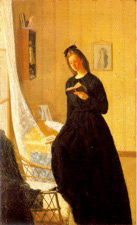 By 1910, her personal style had reached maturity. After that she restricted herself to a very select field of subjects: a few still-lifes, interiors, and landscapes, the remainder being all female portraits. In 1911 she moved to Meudon, a suburb of Paris, in order to be close to Rodin, who kept a country house there. In October of 1912 she began instruction in Roman Catholicism and was received into the Church the following year. Coincident with her reception, Girl Reading at the Window, a 16 x 10 inch oil appeared at the Armory Show, lent by her patron John Quinn. Quinn was instrumental in mounting the show, which announced the coming of modern art to the United States. The painting has been on view at the Museum of Modern Art since 1971.
Her faith took root, however, in a personality that grew increasingly bent on detachment from the world. "Aloneness," she wrote, "is nearer God, nearer reality." Yet friends wondered whether this asceticism, seemingly countenanced by her turn toward Catholicism, did not mask psychic turbulence. She was said to be "reserved, secretive, with a passionate violence that caused her suffering."
In 1926, Gwen John established her final strong attachment, this time with Vera Oumançoff, sister of Raïssa Maritain. The relationship began when Gwen John sought the spiritual counsel of the Maritains. She had been profoundly disturbed over the death of Rilke, and wondered whether one ought to pray for his soul in proximity to the region where he expired. After the initial encounter outside the parish church in Meudon, however, she fastened her attentions on Vera with the same fevered intensity she had on Rodin. These affections, "intolerably engrossing" said Jacques Maritain, were regulated by Vera who insisted that Gwen desist from her torrent of impassioned letters, and write only once a week. Thus began a series of letters and accompanying drawings sent by the artist to Vera Oumançoff, usually on Monday, from January 1928 to July 1929. Vera saved these drawings, although evidently she did not appreciate their artistic value. At the time of Vera's death in 1959, the Gwen John drawings were found stored in a cupboard.
By 1930, Vera felt the need to sever the relationship entirely, for she believed that the spiritual welfare of Gwen John demanded a new, harsher discipline. Reflecting back on this episode, Jacques Maritain explained in his Notebooks that Vera had come to understand "the impossibility of remedying the need she [Gwen John] had of torturing herself." Oddly, Maritain himself, despite his known support and admiration for the works of Rouault and Chagall, appeared to lack any personal appreciation for Gwen John's art. While he readily attests an "unheard-of-passion for her art . . . and exceptional talent," he praises the paintings strictly through quotations from intermediaries. At any rate, these 200 gouaches and pencil sketches bring us near to the end of John's productive years. After 1933, she ceased painting altogether and turned to gardening in her small plot on the rue Babie.
The relation between art and faith in a particular artist is always shrouded by a certain opacity. In the case of Gwen John, where polarities and tensions seemed to jangle perpetually, the matter is further darkened. On one level, that of her craft, her mature style was said to be in place before her conversion. Sir John Rothenstein concludes: "The fact is that neither of the scorching and exalting experiences she underwent [Rodin and conversion] appears to have had any immediate effect on her art; they seem to have neither hastened nor retarded its serene progress." Such a view accords with the secularized approach, mentioned above; yet it relates equally well with Thomistic aesthetics. Etienne Gilson's remarks in The Art of the Beautiful are relevant:
Article Continued On Next Page
Page: 2 of 3
11/23/2010 5:00:00 AM
Catholic
Art
History
Media
Christianity
Roman Catholicism
more at patheos
1

Daniel Wiseman Named Belmont Abbey VP
2
Estaciones Ecológicas del Vía Crucis, 2026
3

What Meaningful Bird Encounters Taught Me About Letting Go
4
About
Patheos Explore the world's faith through different perspectives on religion and spirituality! Patheos has the views of the prevalent religions and spiritualities of the world.
Ad-Free & Subscriber Log-In Subscription Support
- About Us
- 2026 Calendar
- Videos
- Podcasts
- Library of World Religions
- Faith In Media Tracker
- Advertise With Us
- Write for Us
- Privacy Policy
- Terms of Service
- Do Not Sell My Data
- Contact Us
- Radiant Digital
- Manage Newsletter Subscriptions
- Unsubscribe From Notifications
- Sitemap
Copyright 2008-2026, Patheos. All rights reserved.
Subscription Support Ad-Free & Subscriber Log-In
Follow Patheos