
BuddhistCatholicContemplativeEvangelicalGeneral ChristianHinduJewishLatter-day SaintMuslimNew VisionsProgressive Christian
Beliefs
- Buddhist
- Catholic
- Contemplative
- Evangelical
- General Christian
- Hindu
- Jewish
- Latter-day Saint
- More Voices
- Muslim
- New Visions
- Pagan
- Progressive Christian
Topics
- Religion News
- Food and Religion
- Sports and Religion
- Religious Art
- Religious Music and Entertainment
- Religious Events
- History and Religion
- Style and Religion
- Politics and Religion
- Women in Religion
- Recreation Outdoors and Religion
- Business Finance and Religion
- Careers Workplace and Religion
- Education and Religion
- Family Parenting and Religion
- Health Fitness and Religion
- Home and Religion
- Relationships and Religion
- Technology and Religion
- Travel and Religion
Columnists
- Buddhist Columnists
- Business Finance and Religion Columnists
- Careers Workplace and Religion Columnists
- Catholic Columnists
- Contemplative Columnists
- Education and Religion Columnists
- Evangelists Columnists
- Family Parenting and Religion Columnists
- General Christian Columnists
- Health Fitness and Religion Columnists
- Hindu Columnists
- History and Religion Columnists
- Home and Religion Columnists
- Jewish Columnists
- More Voices Columnists
- Latter Day Columnists
- Muslim Columnists
- New Visions Columnists
- Nonreligious Columnists
- Pagan Columnists
- Politics and Religion Columnists
- Progressive Columnists
- Recreation Outdoors and Religion Columnists
- Relationships and Religion Columnists
- Religion News Columnists
- Religious Art Columnists
- Religious Events Columnists
- Religious Music and Entertainment Columnists
- Sports and Religion Columnists
- Style and Religion Columnists
- Technology and Religion Columnists
- Travel and Religion Columnists
- Women in Religion Columnists
Resource Library
- 2026 Calendar
- Library of World Religions
- The 100 Most Holy Places on Earth
- Patheos Answers
- Podcasts
- Videos
- Faith Leaders Database
- Anglican Episcopalian
- Bahai
- Baptist
- Buddhism
- Christianity
- Confucianism
- Eastern Orthodoxy
- Hinduism
- Holiness and Pentecostal
- ISKCON
- Islam
- Judaism
- Lutheran
- Methodist
- The Church of Jesus Christ of Latter-day Saints
- New Age
- Paganism
- Presbytarian and Reformed
- Protestantism
- Religion Behind the Scenes
- Roman Catholic
- Scientology
- Shia Islam
- Sikhism
- Sufism
- Sunni Islam
- Taoism
- Zen
- See all religions
Research Tools
 Ad-Free & Subscriber Log-In Subscription Support
Ad-Free & Subscriber Log-In Subscription Support
Follow Patheos 

- Trending:
- Forgiveness
- |
- Marriage
- |
- Consciousness
- |
- Death Penalty
- |
- Election
- |
- Halloween
Catholic
The Brutality of Grace
October 19, 2010 by Joseph Susanka
On the surface, this is as dark and deeply cynical a story as one could imagine, but the graces are there as well. As the film draws to its close, two particularly important moments occur: In the first, Chigurh presents his last victim with his trusty coin, instructing her to determine whether she will die: "Call it, sister." But she refuses to participate, telling him: "I ain't gonna call it. The coin don't have no say. It's just you." Robbed of his reliance on "Fate," Chigurh is forced to take responsibility for his actions; free will is thrust upon him, whether he desires it or not. A subsequent car accident sheds an entirely new light on this "chanceless" world: If life is no longer random, Chigurh's brush with death casts an ominous pall over his eventual survival. Someone is watching, and the man’s transgressions will not go unpunished forever.
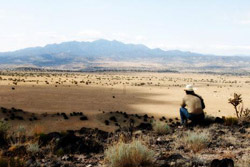 But perhaps the most intriguing example of the intrusion of grace is the way in which the film underscores the importance of the title's most intriguing adjective, "Old." When Sheriff Ed Tom Bell visits his Uncle Ellis, the old man puts to rest the notion that Chigurh is a sign of a new and insurmountable evil: "What you got ain't nothin' new. This country is hard on people. You can't stop what's coming. It ain't all waitin' on you. That's vanity." This, combined with the dream described by Bell at the film's conclusion, reveal the story to be far more grace-filled than it would seem at first glance. Until late in the film, Deputy Wendell, the sheriff's assistant, seems to be used for little more than comic relief. Yet it is the deputy (and his generation) who proves most capable of dealing with Chigurh and his ilk. Far from suggesting that mankind is ill-equipped to confront evil and violence, the story shows that Someone (in His Infinite Providence) has carefully ensured that "the right man for the job" appears on the scene at just the right moment.
McCarthy's approach to grace and violence is still evolving here, and like All the Pretty Horses before it, No Country for Old Men leaves the viewer unsure as to whether the author intends to point toward the Divine in the midst of such darkness. That certitude comes with The Road, the final (and most interesting) of the McCarthy adaptations.
The Road tells the raw, unrelenting story of a man (The Man) and his son (The Boy) as they journey across a desolate, post-apocalyptic landscape peopled by little more than cannibals, chaos, and despair. Convinced that the seashore will be their salvation, The Man drives the two of them relentlessly across the devastation of "post-event" America, consumed by the overwhelming need to protect his son in a world without hope. The frustrating (and essential) lack of back story; the stark, cruel imagery; and the seemingly impossible situation in which The Man and The Boy find themselves creates the perfect environment for those "imperceptible intrusions of grace" O'Connor so loved to explore.
While protecting his son from the physical dangers of this new, harsh reality, The Man fails to recognize that The Boy is steadfastly protecting him from the more destructive spiritual threat of despair. Time and again, his son reminds him that they are "still the good guys," and that "we have to keep carrying the fire" -- a fire that sets them apart from nearly every other survivor in this darkening world. Much of the film's language and symbolism is eerily incarnational in tone: "If I were God, I would have made the world just so and no different. And so I have you . . . I have you." "He is an angel. To me, he's a god." "All I know is that the child is my warrant, and if he is not the Word of God, then God never spoke." Throughout it all runs the language of fire, light, and goodness -- and holding out hope that, in spite of the utter hopelessness of the human condition, there is more to be believed in than just humanity. When The Man's ceaseless vigilance in protecting his son finally becomes more than he can bear, a solution presents itself in a way so inexplicable and unexpected that there can be no doubt as to its true origin.
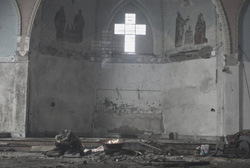 When discussing the purpose and meaning of The Road, McCarthy himself compared it to another of his works, Blood Meridian, saying that, if Meridian was about "the limits of our inhumanity," The Road was about "the limits of our humanity." But as McCarthy's menacing, wrenching, and achingly beautiful story highlights so well, it is vitally important to remember that our humanity has limits in both directions. In The Road, we must deal with the ugliness of a society without hope and the level of inhumanity to which such a society will sink. But more importantly, the story deals with man's upper boundary -- the boundary that exists between our humanity and the Divine; the home of those very moments of Grace with which McCarthy (and O'Connor before him) deals so insightfully.
Article Continued On Next Page
Page: 2 of 3
10/19/2010 4:00:00 AM
Catholic
Violence
Faith
literature
Media
Movies
Christianity
Roman Catholicism
more at patheos
1

America’s Crisis Is Deeper Than Politics
2

MAGA's Assault on Religious Liberty
3

Owning Things Without Being Owned: The 100 Thing Challenge
4

Medicare and the Push for Universal Health Care

About Joseph Susanka
Joseph Susanka has been doing development work for institutions of Catholic higher education since his graduation from Thomas Aquinas College in 1999. He blogs at Crisis Magazine, where he also contributes feature articles on a variety of topics.
Patheos Explore the world's faith through different perspectives on religion and spirituality! Patheos has the views of the prevalent religions and spiritualities of the world.
Ad-Free & Subscriber Log-In Subscription Support
- About Us
- 2026 Calendar
- Videos
- Podcasts
- Library of World Religions
- Faith In Media Tracker
- Advertise With Us
- Write for Us
- Privacy Policy
- Terms of Service
- Do Not Sell My Data
- Contact Us
- Radiant Digital
- Manage Newsletter Subscriptions
- Unsubscribe From Notifications
- Sitemap
Copyright 2008-2026, Patheos. All rights reserved.
Subscription Support Ad-Free & Subscriber Log-In
Follow Patheos