
BuddhistCatholicContemplativeEvangelicalGeneral ChristianHinduJewishLatter-day SaintMuslimNew VisionsProgressive Christian
Beliefs
- Buddhist
- Catholic
- Contemplative
- Evangelical
- General Christian
- Hindu
- Jewish
- Latter-day Saint
- More Voices
- Muslim
- New Visions
- Pagan
- Progressive Christian
Topics
- Religion News
- Food and Religion
- Sports and Religion
- Religious Art
- Religious Music and Entertainment
- Religious Events
- History and Religion
- Style and Religion
- Politics and Religion
- Women in Religion
- Recreation Outdoors and Religion
- Business Finance and Religion
- Careers Workplace and Religion
- Education and Religion
- Family Parenting and Religion
- Health Fitness and Religion
- Home and Religion
- Relationships and Religion
- Technology and Religion
- Travel and Religion
Columnists
- Buddhist Columnists
- Business Finance and Religion Columnists
- Careers Workplace and Religion Columnists
- Catholic Columnists
- Contemplative Columnists
- Education and Religion Columnists
- Evangelists Columnists
- Family Parenting and Religion Columnists
- General Christian Columnists
- Health Fitness and Religion Columnists
- Hindu Columnists
- History and Religion Columnists
- Home and Religion Columnists
- Jewish Columnists
- More Voices Columnists
- Latter Day Columnists
- Muslim Columnists
- New Visions Columnists
- Nonreligious Columnists
- Pagan Columnists
- Politics and Religion Columnists
- Progressive Columnists
- Recreation Outdoors and Religion Columnists
- Relationships and Religion Columnists
- Religion News Columnists
- Religious Art Columnists
- Religious Events Columnists
- Religious Music and Entertainment Columnists
- Sports and Religion Columnists
- Style and Religion Columnists
- Technology and Religion Columnists
- Travel and Religion Columnists
- Women in Religion Columnists
Resource Library
- 2026 Calendar
- Library of World Religions
- The 100 Most Holy Places on Earth
- Patheos Answers
- Podcasts
- Videos
- Faith Leaders Database
- Anglican Episcopalian
- Bahai
- Baptist
- Buddhism
- Christianity
- Confucianism
- Eastern Orthodoxy
- Hinduism
- Holiness and Pentecostal
- ISKCON
- Islam
- Judaism
- Lutheran
- Methodist
- The Church of Jesus Christ of Latter-day Saints
- New Age
- Paganism
- Presbytarian and Reformed
- Protestantism
- Religion Behind the Scenes
- Roman Catholic
- Scientology
- Shia Islam
- Sikhism
- Sufism
- Sunni Islam
- Taoism
- Zen
- See all religions
Research Tools
 Ad-Free & Subscriber Log-In Subscription Support
Follow Patheos 

- Trending:
- Advent
- |
- Forgiveness
- |
- Thanksgiving
- |
- Election
- |
- Seasonal Holidays
- |
- Marriage
Buddha's Brain
May 18, 2010
Conclusion
The intertwining of mind and brain, information and matter, means that we need psychology to understand the brain . . . and neurology to understand the mind. And both are illuminated by centuries of practical experience in the world's contemplative traditions.
The intersection and integration of these three -- psychology, neurology, and contemplation -- is the heartwood of personal well-being and spiritual growth. The movement of Buddhism into the West has created an historically unprecedented opportunity for the dharma to inform science and vice versa, for the benefit of all beings.
Key Features and Functions of Your Brain Shaped by evolution; the main genetic differences between humans and chimpanzees focus on the brain, particularly its social, emotional, linguistic, and conceptual abilities 3 pounds, 1.1 trillion cells, including 100 billion "gray matter" neurons Always "on" -- 2% of the body's weight uses about 25% of its oxygen Average neuron has about 1000 connections (synapses), 100 trillion in all Synapses firing 1 to 100 times a second Regions linked by brainwaves synchronized within a few milliseconds Extremely interconnected network full of circular loops Number of possible brain states: 1 followed by a million zeros An organ that learns from experiences through lifelong changes in its structure The most complex object known in the universe
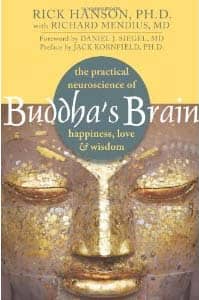
For further reading, see Hanson and Mendius' Buddha's Brain: the Practical Neuroscience of Happiness, Love and Wisdom, "Meditation on Demand" (Scientific American), and Wise Brain.
* * * *
Reprinted with permission from Inquiring Mind, ©2007 by Rick Hanson, Ph.D. and Rick Mendius, M.D.
Rick Hanson, Ph.D. is a clinical psychologist, author, and teacher with a great interest in the intersection of psychology, neurology, and Buddhism. He has written and taught extensively about the essential inner skills of personal well-being, psychological growth, and contemplative practice, as well as about relationships, family life, and raising children. He is the author of Mother Nurture: A Mother's Guide to Health in Body, Mind, and Intimate Relationships and his latest book is Buddha's Brain: The Practical Neuroscience of Happiness, Love, and Wisdom (with Rick Mendius, M.D.). He and Rick Mendius have also created the audio program, Meditations to Change Your Brain.
Rick Mendius, M.D. is a neurologist, author, and teacher. He trained at UCLA as an epileptologist under Jerome Engel and as a neurobehaviorist under Frank Benson and Jeff Cummings. He has been on the teaching faculty of UCLA, Oregon Health Sciences University, and Stanford University. His meditation practice began in the 1980s with Shinzen Young in Los Angeles, and continues at Spirit Rock with Jack Kornfield, Phillip Moffitt, Ajahn Amaro, and Ajahn Sumedho.
Page: 4 of 4
5/18/2010 4:00:00 AM
Religion and Science
science
Buddhism
more at patheos
1

2

3

When Leaders Don't Practice What They Preach
4

Colorado's Preschool Battle and Catholic Family Rights
About
Patheos Explore the world's faith through different perspectives on religion and spirituality! Patheos has the views of the prevalent religions and spiritualities of the world.
Ad-Free & Subscriber Log-In Subscription Support
- About Us
- 2026 Calendar
- Videos
- Podcasts
- Library of World Religions
- Faith In Media Tracker
- Advertise With Us
- Write for Us
- Privacy Policy
- Terms of Service
- Do Not Sell My Data
- Contact Us
- Radiant Digital
- Manage Newsletter Subscriptions
- Unsubscribe From Notifications
- Sitemap
Copyright 2008-2026, Patheos, part of the Radiant Digital network of media brands. All rights reserved.
Subscription Support Ad-Free & Subscriber Log-In
Follow Patheos