
BuddhistCatholicContemplativeEvangelicalGeneral ChristianHinduJewishLatter-day SaintMuslimNew VisionsProgressive Christian
Beliefs
- Buddhist
- Catholic
- Contemplative
- Evangelical
- General Christian
- Hindu
- Jewish
- Latter-day Saint
- More Voices
- Muslim
- New Visions
- Pagan
- Progressive Christian
Topics
- Religion News
- Food and Religion
- Sports and Religion
- Religious Art
- Religious Music and Entertainment
- Religious Events
- History and Religion
- Style and Religion
- Politics and Religion
- Women in Religion
- Recreation Outdoors and Religion
- Business Finance and Religion
- Careers Workplace and Religion
- Education and Religion
- Family Parenting and Religion
- Health Fitness and Religion
- Home and Religion
- Relationships and Religion
- Technology and Religion
- Travel and Religion
Columnists
- Buddhist Columnists
- Business Finance and Religion Columnists
- Careers Workplace and Religion Columnists
- Catholic Columnists
- Contemplative Columnists
- Education and Religion Columnists
- Evangelists Columnists
- Family Parenting and Religion Columnists
- General Christian Columnists
- Health Fitness and Religion Columnists
- Hindu Columnists
- History and Religion Columnists
- Home and Religion Columnists
- Jewish Columnists
- More Voices Columnists
- Latter Day Columnists
- Muslim Columnists
- New Visions Columnists
- Nonreligious Columnists
- Pagan Columnists
- Politics and Religion Columnists
- Progressive Columnists
- Recreation Outdoors and Religion Columnists
- Relationships and Religion Columnists
- Religion News Columnists
- Religious Art Columnists
- Religious Events Columnists
- Religious Music and Entertainment Columnists
- Sports and Religion Columnists
- Style and Religion Columnists
- Technology and Religion Columnists
- Travel and Religion Columnists
- Women in Religion Columnists
Resource Library
- 2026 Calendar
- Library of World Religions
- The 100 Most Holy Places on Earth
- Patheos Answers
- Podcasts
- Videos
- Faith Leaders Database
- Anglican Episcopalian
- Bahai
- Baptist
- Buddhism
- Christianity
- Confucianism
- Eastern Orthodoxy
- Hinduism
- Holiness and Pentecostal
- ISKCON
- Islam
- Judaism
- Lutheran
- Methodist
- The Church of Jesus Christ of Latter-day Saints
- New Age
- Paganism
- Presbytarian and Reformed
- Protestantism
- Religion Behind the Scenes
- Roman Catholic
- Scientology
- Shia Islam
- Sikhism
- Sufism
- Sunni Islam
- Taoism
- Zen
- See all religions
Research Tools
 Ad-Free & Subscriber Log-In Subscription Support
Ad-Free & Subscriber Log-In Subscription Support
Follow Patheos 

- Trending:
- Forgiveness
- |
- Marriage
- |
- Consciousness
- |
- Death Penalty
- |
- Election
- |
- Halloween
Make Love, Not War
March 23, 2010 by Beth Davies-Stofka
A Review of From Slogans to Mantras
By Beth Davies-Stofka
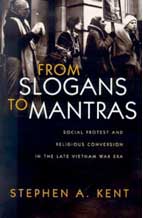 From Slogans to Mantras:
Social Protest and Religious Conversion in the Late Vietnam War Era
By Stephen A. Kent
Syracuse University Press, 2001
Make love, not war.
This was the slogan that defined a generation of activists. For a few short years they threw themselves body and soul into changing this country. These young people called themselves a Movement, and they committed themselves to generating a Revolution.
From north to south and coast to coast, young Americans demonstrated, organized, gathered, experimented, and struggled to make themselves heard by university administrations, state and local governments, and the powerful federal government. They demanded a voice in the decisions that affected their lives.
No decision affected their lives as much as the decision to escalate U.S. military involvement in Vietnam. But they didn't limit themselves to opposing the draft. The changes they demanded were comprehensive. They worked for civil rights, voting rights, education reforms, environmental protections, and sexual freedom. They demonstrated for an end to American empire. They worked to expose the exploitation of workers. They highlighted the immorality of dropping bombs on unprotected villagers.
Their struggle was a grueling one. In the America of the late 1960s and early 1970s, demands for equal rights, equal protections, and peace were nothing less than demands for a fundamental redistribution of social and political power. Those who held the power fought back.
And so it was that this country lived through some of the most shocking events in its history. Southern churches were burned to the ground and civil rights workers were kidnapped, beaten, and murdered by local law enforcement and Klansmen. Martin Luther King, Jr., and Robert F. Kennedy were murdered right in front of their supporters. On May 4, 1970, Ohio National Guardsmen opened fire on demonstrators at Kent State University, killing four and wounding nine. Four days later Mississippi National Guardsmen opened fire on demonstrators at Jackson State College, killing two and wounding ten. The violence had a chilling effect on the Movement.
And then, in the early 1970s, thousands of these young people began converting. They became religious. They left the ranks of the politically active counterculture, and joined authoritarian religious organizations like the Divine Light Mission and the Unification Church. Why did these young people, after spending years living by the dictum to "Question Authority," convert to religions that required them to obey orders without question or protest? Conventional academic wisdom says they did this because their perceived political failures caused a deep crisis of meaning.
But in his fascinating and very readable 2001 book From Slogans to Mantras: Social Protest and Religious Conversion in the Late Vietnam War Era, sociologist Stephen A. Kent offered a different interpretation of these astonishing religious conversions. Through careful and rigorous research, and interviews with many of the converts themselves, all of whom had organized and led demonstrations prior to converting, Kent discovered a different narrative. As he put it, these conversions were not due to a crisis of meaning, but a crisis of means. The goals of these activists remained the same, and their commitment to changing the world remained just as strong. They converted because they believed they had found a better means of achieving their goals. In short, they concluded that the best way to change the world was to change themselves.
In the first forty or so pages of the book, Kent lays the essential groundwork to his study, defining the 60s generation through a brief introduction to its roots in the Beats and an analysis of both generations' interests in drugs and religious experience. He distinguishes between different strains within the Movement, and places the music of the Movement in context. Providing a brief history of the political activities of the 60s generation, he brings the reader current with the crisis many of them faced after the violence of 1970 and 1971.
Chapters 4 and 5 provide the heart of the book, detailing the syncretic and heterodox religious organizations that attracted converts from among the politically active leaders of the Movement, and sharing the results of his interviews with these converts. In Chapter 4 Kent discusses the Divine Light Mission, the Hare Krishnas, Chögyam Trungpa, Rinpoche and the Naropa Institute, The Healthy, Happy, Holy Organization (3HO), Transcendental Meditation, and Meher Baba. In Chapter 5 Kent discusses Scientology, the Unification Church, the Jesus Movement and the Christian World Liberation Front, and the Children of God.
Article Continued On Next Page
Page: 1 of 2
3/23/2010 4:00:00 AM
History
Media
politics
Society
Worship
more at patheos
1

Michael W. Smith Joins ‘Daniel’ Biblical Epic as Producer
2
Why I Do My Best Work When Not Thinking: On Instinct & Flow
3
Radical Church & The Ultimate Issue
4

10 Books to Address Christian Nationalism in Your Church

About Beth Davies-Stofka
Beth Davies-Stofka teaches courses on comparative religion and the philosophy of religion. Her teaching and research focus in two areas: the challenges that violence and human suffering present to theological ethics, and explorations of philosophy and...
Patheos Explore the world's faith through different perspectives on religion and spirituality! Patheos has the views of the prevalent religions and spiritualities of the world.
Ad-Free & Subscriber Log-In Subscription Support
- About Us
- 2026 Calendar
- Videos
- Podcasts
- Library of World Religions
- Faith In Media Tracker
- Advertise With Us
- Write for Us
- Privacy Policy
- Terms of Service
- Do Not Sell My Data
- Contact Us
- Radiant Digital
- Manage Newsletter Subscriptions
- Unsubscribe From Notifications
- Sitemap
Copyright 2008-2026, Patheos. All rights reserved.
Subscription Support Ad-Free & Subscriber Log-In
Follow Patheos