
BuddhistCatholicContemplativeEvangelicalGeneral ChristianHinduJewishLatter-day SaintMuslimNew VisionsProgressive Christian
Beliefs
- Buddhist
- Catholic
- Contemplative
- Evangelical
- General Christian
- Hindu
- Jewish
- Latter-day Saint
- More Voices
- Muslim
- New Visions
- Pagan
- Progressive Christian
Topics
- Religion News
- Food and Religion
- Sports and Religion
- Religious Art
- Religious Music and Entertainment
- Religious Events
- History and Religion
- Style and Religion
- Politics and Religion
- Women in Religion
- Recreation Outdoors and Religion
- Business Finance and Religion
- Careers Workplace and Religion
- Education and Religion
- Family Parenting and Religion
- Health Fitness and Religion
- Home and Religion
- Relationships and Religion
- Technology and Religion
- Travel and Religion
Columnists
- Buddhist Columnists
- Business Finance and Religion Columnists
- Careers Workplace and Religion Columnists
- Catholic Columnists
- Contemplative Columnists
- Education and Religion Columnists
- Evangelists Columnists
- Family Parenting and Religion Columnists
- General Christian Columnists
- Health Fitness and Religion Columnists
- Hindu Columnists
- History and Religion Columnists
- Home and Religion Columnists
- Jewish Columnists
- More Voices Columnists
- Latter Day Columnists
- Muslim Columnists
- New Visions Columnists
- Nonreligious Columnists
- Pagan Columnists
- Politics and Religion Columnists
- Progressive Columnists
- Recreation Outdoors and Religion Columnists
- Relationships and Religion Columnists
- Religion News Columnists
- Religious Art Columnists
- Religious Events Columnists
- Religious Music and Entertainment Columnists
- Sports and Religion Columnists
- Style and Religion Columnists
- Technology and Religion Columnists
- Travel and Religion Columnists
- Women in Religion Columnists
Resource Library
- 2026 Calendar
- Library of World Religions
- The 100 Most Holy Places on Earth
- Patheos Answers
- Podcasts
- Videos
- Faith Leaders Database
- Anglican Episcopalian
- Bahai
- Baptist
- Buddhism
- Christianity
- Confucianism
- Eastern Orthodoxy
- Hinduism
- Holiness and Pentecostal
- ISKCON
- Islam
- Judaism
- Lutheran
- Methodist
- The Church of Jesus Christ of Latter-day Saints
- New Age
- Paganism
- Presbytarian and Reformed
- Protestantism
- Religion Behind the Scenes
- Roman Catholic
- Scientology
- Shia Islam
- Sikhism
- Sufism
- Sunni Islam
- Taoism
- Zen
- See all religions
Research Tools
 Ad-Free & Subscriber Log-In Subscription Support
Ad-Free & Subscriber Log-In Subscription Support
Follow Patheos 

- Trending:
- Forgiveness
- |
- Marriage
- |
- Consciousness
- |
- Death Penalty
- |
- Election
- |
- Halloween
Evangelical
You Will Call, I Will Answer: An Interview with William Stuntz
February 02, 2010 by Timothy Dalrymple
It's impossible for me to hear and absorb those messages and then also think that the God of the universe actually loves me. I got close at some points to losing my faith, to seeing God as having declared Himself my enemy. It's hard to worship your enemy.
The pain and the cancer in themselves are not good, then, and yet we as Christians believe that God can bring good out of evil. Not to paper over the negatives, but what good has God brought out of it? What lessons has God taught you, or how has He shaped you?
My experience of cancer especially is that God is just so eager to bless. I find blessing all over the place, not in the cancer itself but all around it. It would almost be easier to answer what blessings I have not found.
Since my cancer diagnosis, I have experienced more friendship from more people than at any other time in my life. I've experienced not just a quality of medical care but a kind of medical care, humane medical care delivered by humane and decent people, that seems Christ-like to me. I don't know the religious convictions of all the people who have treated me, but I certainly believe that they are used by God in ways that are really quite extraordinary to bring blessing to people who are in circumstances that lead them to hunger for blessing. I do hunger for blessing in the midst of these medical conditions, but I regularly find that hunger satisfied.
Are there ways in which your suffering has changed you for the better?
For a time, I think, the chronic pain changed me for the worse. I had a period when I grew more bitter and isolated.
But ultimately the answer is yes. Over the past few years I have become less arrogant, less confident of my own judgments and insights, and better at listening to others.
As a result, I've become a better husband and father than I was. I love better than I did before. I am certain that's true in my family, and maybe even generally beyond my family. I think I am actually better at my job. One of the things I've learned over the years is that believers have a large advantage in many academic fields, but definitely in mine. We understand that the world is not what it should be, and that our own capacities to understand it are severely limited. These are things that many of our colleagues do not understand. They are simple realities. They are facts. And if you understand those realities, then you cannot help but see things that others are not seeing.
Have your experiences led you to think differently about the relationship between the body and the spirit? Christians sometimes behave as though all that matters is the spiritual life. Is that too simple? What does it mean to live our faith as embodied individuals?
That's a great question, and the best way I know to answer it is this. Chronic pain and cancer both make life more concrete. In times of good health, when our bodies are doing everything we want and expect them to do, there is a tendency to think of spiritual life as something that is anything but concrete. That's not possible, I find, in my present circumstances. My medical conditions, independently and together, are inescapable. Perhaps that's the key feature. They are there all the time. There is no time when I am not aware of them. I hurt all the time. I'm exhausted all the time. There is no escaping either of those states of affairs. I simply never feel like I used to feel virtually all the time.
What I find when I think back to the way I used to feel, I see that my life then was so much less concrete. It was not that I felt physical pleasure back then -- in fact, I think I feel more physical pleasure now than I did when I was healthy. It was just that I did not feel very much of anything. My body was nothing more than a vessel carrying me around. I think that sensibility extends to other areas of life. It leads to a life that is more abstract, less personal, a life that is up in the clouds and not down where the rubber meets the road. The abstract life, I find, is impossible to live when your body is broken down.
Do you ever feel hatred toward your body?
I certainly have felt hatred toward my body. There was a time when I felt that more acutely than I do now. I cannot manage to maintain enmity between myself and my body, because my self is in part my body. How can we be enemies? We are stuck together.
These conditions, both of them, become very quickly a part of one's identity. Chronic pain and cancer are not just things that have happened to me. They are things that I am.
Article Continued On Next Page
Page: 2 of 4
2/2/2010 5:00:00 AM
Afterlife
Evangelical
Death
Christianity
Evangelicalism
more at patheos
1

June Jobs Report Shows Steady U.S. Labor Market
2

Your Child Feels Like a Stranger? A Prayer for the Waiting
3
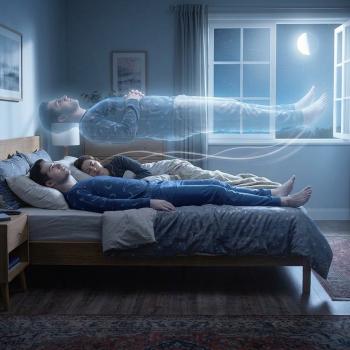
The Out-of-Body Experience: Without the Near-Death Part
4

What Was Jesus’ Central Message?

About Timothy Dalrymple
Timothy Dalrymple is the CEO and Chief Creative Officer of Polymath Innovations, a strategic storytelling agency that advances the good with visionary organizations and brands. He leads a unique team of communicators from around North America and across the creative spectrum, serving mission-driven businesses and nonprofits who need a partner to amplify their voice and good works. Once a world-class gymnast whose career ended with a broken neck, Tim channeled his passions for faith and storytelling into his role as VP of Business Development for Patheos, helping to launch and grow the network into the world's largest religion website. He holds a Ph.D. in Religion from Harvard's Graduate School of Arts and Sciences. Tim blogs at Philosophical Fragments.
Patheos Explore the world's faith through different perspectives on religion and spirituality! Patheos has the views of the prevalent religions and spiritualities of the world.
Ad-Free & Subscriber Log-In Subscription Support
- About Us
- 2026 Calendar
- Videos
- Podcasts
- Library of World Religions
- Faith In Media Tracker
- Advertise With Us
- Write for Us
- Privacy Policy
- Terms of Service
- Do Not Sell My Data
- Contact Us
- Radiant Digital
- Manage Newsletter Subscriptions
- Unsubscribe From Notifications
- Sitemap
Copyright 2008-2026, Patheos. All rights reserved.
Subscription Support Ad-Free & Subscriber Log-In
Follow Patheos