
BuddhistCatholicContemplativeEvangelicalGeneral ChristianHinduJewishLatter-day SaintMuslimNew VisionsProgressive Christian
Beliefs
- Buddhist
- Catholic
- Contemplative
- Evangelical
- General Christian
- Hindu
- Jewish
- Latter-day Saint
- More Voices
- Muslim
- New Visions
- Pagan
- Progressive Christian
Topics
- Religion News
- Food and Religion
- Sports and Religion
- Religious Art
- Religious Music and Entertainment
- Religious Events
- History and Religion
- Style and Religion
- Politics and Religion
- Women in Religion
- Recreation Outdoors and Religion
- Business Finance and Religion
- Careers Workplace and Religion
- Education and Religion
- Family Parenting and Religion
- Health Fitness and Religion
- Home and Religion
- Relationships and Religion
- Technology and Religion
- Travel and Religion
Columnists
- Buddhist Columnists
- Business Finance and Religion Columnists
- Careers Workplace and Religion Columnists
- Catholic Columnists
- Contemplative Columnists
- Education and Religion Columnists
- Evangelists Columnists
- Family Parenting and Religion Columnists
- General Christian Columnists
- Health Fitness and Religion Columnists
- Hindu Columnists
- History and Religion Columnists
- Home and Religion Columnists
- Jewish Columnists
- More Voices Columnists
- Latter Day Columnists
- Muslim Columnists
- New Visions Columnists
- Nonreligious Columnists
- Pagan Columnists
- Politics and Religion Columnists
- Progressive Columnists
- Recreation Outdoors and Religion Columnists
- Relationships and Religion Columnists
- Religion News Columnists
- Religious Art Columnists
- Religious Events Columnists
- Religious Music and Entertainment Columnists
- Sports and Religion Columnists
- Style and Religion Columnists
- Technology and Religion Columnists
- Travel and Religion Columnists
- Women in Religion Columnists
Resource Library
- 2026 Calendar
- Library of World Religions
- The 100 Most Holy Places on Earth
- Patheos Answers
- Podcasts
- Videos
- Faith Leaders Database
- Anglican Episcopalian
- Bahai
- Baptist
- Buddhism
- Christianity
- Confucianism
- Eastern Orthodoxy
- Hinduism
- Holiness and Pentecostal
- ISKCON
- Islam
- Judaism
- Lutheran
- Methodist
- The Church of Jesus Christ of Latter-day Saints
- New Age
- Paganism
- Presbytarian and Reformed
- Protestantism
- Religion Behind the Scenes
- Roman Catholic
- Scientology
- Shia Islam
- Sikhism
- Sufism
- Sunni Islam
- Taoism
- Zen
- See all religions
Research Tools
 Ad-Free & Subscriber Log-In Subscription Support
Ad-Free & Subscriber Log-In Subscription Support
Follow Patheos 

- Trending:
- Forgiveness
- |
- Marriage
- |
- Consciousness
- |
- Death Penalty
- |
- Election
- |
- Halloween
Who Touched Me?
November 13, 2009 by Mark Roberts
By Mark D. Roberts
Jesus realized at once that healing power had gone out from him, so he turned around in the crowd and asked, "Who touched my robe?"(Mark 5:30)
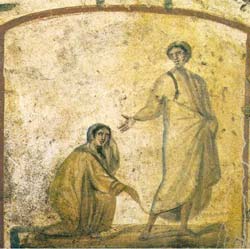 In the previous section of Mark, where Jesus encountered the Gerasene demoniac, Jesus acted in ways that were puzzling, even distressing to those who witnessed them. The puzzlement continues in the next episode of the Gospel of Mark, which is a double-healing story, and one that moves into new territory because one of the healings is actually a resurrection.
This story begins when a synagogue leader begged Jesus to heal his daughter, who was dying from some unnamed disease. Jesus consented to go with the leader, so they headed for his home, with a large crowd following. Suddenly, a woman in the crowd secretly touched Jesus' robe, believing that this would enable her to be healed of a disease that had afflicted her for years. In fact, she was healed instantly. But her hopes for a clandestine healing were dashed when Jesus asked, "Who touched my robe?"
I love the response from the disciples, who took Jesus literally and thought he was being silly. With everybody pressing in around Jesus, lots of people were touching his robe. So why ask "Who touched my robe?" But Jesus knew exactly why he was asking this question, and so did the woman who had been healed. Jesus was asking her to reveal herself, not only to him, but also to the crowd.
We don't know all of the reasons why the woman had wanted to be healed secretly. But part of her motivation surely had to do with the fact that, by touching Jesus, she would make him ritually unclean. This was not something one should do to a Jewish holy man. No doubt the healed woman expected Jesus to be angry with her and the crowd to rebuke her for soiling Jesus' ceremonial status.
When the woman fell before Jesus, trembling with fear, she admitted what she had done. Jesus responded simply, "Daughter, your faith has made you well. Go in peace. Your suffering is over." No mention of uncleanness. No anger. Just affirmation and good news.
So why did Jesus call out this woman, bringing her action into the light? In part, he sought to reassure her, even calling her with the intimate address, "Daughter." In part, Jesus wanted to hold her up as a paragon of faith. And, in part, he wanted all to know that she was healed and restored as a full member of their community. Physical healing was the occasion for a deeper and wider restoration.
Questions for reflection: Have you ever felt like the woman in this story, reaching out to Jesus in desperation? When? What happened? How is Jesus bringing wholeness to your life?
Prayer: O Lord, as I read this story, part of me relates to the disciples. There are so many times when I don't quite get what you're doing. I'm sure I stick my foot in my mouth with you hundreds of times. Probably thousands. Yet you remain in relationship with me, bringing me along patiently and graciously. Thank you!
There is another part of me that relates to this woman. Though I haven't been in her exact situation, there have been many times when I have reached out to you in desperation. Thank you, dear Lord, for being there for me. Thank you for being my Savior, my healer, my hope.
As you did with the woman in this story, so you have done with me. You have asked for more than I expected. You have healed me more deeply than I knew to ask. You have restored me . . . and keep on restoring me . . . with a vision for my wholeness that outstrips my own. All praise be to you, gracious Lord, for your amazing goodness to me. Amen.
Mark D. Roberts, as Senior Director and Scholar-in-Residence for Laity Lodge, is an advisor and frequent contributor to TheHighCalling.org. A Presbyterian pastor, Mark earned his Ph.D. in New Testament from Harvard University. He has written six books, including No Holds Barred: Wrestling with God in Prayer (WaterBrook, 2005). He blogs daily at www.markdroberts.com, and the meditations he writes for The High Calling will be featured at the Evangelical Portal every Thursday.
See a video interview of Dr. Roberts here and here.
11/13/2009 5:00:00 AM
Thursday Work Meditation
Healing
Christianity
Evangelicalism
more at patheos
1
William Seymour: Pentecost & The Azusa Street Revival
2

Who is "Us"? Rethinking Church in a Multicultural Society
3

4

'Amazing Grace' Re-release: Inspiration for New Generations
About Mark Roberts
Mark D. Roberts is Senior Director and Scholar-in-Residence for Laity Lodge, a retreat and renewal ministry in Texas. He blogs at Patheos and writes daily devotionals at www.thehighcalling.org, and he can also be followed through Twitter and Facebook.
Patheos Explore the world's faith through different perspectives on religion and spirituality! Patheos has the views of the prevalent religions and spiritualities of the world.
Ad-Free & Subscriber Log-In Subscription Support
- About Us
- 2026 Calendar
- Videos
- Podcasts
- Library of World Religions
- Faith In Media Tracker
- Advertise With Us
- Write for Us
- Privacy Policy
- Terms of Service
- Do Not Sell My Data
- Contact Us
- Radiant Digital
- Manage Newsletter Subscriptions
- Unsubscribe From Notifications
- Sitemap
Copyright 2008-2026, Patheos. All rights reserved.
Subscription Support Ad-Free & Subscriber Log-In
Follow Patheos