
BuddhistCatholicContemplativeEvangelicalGeneral ChristianHinduJewishLatter-day SaintMuslimNew VisionsProgressive Christian
Beliefs
- Buddhist
- Catholic
- Contemplative
- Evangelical
- General Christian
- Hindu
- Jewish
- Latter-day Saint
- More Voices
- Muslim
- New Visions
- Pagan
- Progressive Christian
Topics
- Religion News
- Food and Religion
- Sports and Religion
- Religious Art
- Religious Music and Entertainment
- Religious Events
- History and Religion
- Style and Religion
- Politics and Religion
- Women in Religion
- Recreation Outdoors and Religion
- Business Finance and Religion
- Careers Workplace and Religion
- Education and Religion
- Family Parenting and Religion
- Health Fitness and Religion
- Home and Religion
- Relationships and Religion
- Technology and Religion
- Travel and Religion
Columnists
- Buddhist Columnists
- Business Finance and Religion Columnists
- Careers Workplace and Religion Columnists
- Catholic Columnists
- Contemplative Columnists
- Education and Religion Columnists
- Evangelists Columnists
- Family Parenting and Religion Columnists
- General Christian Columnists
- Health Fitness and Religion Columnists
- Hindu Columnists
- History and Religion Columnists
- Home and Religion Columnists
- Jewish Columnists
- More Voices Columnists
- Latter Day Columnists
- Muslim Columnists
- New Visions Columnists
- Nonreligious Columnists
- Pagan Columnists
- Politics and Religion Columnists
- Progressive Columnists
- Recreation Outdoors and Religion Columnists
- Relationships and Religion Columnists
- Religion News Columnists
- Religious Art Columnists
- Religious Events Columnists
- Religious Music and Entertainment Columnists
- Sports and Religion Columnists
- Style and Religion Columnists
- Technology and Religion Columnists
- Travel and Religion Columnists
- Women in Religion Columnists
Resource Library
- 2026 Calendar
- Library of World Religions
- The 100 Most Holy Places on Earth
- Patheos Answers
- Podcasts
- Videos
- Faith Leaders Database
- Anglican Episcopalian
- Bahai
- Baptist
- Buddhism
- Christianity
- Confucianism
- Eastern Orthodoxy
- Hinduism
- Holiness and Pentecostal
- ISKCON
- Islam
- Judaism
- Lutheran
- Methodist
- The Church of Jesus Christ of Latter-day Saints
- New Age
- Paganism
- Presbytarian and Reformed
- Protestantism
- Religion Behind the Scenes
- Roman Catholic
- Scientology
- Shia Islam
- Sikhism
- Sufism
- Sunni Islam
- Taoism
- Zen
- See all religions
Research Tools
 Ad-Free & Subscriber Log-In Subscription Support
Ad-Free & Subscriber Log-In Subscription Support
Follow Patheos 

- Trending:
- Forgiveness
- |
- Marriage
- |
- Consciousness
- |
- Death Penalty
- |
- Election
- |
- Halloween
Homeless at Harvard: Part One
October 09, 2009 by Timothy Dalrymple
This is Part One of a Patheos interview with John Frame, a Harvard student who sought understanding and appreciation of the lives of the homeless by becoming one. John Frame has a diverse educational background in criminal justice, leadership, business administration, public administration, and theology. He will be graduating with a Master of Theology (Th.M.) degree from Harvard Divinity School. Part Two continues the conversation.
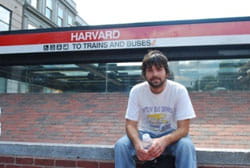 Was this decision to live among the homeless for the summer an expression of your faith? Did you see this as a part of the imitation of Christ?
This is a very good question. And the answer is not black and white. In some ways I would answer affirmatively. My decision to temporarily live among the homeless was borne out of several aspects of the story of who I am. It was most directly borne out of my research about local homeless issues. My research focused on the social networks of the local homeless community and how Jesus-followers in the mainstream can bond with homeless individuals in ways that can -- specifically spiritually and emotionally -- benefit all parties involved in the relational exchange.
My desire was to live on the streets this summer and ultimately write about the experience. I wanted to experience first-hand, and share from an insider's perspective, what the homeless life is like. By sharing with others a glimpse into a homeless community, I believe that people can gain a better understanding of the realities of those who are often invisible or looked down upon -- and value their humanity, as well.
Everyone's little story is rooted in a greater narrative, and I have been influenced by authors and Christian social justice advocates who teach about loving and living with the poor. These ideas have influenced me and guided me to think differently about the action, purpose, and work of Christians and the church. And as I think about my interest in homelessness (and even ideas I have had in the past of what it would be like to actually experience homelessness), I think back to the brief times I spent ministering and hanging with the homeless during two spring break trips to Atlanta.
In August 2008, a few months after my last trip to Atlanta, I considered with a couple buddies the idea of traveling to Atlanta for one week to "be homeless." It seemed like such a formidable experience. The experience would help us understand the plight of those with whom we had come into contact. The idea never came to fruition, but was something that was interesting to think about. Another experience that influenced me about personally identifying with the homeless was an experience that some of my college friends pursued several years ago. They stayed outside around our campus at Anderson University for one week, not eating in the dining hall or showering. They relied on the good graces of friends to share food and other provisions with them. For these guys, it was both a time to become personally aware of what homelessness might be like (it was cold that week), and also to increase awareness of homelessness among the university's students.
As I concluded my research at the Divinity School, I considered how I might turn it into something that would be read on a broader scale. I felt passionate about encouraging people in the mainstream -- specifically Christians -- to build relationships with the poor. I wish for Christians to overtly love the unloved and be Christ to the outcast.
I see homelessness as one local example of impoverishment. (No, not all homeless people are impoverished -- at least financially! When I think about terms like "poor" or "impoverishment" I also think about social capital.) I believe it is important for those in the mainstream to seek relationships with those who are clearly outside of the mainstream (although many of the homeless in Harvard Square could be easily mistaken for "regular" people in the mainstream; very few of them would likely be identified as homeless). My concern about relationships with the poor extends beyond issues of American homelessness. As one author who has influenced me said, "It's not that we don't care about the poor, it's that we don't know them."
So this is a long introduction to my response to the first question. Yes, my decision to live among the homeless for the summer was an expression of my faith. But, it was not solely an expression of my faith, nor was it primarily an expression of my faith. It was, as I described it this summer: 1) for the purpose of attempting to get a taste of what the homeless life was about, and 2) to gain experiences that I can share with others as I encourage others to build relationships with the poor and homeless. Both of these reasons are rooted in my faith. To borrow some words from one of my professors, I wish to humanize a population that has become, at least in some ways, de-humanized; and disrupt stereotypes that are often not only unnecessary, but inaccurate. Yes, these desires ultimately link to my faith.
Article Continued On Next Page
Page: 1 of 2
10/9/2009 4:00:00 AM
Faith on Campus
Society
Christianity
Evangelicalism
more at patheos
1

"The Tests of Abraham and Sarah"
2

3

William Tyndale And The 1526 English Bible: 500 years later
4
An Ecological Stations of the Cross, 2026

About Timothy Dalrymple
Timothy Dalrymple is the CEO and Chief Creative Officer of Polymath Innovations, a strategic storytelling agency that advances the good with visionary organizations and brands. He leads a unique team of communicators from around North America and across the creative spectrum, serving mission-driven businesses and nonprofits who need a partner to amplify their voice and good works. Once a world-class gymnast whose career ended with a broken neck, Tim channeled his passions for faith and storytelling into his role as VP of Business Development for Patheos, helping to launch and grow the network into the world's largest religion website. He holds a Ph.D. in Religion from Harvard's Graduate School of Arts and Sciences. Tim blogs at Philosophical Fragments.
Patheos Explore the world's faith through different perspectives on religion and spirituality! Patheos has the views of the prevalent religions and spiritualities of the world.
Ad-Free & Subscriber Log-In Subscription Support
- About Us
- 2026 Calendar
- Videos
- Podcasts
- Library of World Religions
- Faith In Media Tracker
- Advertise With Us
- Write for Us
- Privacy Policy
- Terms of Service
- Do Not Sell My Data
- Contact Us
- Radiant Digital
- Manage Newsletter Subscriptions
- Unsubscribe From Notifications
- Sitemap
Copyright 2008-2026, Patheos. All rights reserved.
Subscription Support Ad-Free & Subscriber Log-In
Follow Patheos