
BuddhistCatholicContemplativeEvangelicalGeneral ChristianHinduJewishLatter-day SaintMuslimNew VisionsProgressive Christian
Beliefs
- Buddhist
- Catholic
- Contemplative
- Evangelical
- General Christian
- Hindu
- Jewish
- Latter-day Saint
- More Voices
- Muslim
- New Visions
- Pagan
- Progressive Christian
Topics
- Religion News
- Food and Religion
- Sports and Religion
- Religious Art
- Religious Music and Entertainment
- Religious Events
- History and Religion
- Style and Religion
- Politics and Religion
- Women in Religion
- Recreation Outdoors and Religion
- Business Finance and Religion
- Careers Workplace and Religion
- Education and Religion
- Family Parenting and Religion
- Health Fitness and Religion
- Home and Religion
- Relationships and Religion
- Technology and Religion
- Travel and Religion
Columnists
- Buddhist Columnists
- Business Finance and Religion Columnists
- Careers Workplace and Religion Columnists
- Catholic Columnists
- Contemplative Columnists
- Education and Religion Columnists
- Evangelists Columnists
- Family Parenting and Religion Columnists
- General Christian Columnists
- Health Fitness and Religion Columnists
- Hindu Columnists
- History and Religion Columnists
- Home and Religion Columnists
- Jewish Columnists
- More Voices Columnists
- Latter Day Columnists
- Muslim Columnists
- New Visions Columnists
- Nonreligious Columnists
- Pagan Columnists
- Politics and Religion Columnists
- Progressive Columnists
- Recreation Outdoors and Religion Columnists
- Relationships and Religion Columnists
- Religion News Columnists
- Religious Art Columnists
- Religious Events Columnists
- Religious Music and Entertainment Columnists
- Sports and Religion Columnists
- Style and Religion Columnists
- Technology and Religion Columnists
- Travel and Religion Columnists
- Women in Religion Columnists
Resource Library
- 2026 Calendar
- Library of World Religions
- The 100 Most Holy Places on Earth
- Patheos Answers
- Podcasts
- Videos
- Faith Leaders Database
- Anglican Episcopalian
- Bahai
- Baptist
- Buddhism
- Christianity
- Confucianism
- Eastern Orthodoxy
- Hinduism
- Holiness and Pentecostal
- ISKCON
- Islam
- Judaism
- Lutheran
- Methodist
- The Church of Jesus Christ of Latter-day Saints
- New Age
- Paganism
- Presbytarian and Reformed
- Protestantism
- Religion Behind the Scenes
- Roman Catholic
- Scientology
- Shia Islam
- Sikhism
- Sufism
- Sunni Islam
- Taoism
- Zen
- See all religions
Research Tools
 Ad-Free & Subscriber Log-In Subscription Support
Follow Patheos 

- Trending:
- Advent
- |
- Forgiveness
- |
- Thanksgiving
- |
- Election
- |
- Seasonal Holidays
- |
- Marriage
Progressive Christian
Prophecy and Public Policy
June 17, 2012 by Frederick Schmidt
There are connections between public policy and the prophetic tradition. I also think that our religious and spiritual commitments should shape our contribution to the public sphere. But the challenges are very different in our world than they were in ancient Israel.
In ancient Israel, to be the people of God was to believe something about the nation that was religious in nature, and to say something about the nation's religion was to say something intrinsically political. The way in which we think about and distinguish between religion and politics would have been unintelligible to the Israelites.
The problem of applying the prophetic tradition to public policy is further complicated by the fact that "the prophetic tradition" was not a free-floating body of values and commitments. It had its roots in certain convictions about Israel, the covenant with God, and a way of life required by the covenant. "The prophetic tradition" also presupposed that the nation should live into that covenant—that is, the nation was to become more thoroughly and completely the people of God.
The socio-political context in which we live is radically different. We distinguish between the religious and the political. We declare the religious sphere free of political interference and we resist overt religious interference in the public sphere.
The Constitution establishes freedom for religion, but it does not enshrine any one version of it. And while there are people who argue that there are certain divinely ordered ways of living that should shape our national life, we do not live in a Jewish or Christian nation, nor is there any sense in which our nation could be described as the people of God.
We are left at a complex intersection in history. Arguably, ancient Judaism practiced religion and politics as a seamless whole. Early Christianity practiced its faith with little illusion about its ability to shape the affairs of the Roman Empire. Constantine marked a brief period of time in which religious and political life flirted with reunion. And the medieval church struggled in an environment in which the church's religious authority trumped political power. Now the two belong to separate spheres and we live in an Erastian era in which, if there is any relationship at all between the religious and political, western Christian leaders assume political authority trumps the spiritual authority of the church.
As such, the prophetic tradition is without the God-given and covenantal environment that nurtured it and it is also without the telos, or goal, to which it was devoted. Even if the United States lived in close conformity to what any of us believe are "prophetic values" it still would not correspond to what the prophets had in mind.
Arguably, the church—a.k.a., the people of God—could or should be that telos or goal of that prophetic vision for Christians. Here theologians like Stanley Hauerwas are right. A church shaped by a prophetic vision is or should understand itself to be a sect: a socially and individually defining experience that distinguishes its members from everyone around it and witnesses to the rest of the culture. But on that score the mainline church is often nothing of the sort. It doesn't want to be that kind of community and its membership does not want to cede that kind of energy and time to the experience. Instead, on balance, mainline Christianity is comfortable with assuming its respectable place alongside the rest of society's sane, sober, and safely predictable institutions—holding an occasional position that gestures toward a different way of life, but rarely challenging the political norms.
The other problem is this: We mainline clergy don't want to be that kind of prophetic witness either. Better to go on preaching the prophetic word, well dressed, well heeled, and ensconced in middle class neighborhoods dotted across the country and comforted by the fact that the right stickers are on the back of the bumper.
Don't get me wrong. I would perish under the same criticism. Likewise, I don't know how we get from where we are in terms of our social and religious setting to what I have outlined above in theological terms as authentic prophetic witness.
It might be better to grant that we can only be socially engaged—that prophetic preaching is an artifact of the past or as rare as martyrs. If that's the case we might insist on these things:
1) Think faithfully (i.e., theologically about these issues, taking, as much as possible, God's perspective), examining both our political and economic assumptions.
2) Eschew all political points of view offered by the culture around us and insist that theological perspective govern our engagement. Partnerships with both the left and right are just a deal with Egypt anyway and their chariots are sure to fail us.
3) Acknowledge, preach, and insist that the people of God avoid identifying their moral and social obligation with political activity, knowing that not only will the results be fragmentary, but the nation will never be the people of God and can't be in a setting as pluralistic as ours.
4) Be honest about where we are at the moment as a church—which is something well less than an alternative community, but which might point in some broken and fragile fashion to a different way of being.
The alternative, of course, is to become a completely different kind of church.
6/17/2012 4:00:00 AM
Progressive Christian
The Spiritual Landscape
History
politics
Progressive Christianity
Social Justice
Spirituality
Christianity
more at patheos
1

The Bloody Road to Castle Dracula
2
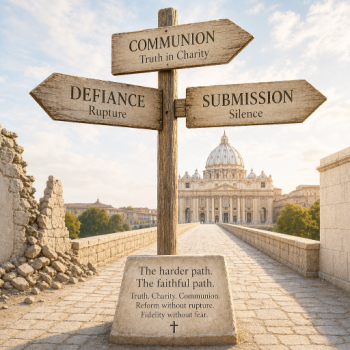
The Limits of Dissent: Pentin's Interview with Kwasniewski
3

A Word On the 2026 Catholic Voters' Shift Towards Democrats
4

God without Sin... for Children

About Frederick Schmidt
Frederick W. Schmidt is the author of The Dave Test: A Raw Look at Real Life in Hard Times (Abingdon Press: 2013) and several other books, including A Still Small Voice: Women, Ordination and the Church (Syracuse University Press, 1998), The Changing Face of God (Morehouse, 2000), When Suffering Persists (Morehouse, 2001), in Italian translation: Sofferenza, All ricerca di una riposta (Torino: Claudiana, 2004), What God Wants for Your Life (Harper, 2005), Conversations with Scripture: Revelation (Morehouse, 2005) and Conversations with Scripture: Luke (Morehouse, 2009). He holds the Rueben P. Job Chair in Spiritual Formation at Garrett-Evangelical Theological Seminary in Evanston, IL, and directs the Job Institute for Spiritual formation. He is an Episcopal Priest, spiritual director, retreat facilitator, conference leader, writer, and Consulting Editor at Church Publishing in New York. He and his wife, Natalie live in Chicago, Illinois. He can also be reached at: http://frederickwschmidt.com/
Patheos Explore the world's faith through different perspectives on religion and spirituality! Patheos has the views of the prevalent religions and spiritualities of the world.
Ad-Free & Subscriber Log-In Subscription Support
- About Us
- 2026 Calendar
- Videos
- Podcasts
- Library of World Religions
- Faith In Media Tracker
- Advertise With Us
- Write for Us
- Privacy Policy
- Terms of Service
- Do Not Sell My Data
- Contact Us
- Radiant Digital
- Manage Newsletter Subscriptions
- Unsubscribe From Notifications
- Sitemap
Copyright 2008-2026, Patheos, part of the Radiant Digital network of media brands. All rights reserved.
Subscription Support Ad-Free & Subscriber Log-In
Follow Patheos