
BuddhistCatholicContemplativeEvangelicalGeneral ChristianHinduJewishLatter-day SaintMuslimNew VisionsProgressive Christian
Beliefs
- Buddhist
- Catholic
- Contemplative
- Evangelical
- General Christian
- Hindu
- Jewish
- Latter-day Saint
- More Voices
- Muslim
- New Visions
- Pagan
- Progressive Christian
Topics
- Religion News
- Food and Religion
- Sports and Religion
- Religious Art
- Religious Music and Entertainment
- Religious Events
- History and Religion
- Style and Religion
- Politics and Religion
- Women in Religion
- Recreation Outdoors and Religion
- Business Finance and Religion
- Careers Workplace and Religion
- Education and Religion
- Family Parenting and Religion
- Health Fitness and Religion
- Home and Religion
- Relationships and Religion
- Technology and Religion
- Travel and Religion
Columnists
- Buddhist Columnists
- Business Finance and Religion Columnists
- Careers Workplace and Religion Columnists
- Catholic Columnists
- Contemplative Columnists
- Education and Religion Columnists
- Evangelists Columnists
- Family Parenting and Religion Columnists
- General Christian Columnists
- Health Fitness and Religion Columnists
- Hindu Columnists
- History and Religion Columnists
- Home and Religion Columnists
- Jewish Columnists
- More Voices Columnists
- Latter Day Columnists
- Muslim Columnists
- New Visions Columnists
- Nonreligious Columnists
- Pagan Columnists
- Politics and Religion Columnists
- Progressive Columnists
- Recreation Outdoors and Religion Columnists
- Relationships and Religion Columnists
- Religion News Columnists
- Religious Art Columnists
- Religious Events Columnists
- Religious Music and Entertainment Columnists
- Sports and Religion Columnists
- Style and Religion Columnists
- Technology and Religion Columnists
- Travel and Religion Columnists
- Women in Religion Columnists
Resource Library
- 2026 Calendar
- Library of World Religions
- The 100 Most Holy Places on Earth
- Patheos Answers
- Podcasts
- Videos
- Faith Leaders Database
- Anglican Episcopalian
- Bahai
- Baptist
- Buddhism
- Christianity
- Confucianism
- Eastern Orthodoxy
- Hinduism
- Holiness and Pentecostal
- ISKCON
- Islam
- Judaism
- Lutheran
- Methodist
- The Church of Jesus Christ of Latter-day Saints
- New Age
- Paganism
- Presbytarian and Reformed
- Protestantism
- Religion Behind the Scenes
- Roman Catholic
- Scientology
- Shia Islam
- Sikhism
- Sufism
- Sunni Islam
- Taoism
- Zen
- See all religions
Research Tools
 Ad-Free & Subscriber Log-In Subscription Support
Ad-Free & Subscriber Log-In Subscription Support
Follow Patheos 

- Trending:
- Forgiveness
- |
- Marriage
- |
- Consciousness
- |
- Death Penalty
- |
- Election
- |
- Halloween
RELIGION LIBRARY
Taoism
Toggle navigation
Rituals and Worship
Sacred Space
Sacred space and sacred time are one in Taoism. The ritual space that is created by the Taoshi symbolizes the cosmos and links heaven and earth. It is always created just before the ritual begins, whether the ritual takes place outdoors, in the home of a layperson, or inside a temple. It is a sacred area created for the purpose of the ritual, and then returned to ordinary space at the ritual's end.
A contemporary ritual structure, used today in southern Taiwan in a Way of the Celestial Masters ritual, begins with a square, each of the four sides representing north, south, east, and west. The square is divided into an inner and an outer altar, the inner to the north and the outer to the south. Just within the boundary to the north are hung portraits of the presiding deities. These may include the Heavenly Worthy of the Primordial Beginning, the Heavenly Worthy of the Numinous Treasure, the Heavenly Worthy of the Way and its Power (the deified Laozi), the Jade Emperor, and the Great Emperor of the Purple Empyrean. These are the deities of highest rank.
A table located just to the south of these portraits is the Golden Gate, a threshold, and below that is the "cave table," where the heart of the ritual will take place.
Portraits are hung along the east and west boundaries. Along the west, within the inner altar area, are the gods of earth and hell, and along the east, the gods of heaven and water. Along the eastern boundary of the outer altar area are portraits of Taoist officers and generals and the Four Saints and along the east, officers and generals and the Six Masters. The officers and generals include the Mother of Lightning, the Duke of Thunder, the marshals of the four directions, and other martial and protective deities. The identity of the Four Saints varies; sometimes they are the Emperors of the four directions. The Six Masters include Zhang Taoling and other Celestial Masters. These are the mid-ranking deities.
Just within the southern boundary is the Three Realms Table (the Three Realms include various lesser heavens). Offerings for the popular gods are placed here, and behind it are bleachers on which deities that are brought from people's homes and deities from temples are placed so that they can observe the ritual. These are the deities of lowest rank.
The officiating priests, including those who recite the liturgies, are located around the cave table, and the musicians are to the east and west. A few high ranking laypersons may attend, or they may be represented by lanterns hung along the south wall.
The hierarchy of participants, including the gods, is evident in this arrangement. This hierarchical structure, the titles of the members of the pantheon, and the ritual itself are all elements taken from Han religion, which was based on Shang and Zhou religious practices.
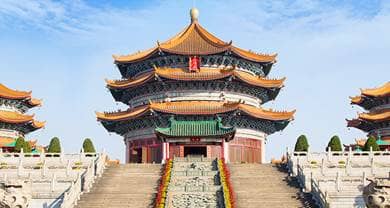
The sacred spaces created by Taoist priests for rituals are not the only sacred spaces in Taoism. There are also geographical locations imbued with sacred energy. The most notable of these are the five sacred mountains of Taoism, which are located in the north (Hengshan in Shanxi province), south (also called Hengshan, but this Heng is a different word, in Hunan), east (Taishan in Shandong), west (Huashan in Shaanxi), and center (Songshan in Henan). Other mountains are considered sacred as well, some more notable than the five, such as Mao Shan and Longhu Shan, headquarters for Shangqing and Zhengyi Taoism respectively, or Zhongnan Shan, where the founder of Quanzhen Taoism had a hermitage and had contact with divine beings. Other mountains, like Kunlun, are believed to be the dwelling places of immortals.
Caves and grottoes are also thought to be sacred. There are countless caves and grottoes within the mountains of China, and among them are many that are occupied by hermits and Taoist adepts.
The central altar for Taoist ritual is also called a cave, but it is understood that at the same time it is a mountain. At this altar, the Taoshi goes within/rises to the peak as he undertakes a mystical journey on behalf of all. The ritual brings the participants back to the state of the cosmos before time, space, and matter had been differentiated.
Study Questions:
1. Why are sacred space and sacred time inseparable?
2. Why is a sense of direction (north, south, east, west) important in performing the Way of the Celestial Masters ritual?
3. Why do certain geographical locations and natural formations function as sacred sites?
Back to Religion Library
Editor's picks See all columnists

Evangelical
Before You Unplug or Sign Out for Good

Evangelical
What Is the Purpose of Spiritual Gifts, and How Do You Discover Yours?

New Visions
5 Ways to Hear What God is Telling You

Muslim
How Awake Are We? When Waking Up is Falling Asleep

Latter-day Saint
"The Church supports the use of vaccinations"

Evangelical
Luther and the Beauty of Christ

The Soul of Gospel Music Explored in New Netflix Series "Voices of Fire"

Seven Ways to Think About Christian Mysticism
Evangelical

Evangelical

Muslim
Imam Ali’s letter to the Governor- Everlasting Example of Good...

Progressive Christian
Patheos Explore the world's faith through different perspectives on religion and spirituality! Patheos has the views of the prevalent religions and spiritualities of the world.
Ad-Free & Subscriber Log-In Subscription Support
- About Us
- 2026 Calendar
- Videos
- Podcasts
- Library of World Religions
- Faith In Media Tracker
- Advertise With Us
- Write for Us
- Privacy Policy
- Terms of Service
- Do Not Sell My Data
- Contact Us
- Radiant Digital
- Manage Newsletter Subscriptions
- Unsubscribe From Notifications
- Sitemap
Copyright 2008-2026, Patheos. All rights reserved.
Subscription Support Ad-Free & Subscriber Log-In
Follow Patheos