
BuddhistCatholicContemplativeEvangelicalGeneral ChristianHinduJewishLatter-day SaintMuslimNew VisionsProgressive Christian
Beliefs
- Buddhist
- Catholic
- Contemplative
- Evangelical
- General Christian
- Hindu
- Jewish
- Latter-day Saint
- More Voices
- Muslim
- New Visions
- Pagan
- Progressive Christian
Topics
- Religion News
- Food and Religion
- Sports and Religion
- Religious Art
- Religious Music and Entertainment
- Religious Events
- History and Religion
- Style and Religion
- Politics and Religion
- Women in Religion
- Recreation Outdoors and Religion
- Business Finance and Religion
- Careers Workplace and Religion
- Education and Religion
- Family Parenting and Religion
- Health Fitness and Religion
- Home and Religion
- Relationships and Religion
- Technology and Religion
- Travel and Religion
Columnists
- Buddhist Columnists
- Business Finance and Religion Columnists
- Careers Workplace and Religion Columnists
- Catholic Columnists
- Contemplative Columnists
- Education and Religion Columnists
- Evangelists Columnists
- Family Parenting and Religion Columnists
- General Christian Columnists
- Health Fitness and Religion Columnists
- Hindu Columnists
- History and Religion Columnists
- Home and Religion Columnists
- Jewish Columnists
- More Voices Columnists
- Latter Day Columnists
- Muslim Columnists
- New Visions Columnists
- Nonreligious Columnists
- Pagan Columnists
- Politics and Religion Columnists
- Progressive Columnists
- Recreation Outdoors and Religion Columnists
- Relationships and Religion Columnists
- Religion News Columnists
- Religious Art Columnists
- Religious Events Columnists
- Religious Music and Entertainment Columnists
- Sports and Religion Columnists
- Style and Religion Columnists
- Technology and Religion Columnists
- Travel and Religion Columnists
- Women in Religion Columnists
Resource Library
- 2026 Calendar
- Library of World Religions
- The 100 Most Holy Places on Earth
- Patheos Answers
- Podcasts
- Videos
- Faith Leaders Database
- Anglican Episcopalian
- Bahai
- Baptist
- Buddhism
- Christianity
- Confucianism
- Eastern Orthodoxy
- Hinduism
- Holiness and Pentecostal
- ISKCON
- Islam
- Judaism
- Lutheran
- Methodist
- The Church of Jesus Christ of Latter-day Saints
- New Age
- Paganism
- Presbytarian and Reformed
- Protestantism
- Religion Behind the Scenes
- Roman Catholic
- Scientology
- Shia Islam
- Sikhism
- Sufism
- Sunni Islam
- Taoism
- Zen
- See all religions
Research Tools
 Ad-Free & Subscriber Log-In Subscription Support
Ad-Free & Subscriber Log-In Subscription Support
Follow Patheos 

- Trending:
- Forgiveness
- |
- Marriage
- |
- Consciousness
- |
- Death Penalty
- |
- Election
- |
- Halloween
RELIGION LIBRARY
Roman Catholicism
Toggle navigation
History
Early Developments
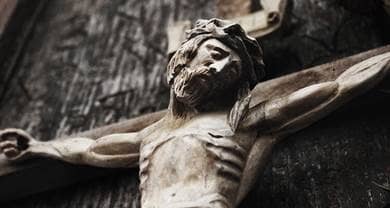
Starting from Jesus' own Jewish heritage, Christianity established a distinct entity within a few decades after his public life, crucifixion, and resurrection. Christianity drew on this Jewish heritage as well as the structures of the Roman Empire and the Hellenistic Greek philosophy prevailing in the Middle East at the time.
The new faith began to spread from Jewish synagogues to Roman provincial sites, often through open-air preaching by Jesus' first apostles and then their successors who were successively handing down the faith. As early as 40 C.E., after just a decade had passed since Jesus' ministry, the phrase Christianoi (followers of Christ) was heard in Antioch. Before long, an archipelago of churches--that is, communities of Christians bound closely to each other in one location but fairly loosely from one place to another--had developed along the Mediterranean basin. The spread of Christianity was an urban phenomenon that traveled along Roman roads and flourished in Roman population centers. By early in the 2nd century, a local leader named Ignatius could use the word catholicity (from Greek katholikos, universal) to describe how Christianity was already found in the universal Roman world as defined at that time.
We call this early period the apostolic age, when Jesus' first disciples (students), now apostles (teachers) in their own right, preached the good news of salvation. This is the age described in the New Testament and represents the century during which gospels, epistles, and other books comprising Christian scripture were composed. A sub-apostolic ("after the apostolic") age followed that, in turn, led to an expanding circuit of churches not only in Roman provincial cities in the Mediterranean area, but also moving inland and northward into Europe. As it spread west and north, Christianity developed a strong Latin basis and began to be separated from its eastern, Greek roots. This led to some linguistic difficulties in describing complex theological concepts--such as Jesus' humanity and divinity, his place in the Trinity, and Mary's position as mother of the human Jesus and the Son of God--in ways that were commonly accessible.
In the next few centuries, the new faith was a persecuted, illegal, and often necessarily underground religion. Roman officials considered Christians to be atheists because they didn't worship Greco-Roman gods, and subversive traitors, because Roman religion was closely tied to support of the state. Persecution, however, was not constant but came in waves. Nero, for instance, blamed Christians for the huge Roman fire that he himself may have instigated in 64 C.E. Both Peter and Paul were killed in the city-wide persecution in the four years that followed, which included Christians being tied to posts and burned alive to provide light for Nero as he strolled through his gardens. Still, relative toleration ensued: in the early 2nd century, the emperor Trajan instructed a provincial governor named Pliny the Younger that Christians were not to be hunted out and could be tried only with direct and open evidence.
By the late 2nd century, Christianity had spread rapidly and particularly among women, slaves, and artisans--the lower and less privileged segments of the Roman population. Each time Rome imperial control waned, largely because of poor economic conditions, leadership, or military danger, Christians were often scapegoated as atheists. In 201, Rome declared converting to Christianity or Judaism to be a capital offense.
There were empire-wide, systematic persecutions in the middle of the 3rd century under the emperors Decius and Valerius. Emperor Diocletian ordered what was the worst and largest persecution, in 303-305, when Christianity stood nearly on the brink. Diocletian hunted out and dismissed clandestine Christians in imperial service, confiscated liturgical objects, burned scriptures, and leveled meeting places.
It was at this point that Constantine, moving toward total domination, gained the victory at the Battle of the Milvian Bridge in 312 and attributed it to Jesus. The next year, his Edict of Milan permitted Christianity to be tolerated and even favored among other religions. Constantine endowed the Church with property, buildings, and perhaps land, a step toward an imperial Church that looked increasingly Roman in style and administration-a development with both advantages as well as disadvantages. In 380, Theodosius finally declared Christianity to be the one and only religion permitted in the Roman Empire, turning the tables by declaring all other religions, including the Greco-Roman system that had been the norm for a millennium, to be pagan, atheistic, illegal, and traitorous.
Study Questions:
1. How was Christianity originally spread?
2. What events occurred during the apostolic age? The sub-apostolic age?
3. Why were Christians persecuted (during Christianity’s infancy)?
4. How did political opinions of Christianity evolve over the 3rd and 4th centuries?
Back to Religion Library
Editor's picks See all columnists

Evangelical
Before You Unplug or Sign Out for Good

Evangelical
What Is the Purpose of Spiritual Gifts, and How Do You Discover Yours?

New Visions
5 Ways to Hear What God is Telling You

Muslim
How Awake Are We? When Waking Up is Falling Asleep

Latter-day Saint
"The Church supports the use of vaccinations"

Evangelical
Luther and the Beauty of Christ

The Soul of Gospel Music Explored in New Netflix Series "Voices of Fire"

Seven Ways to Think About Christian Mysticism

Evangelical

Evangelical

Muslim
Imam Ali’s letter to the Governor- Everlasting Example of Good...

Progressive Christian
Patheos Explore the world's faith through different perspectives on religion and spirituality! Patheos has the views of the prevalent religions and spiritualities of the world.
Ad-Free & Subscriber Log-In Subscription Support
- About Us
- 2026 Calendar
- Videos
- Podcasts
- Library of World Religions
- Faith In Media Tracker
- Advertise With Us
- Write for Us
- Privacy Policy
- Terms of Service
- Do Not Sell My Data
- Contact Us
- Radiant Digital
- Manage Newsletter Subscriptions
- Unsubscribe From Notifications
- Sitemap
Copyright 2008-2026, Patheos. All rights reserved.
Subscription Support Ad-Free & Subscriber Log-In
Follow Patheos