
BuddhistCatholicContemplativeEvangelicalGeneral ChristianHinduJewishLatter-day SaintMuslimNew VisionsProgressive Christian
Beliefs
- Buddhist
- Catholic
- Contemplative
- Evangelical
- General Christian
- Hindu
- Jewish
- Latter-day Saint
- More Voices
- Muslim
- New Visions
- Pagan
- Progressive Christian
Topics
- Religion News
- Food and Religion
- Sports and Religion
- Religious Art
- Religious Music and Entertainment
- Religious Events
- History and Religion
- Style and Religion
- Politics and Religion
- Women in Religion
- Recreation Outdoors and Religion
- Business Finance and Religion
- Careers Workplace and Religion
- Education and Religion
- Family Parenting and Religion
- Health Fitness and Religion
- Home and Religion
- Relationships and Religion
- Technology and Religion
- Travel and Religion
Columnists
- Buddhist Columnists
- Business Finance and Religion Columnists
- Careers Workplace and Religion Columnists
- Catholic Columnists
- Contemplative Columnists
- Education and Religion Columnists
- Evangelists Columnists
- Family Parenting and Religion Columnists
- General Christian Columnists
- Health Fitness and Religion Columnists
- Hindu Columnists
- History and Religion Columnists
- Home and Religion Columnists
- Jewish Columnists
- More Voices Columnists
- Latter Day Columnists
- Muslim Columnists
- New Visions Columnists
- Nonreligious Columnists
- Pagan Columnists
- Politics and Religion Columnists
- Progressive Columnists
- Recreation Outdoors and Religion Columnists
- Relationships and Religion Columnists
- Religion News Columnists
- Religious Art Columnists
- Religious Events Columnists
- Religious Music and Entertainment Columnists
- Sports and Religion Columnists
- Style and Religion Columnists
- Technology and Religion Columnists
- Travel and Religion Columnists
- Women in Religion Columnists
Resource Library
- 2026 Calendar
- Library of World Religions
- The 100 Most Holy Places on Earth
- Patheos Answers
- Podcasts
- Videos
- Faith Leaders Database
- Anglican Episcopalian
- Bahai
- Baptist
- Buddhism
- Christianity
- Confucianism
- Eastern Orthodoxy
- Hinduism
- Holiness and Pentecostal
- ISKCON
- Islam
- Judaism
- Lutheran
- Methodist
- The Church of Jesus Christ of Latter-day Saints
- New Age
- Paganism
- Presbytarian and Reformed
- Protestantism
- Religion Behind the Scenes
- Roman Catholic
- Scientology
- Shia Islam
- Sikhism
- Sufism
- Sunni Islam
- Taoism
- Zen
- See all religions
Research Tools
 Ad-Free & Subscriber Log-In Subscription Support
Ad-Free & Subscriber Log-In Subscription Support
Follow Patheos 

- Trending:
- Forgiveness
- |
- Marriage
- |
- Consciousness
- |
- Death Penalty
- |
- Election
- |
- Halloween
RELIGION LIBRARY
Roman Catholicism
Toggle navigation
Beliefs
Afterlife and Salvation
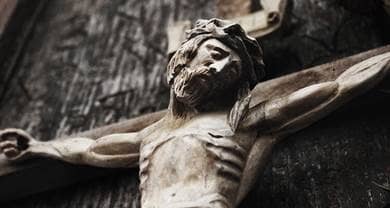
In Catholic Christian understanding, all of human history is geared toward salvation. Humans are trapped by their own sinfulness in bondage to death, but God became incarnate in Jesus and broke the bondage, allowing those who believe in Christ to be saved from their fate of death. Salvation is a gift from God, given not as payment for good actions but as freely given grace.
Unlike some Christian groups who focus on individual election, the idea that God chose in the beginning of time those persons who would be granted salvation, Catholics believe in corporate salvation. This refers to the belief that God grants salvation through the medium of the Church to all who participate in it. Catholics have long affirmed that there is no salvation outside the Church and traditionally this has been understood to mean that all those who are not in communion with the Catholic Church cannot be saved. More recently, though, the understanding of what is means to be outside the Church has shifted: Catholics believe that the Church is the sign of God's presence in the world, that all those who come to God do so through the medium of the Church even when they themselves do not recognize the Catholic Church's role in their salvation.
Catholics see a close connection between salvation and atonement, which is the way that God comes to forgive human sin through the actions of Jesus the Christ. Many theories have been proposed about how this happens, but the two most influential in Catholic understanding are that Christ paid a ransom to Satan and that Christ offered himself as a substitute to God. A number of writers in the early Church, especially Origen (185-254), talked about the atonement as a ransom; they believed that humans were in bondage to Satan, deserving death because of their sins. Since Jesus lived a perfect and sinless life, he owed nothing to Satan but allowed himself to suffer death anyway, ransoming the souls of all of humanity by breaking Satan's claim to own them due to sinfulness. St. Anselm (1033-1109) gave the classic formulation of the substitution theory. He said that humans owe God a perfect life but are unable to deliver it because of their sinfulness. God became incarnate in Jesus and lived a perfect life, meaning that he owed nothing more to God, but he freely chose to accept death. With this action he created such a surplus of obedience and honor that he repaid to God all that humans had been or would be unable to pay. Thus he substituted his obedience for their sinfulness.
Atonement allows God to grant salvation to humans who are not in themselves worthy of it. Salvation is experienced in this life as a reweaving of the human-divine relationship that was broken with sin, and beyond death as a new life lived in communion with God in heaven.
In traditional Catholic understanding, the human retains individuality beyond death and goes on to experience one of three states of being: heaven, purgatory, or hell. Heaven is the place of perfect peace and joy, a place where humans join the angels in having direct knowledge of God and praising God through eternity. It is the hope and desire of all Catholics to reach heaven and exist in this perfection, but they generally believe that most souls are not cleansed enough of sin in this lifetime to be ready for heaven and instead will enter an interim state called purgatory.
Purgatory is, as its name suggests, a place of purgation. Christ's death may have opened the way for humans to receive salvation and attain heaven, but their souls are still warped by the sins they have committed. In order to purify their souls, humans pass through purgatory, where they endure severe punishment and in the process become cleansed of sin and its ill effects. All humans who enter purgatory will eventually pass from it into heaven, but they will spend differing amounts of time in the purgatorial fire depending on how warped their souls became due to sin.
The souls of those who are too corrupted with sin and who continue in disobedience to God until death cannot be cleansed even in the fires of purgatory and will instead choose hell. Hell has traditionally been thought of as a place of unending torment but is now more commonly seen as the state of being totally removed from the goodness of God's presence. Theologians today talk about the suffering of souls in hell less in physical and more in psychic terms: the soul's endless sorrow at an eternity spent away from the source of all good and truth, with no possibility of a reprieve.
Study Questions:
1. What is corporate salvation?
2. Why is the Church, as opposed to the title “Catholic,” crucial for salvation?
3. How do Catholics understand atonement?
4. What is purgatory? Is it a final destination for Catholic souls?
Back to Religion Library
Editor's picks See all columnists

Evangelical
Before You Unplug or Sign Out for Good

Evangelical
What Is the Purpose of Spiritual Gifts, and How Do You Discover Yours?

New Visions
5 Ways to Hear What God is Telling You

Muslim
How Awake Are We? When Waking Up is Falling Asleep

Latter-day Saint
"The Church supports the use of vaccinations"

Evangelical
Luther and the Beauty of Christ

The Soul of Gospel Music Explored in New Netflix Series "Voices of Fire"

Seven Ways to Think About Christian Mysticism

Evangelical

Evangelical

Muslim
Imam Ali’s letter to the Governor- Everlasting Example of Good...

Progressive Christian
Patheos Explore the world's faith through different perspectives on religion and spirituality! Patheos has the views of the prevalent religions and spiritualities of the world.
Ad-Free & Subscriber Log-In Subscription Support
- About Us
- 2026 Calendar
- Videos
- Podcasts
- Library of World Religions
- Faith In Media Tracker
- Advertise With Us
- Write for Us
- Privacy Policy
- Terms of Service
- Do Not Sell My Data
- Contact Us
- Radiant Digital
- Manage Newsletter Subscriptions
- Unsubscribe From Notifications
- Sitemap
Copyright 2008-2026, Patheos. All rights reserved.
Subscription Support Ad-Free & Subscriber Log-In
Follow Patheos