
BuddhistCatholicContemplativeEvangelicalGeneral ChristianHinduJewishLatter-day SaintMuslimNew VisionsProgressive Christian
Beliefs
- Buddhist
- Catholic
- Contemplative
- Evangelical
- General Christian
- Hindu
- Jewish
- Latter-day Saint
- More Voices
- Muslim
- New Visions
- Pagan
- Progressive Christian
Topics
- Religion News
- Food and Religion
- Sports and Religion
- Religious Art
- Religious Music and Entertainment
- Religious Events
- History and Religion
- Style and Religion
- Politics and Religion
- Women in Religion
- Recreation Outdoors and Religion
- Business Finance and Religion
- Careers Workplace and Religion
- Education and Religion
- Family Parenting and Religion
- Health Fitness and Religion
- Home and Religion
- Relationships and Religion
- Technology and Religion
- Travel and Religion
Columnists
- Buddhist Columnists
- Business Finance and Religion Columnists
- Careers Workplace and Religion Columnists
- Catholic Columnists
- Contemplative Columnists
- Education and Religion Columnists
- Evangelists Columnists
- Family Parenting and Religion Columnists
- General Christian Columnists
- Health Fitness and Religion Columnists
- Hindu Columnists
- History and Religion Columnists
- Home and Religion Columnists
- Jewish Columnists
- More Voices Columnists
- Latter Day Columnists
- Muslim Columnists
- New Visions Columnists
- Nonreligious Columnists
- Pagan Columnists
- Politics and Religion Columnists
- Progressive Columnists
- Recreation Outdoors and Religion Columnists
- Relationships and Religion Columnists
- Religion News Columnists
- Religious Art Columnists
- Religious Events Columnists
- Religious Music and Entertainment Columnists
- Sports and Religion Columnists
- Style and Religion Columnists
- Technology and Religion Columnists
- Travel and Religion Columnists
- Women in Religion Columnists
Resource Library
- 2026 Calendar
- Library of World Religions
- The 100 Most Holy Places on Earth
- Patheos Answers
- Podcasts
- Videos
- Faith Leaders Database
- Anglican Episcopalian
- Bahai
- Baptist
- Buddhism
- Christianity
- Confucianism
- Eastern Orthodoxy
- Hinduism
- Holiness and Pentecostal
- ISKCON
- Islam
- Judaism
- Lutheran
- Methodist
- The Church of Jesus Christ of Latter-day Saints
- New Age
- Paganism
- Presbytarian and Reformed
- Protestantism
- Religion Behind the Scenes
- Roman Catholic
- Scientology
- Shia Islam
- Sikhism
- Sufism
- Sunni Islam
- Taoism
- Zen
- See all religions
Research Tools
 Ad-Free & Subscriber Log-In Subscription Support
Ad-Free & Subscriber Log-In Subscription Support
Follow Patheos 

- Trending:
- Forgiveness
- |
- Marriage
- |
- Consciousness
- |
- Death Penalty
- |
- Election
- |
- Halloween
RELIGION LIBRARY
Paganism
Toggle navigation
Rituals and Worship
Sacred Space
Many Pagans embrace the idea that the universe is enchanted; that even the most mundane and ordinary elements of nature are, at least potentially, pregnant with spiritual power and possibility. Taken to its pantheistic or monistic extreme, Paganism celebrates all space - all of nature - as sacred or holy. But within that framework of overall immanence, particular sites or points within the natural world are revered as places of special spiritual power and worthy of reverence and veneration.
Stonehenge, Angkor Wat, Newgrange, The Pyramids of Egypt, Macchu Picchu, the Parthenon, the Great Serpent Mound - all over the world, numerous sites of ancient ceremonial and religious significance remain today as mysterious mute testaments to prehistoric or ancient spirituality. Pagans often look to such venerable monuments for inspiration in the continuing quest to revive or recreate polytheistic, goddess-centered, or earth-based devotion.
Such human-made sites often are subject to a variety of different interpretations. Some are burial grounds; others appear to be giant observatories; still others have no clear religious or ceremonial meaning. Prehistoric sites are often the subject of imaginative speculation as different theorists offer their interpretation as to the original or ultimate meaning and purpose of such sites.
In addition to sites that were clearly fashioned by human hands, other remarkable or distinctive sites throughout the earth have become subject to spiritual devotion, often because of distinguishing geographic features, but also because of metaphysical beliefs associated with such sites. Glastonbury Tor in England, the Black Hills of South Dakota, and Ki l a u e a in Hawaii are examples of spectacular sacred sites, while many less dramatic sites may be centers of regional or local veneration, such as the tradition of holy well veneration in the Celtic countries.
Such sites typically achieve status as "sacred" in the minds of devotees because of historical significance, particularly in regard to mythology or folklore. Sites associated with ancient gods or goddesses carry special significance even for latter-day Pagans. Remarkable trees, abundant water sources, and other singular features of the earth can be imbued with meaning, either received through folklore or local tradition, or even established by contemporary Pagan individuals or groups who feel drawn to find or create spiritual meaning through relationship with a particular feature of the natural world.
In addition to such physical forms of sacred space, Pagan traditions often also include metaphysical or imaginal forms of sacrality as well. These include mythic concepts of the otherworld, ritually created sacred space (such as the Wiccan "World Between the Worlds"), and even the concept of sacred space as found within each individual's own capacity for inner visualization.
Concepts of the otherworld can take many forms. Nonmaterial realms may exist above, below, or interwoven with the material world. They can exist in a variety of metaphorical locations, such as over or beneath the ocean, through the mist, or within so-called hollow hills ("fairy mounds"). The otherworld can be a place of ineffable beauty and wonder, but also a realm fraught with danger and challenge. It can be populated with gods, goddesses, ancestors, heroes and heroines, as well as spirits, elves, fairies, or other entities seen as intimately connected with nature.
Sometimes human beings can visit otherworldly realms, although myths are often vague about how such a journey can occur. Once in the otherworld, the human visitor may have a quest or sacred task to complete, may be held prisoner, or may fall in love with a beautiful otherworldly figure and then face a terrible choice between remaining with the lover or returning home to the mundane realm.
Perhaps such "otherworlds" only exist in human imagination - but even so, they can be meaningful elements within an individual's or a group's spiritual practice. Such forays into the realm of mythic imagination can be experienced as challenging, healing, inspirational, or deeply transformational.
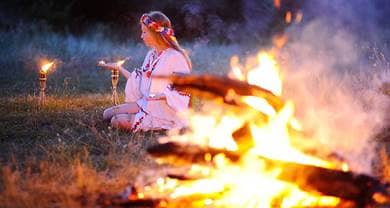
Many Pagan groups and individuals engage in magical ritual practices as part of their spiritual life. Such rituals can be devotional in nature (offering love, honor, and worship to gods, ancestors, or nature spirits) or thaumaturgical (attempting to create real change in the world through magical means). In some Pagan traditions, performing a sacred ritual involves establishing a bounded space (often a circle) in which the energy of the ceremony occurs. This space is understood as having a magical quality that sets it apart from the rest of the physical universe. In Wicca, for example, such magically inscribed ritual circles are said to create a world "between the worlds" - a spiritual locus between the material and the spiritual realms, allowing access to both planes. Unlike other faith traditions where rituals need to be performed in relation to a specific physical location (such as a church or a temple), the magical circle is, in essence, a portable sacred space that can by psychically created with each new ritual and then dismantled when the ritual is finished.
Pagans do not seek to create a rigid distinction between what is and is not sacred, but rather to anchor a cosmic understanding of the universe as enchanted within specific locations that are particularly appropriate for veneration. For Pagans, sacred space is a key to understanding that all of nature - indeed, all of the cosmos - is holy, by and through the particular veneration of a specific location (either in the physical universe, in the spiritual otherworld, or within the imaginal space of the devotee).
Study Questions:
1. Why could all spaces be considered sacred?
2. How have prehistoric sacred sites come to be understood within contemporary society?
3. How does myth influence a site’s sacred value?
4. What is the “otherworld”? Where does it exist and what takes place there?
Back to Religion Library
Editor's picks See all columnists
Evangelical
Before You Unplug or Sign Out for Good
Evangelical
What Is the Purpose of Spiritual Gifts, and How Do You Discover Yours?
New Visions
5 Ways to Hear What God is Telling You
Muslim
How Awake Are We? When Waking Up is Falling Asleep
Latter-day Saint
"The Church supports the use of vaccinations"
Evangelical
Luther and the Beauty of Christ
The Soul of Gospel Music Explored in New Netflix Series "Voices of Fire"
Seven Ways to Think About Christian Mysticism

Evangelical
Evangelical
Muslim
Imam Ali’s letter to the Governor- Everlasting Example of Good...
Progressive Christian
Patheos Explore the world's faith through different perspectives on religion and spirituality! Patheos has the views of the prevalent religions and spiritualities of the world.
Ad-Free & Subscriber Log-In Subscription Support
- About Us
- 2026 Calendar
- Videos
- Podcasts
- Library of World Religions
- Faith In Media Tracker
- Advertise With Us
- Write for Us
- Privacy Policy
- Terms of Service
- Do Not Sell My Data
- Contact Us
- Radiant Digital
- Manage Newsletter Subscriptions
- Unsubscribe From Notifications
- Sitemap
Copyright 2008-2026, Patheos. All rights reserved.
Subscription Support Ad-Free & Subscriber Log-In
Follow Patheos