
BuddhistCatholicContemplativeEvangelicalGeneral ChristianHinduJewishLatter-day SaintMuslimNew VisionsProgressive Christian
Beliefs
- Buddhist
- Catholic
- Contemplative
- Evangelical
- General Christian
- Hindu
- Jewish
- Latter-day Saint
- More Voices
- Muslim
- New Visions
- Pagan
- Progressive Christian
Topics
- Religion News
- Food and Religion
- Sports and Religion
- Religious Art
- Religious Music and Entertainment
- Religious Events
- History and Religion
- Style and Religion
- Politics and Religion
- Women in Religion
- Recreation Outdoors and Religion
- Business Finance and Religion
- Careers Workplace and Religion
- Education and Religion
- Family Parenting and Religion
- Health Fitness and Religion
- Home and Religion
- Relationships and Religion
- Technology and Religion
- Travel and Religion
Columnists
- Buddhist Columnists
- Business Finance and Religion Columnists
- Careers Workplace and Religion Columnists
- Catholic Columnists
- Contemplative Columnists
- Education and Religion Columnists
- Evangelists Columnists
- Family Parenting and Religion Columnists
- General Christian Columnists
- Health Fitness and Religion Columnists
- Hindu Columnists
- History and Religion Columnists
- Home and Religion Columnists
- Jewish Columnists
- More Voices Columnists
- Latter Day Columnists
- Muslim Columnists
- New Visions Columnists
- Nonreligious Columnists
- Pagan Columnists
- Politics and Religion Columnists
- Progressive Columnists
- Recreation Outdoors and Religion Columnists
- Relationships and Religion Columnists
- Religion News Columnists
- Religious Art Columnists
- Religious Events Columnists
- Religious Music and Entertainment Columnists
- Sports and Religion Columnists
- Style and Religion Columnists
- Technology and Religion Columnists
- Travel and Religion Columnists
- Women in Religion Columnists
Resource Library
- 2026 Calendar
- Library of World Religions
- The 100 Most Holy Places on Earth
- Patheos Answers
- Podcasts
- Videos
- Faith Leaders Database
- Anglican Episcopalian
- Bahai
- Baptist
- Buddhism
- Christianity
- Confucianism
- Eastern Orthodoxy
- Hinduism
- Holiness and Pentecostal
- ISKCON
- Islam
- Judaism
- Lutheran
- Methodist
- The Church of Jesus Christ of Latter-day Saints
- New Age
- Paganism
- Presbytarian and Reformed
- Protestantism
- Religion Behind the Scenes
- Roman Catholic
- Scientology
- Shia Islam
- Sikhism
- Sufism
- Sunni Islam
- Taoism
- Zen
- See all religions
Research Tools
 Ad-Free & Subscriber Log-In Subscription Support
Ad-Free & Subscriber Log-In Subscription Support
Follow Patheos 

- Trending:
- Forgiveness
- |
- Marriage
- |
- Consciousness
- |
- Death Penalty
- |
- Election
- |
- Halloween
RELIGION LIBRARY
Paganism
Toggle navigation
Origins
Influences
In its ancient forms, Paganism had one key influence: nature itself. But in its rebirth in the 18th-20th centuries as various new or revived forms of nature-centered spirituality, Paganism in fact has been influenced by a variety of sources, not all explicitly religious or spiritual.
In The Triumph of the Moon: A History of Modern Pagan Witchcraft (2000), Ronald Hutton traces literary, social, cultural, folkloric, and mythological antecedents to the writings of Gerald Gardner, who is widely regarded as the single most influential figure in the emergence of British witchcraft, or Wicca, in the 1950s. Since Wicca is the largest part of modern Paganism, its influences have been traced to the largest extent.
When Gardner published his book Witchcraft Today in 1954, he probably was not inventing his tale of a surviving "witch cult" in England, but neither was he reporting on a genuine "coven" of witches that has persisted for centuries as a hidden alternative to Christianity. Rather, Gardner drew on a variety of sources in creating the new fertility religion known as Wicca.
- Literary adoration of nature - Modern forms of nature spirituality emerged out of the Romantic movement of the 19th century. Romantic poets venerated and celebrated nature, often in reaction to the unpleasant side of industrialization. This eventually contributed to the establishment of organizations devoted to respect for nature (such as the Boy Scouts) but also to increased interest in ancient forms of religion as means for interacting with the natural world in a spiritual way.
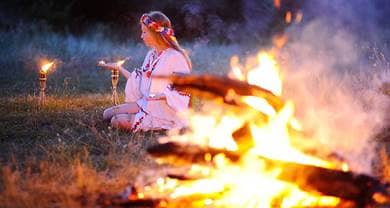
- Romantic interest in primitive religion - Certainly vestigial forms of indigenous European Paganism could be deduced from folklore as well as certain folk practices. Veneration of water at holy wells, ceremonial bonfires during seasonal festivals, and the "cunning man" traditions of folk healers and diviners, all point to religious and spiritual sensibilities that run counter to the prevailing Christian faith in England. Likewise, interest in the "medicine men" and the indigenous religions of North America and Africa inspired those of European ancestry to investigate (or, perhaps, to re-create) their own primal traditions.
- Speculations of a Great Mother Goddess cult in antiquity - By the early 21st century, the concept of one single Great Mother Goddess had fallen out of scholarly favor, but in the late 19th and early 20th century it was a popular idea. Some scholars promoted the idea, while the poet and novelist Robert Graves created his own idiosyncratic vision of Goddess religion in his highly influential book The White Goddess (1966). The Great Mother Goddess emerged as an attractive alternative to the overly male image of God promoted by the Abrahamic religions; furthermore, since the one God was associated with heaven and with spirit, the "One Goddess" took on a complementary role as emblematic of matter and the earth.
- The culture of "Merrie England" - One way in which Romanticism flourished in England was through a nostalgic celebration of English folklore and customs, some of which may well have had ancient roots but others of which could have been more recent in origin. May Day celebrations (particularly the Maypole), Morris Dancing, Yuletide customs, fairy lore, druidism, and various other seasonal festivals all became popular, in part, because of their purported link to a nostalgic understanding of the past. For Gardner and other advocates of nature spirituality, all of these folkloric practices had an explicitly religious dimension to them - they were seen as embedded in ancient British Paganism.
- Anthropological speculation about witchcraft - Another by-product of Romanticism was an interest in occultism and supernatural phenomena, including Theosophy, Spiritualism, and ceremonial magic. As the age of revolution, the 19th century was also marked by hostility toward Christianity as the religion of the establishment. In this context, scholars began to speculate about the true nature of witchcraft as suppressed by Christianity, particularly in late medieval and early modern periods. Researchers like Henry Charles Lea, Jules Michelet, Charles Godfrey Leland, and Margaret Murray helped fashion a new scholarly consensus in which witchcraft as persecuted by Christianity became seen not as the practice of devil worship, but rather as the vestigial remains of authentic pre-Christian European religion.
- A romantic re-visioning of the witch persecutions of early modern Europe - Following the new scholarly consensus about the meaning of witchcraft, the witch trials of Europe became interpreted as a form of religious persecution, in which the dominant faith (Christianity) systematically attacked the weaker "old religion" (ancient European Paganism). This shift in perception changed the image of the witches of Europe from criminal sorceresses to heroic victims. In 1784, German scholar Gottfried Christian Voigt theorized that nine million people (mostly women) had been killed during the European witch persecutions - a figure that became widely accepted among Wiccans and other Pagans until the 1990s, when scholars began to widely question that figure. In all likelihood, only 40,000 - 90,000 people were killed for allegedly being witches (still a horrific number).
- Ceremonial magic and Freemasonry- Many of the ceremonies of Gardner's witch coven drew upon rituals practiced by established secret societies of his day, including Freemasonry and ceremonial magic groups like the Order of the Golden Dawn.
Although other traditions of Paganism have had different influences (for example, the myth of the burning times, i.e., the witch persecution, typically is of little importance to Celtic Reconstructionists or Odinists), this variety of influences serves as an example of how diverse the factors were that contributed to modern revivals or recreations of the Pagan path.
Study Questions:
1. How have the influences on Paganism evolved over time? What do they now include?
2. Who was Gerald Gardner and why is he important?
3. How does the Great Mother Goddess contrast to the God of the Abrahamic tradition?
4. Why have the witch hunts become romantically revisioned?
Back to Religion Library
Editor's picks See all columnists

Evangelical
Before You Unplug or Sign Out for Good

Evangelical
What Is the Purpose of Spiritual Gifts, and How Do You Discover Yours?

New Visions
5 Ways to Hear What God is Telling You

Muslim
How Awake Are We? When Waking Up is Falling Asleep

Latter-day Saint
"The Church supports the use of vaccinations"

Evangelical
Luther and the Beauty of Christ

The Soul of Gospel Music Explored in New Netflix Series "Voices of Fire"

Seven Ways to Think About Christian Mysticism

Evangelical

Evangelical

Muslim
Imam Ali’s letter to the Governor- Everlasting Example of Good...

Progressive Christian
Patheos Explore the world's faith through different perspectives on religion and spirituality! Patheos has the views of the prevalent religions and spiritualities of the world.
Ad-Free & Subscriber Log-In Subscription Support
- About Us
- 2026 Calendar
- Videos
- Podcasts
- Library of World Religions
- Faith In Media Tracker
- Advertise With Us
- Write for Us
- Privacy Policy
- Terms of Service
- Do Not Sell My Data
- Contact Us
- Radiant Digital
- Manage Newsletter Subscriptions
- Unsubscribe From Notifications
- Sitemap
Copyright 2008-2026, Patheos. All rights reserved.
Subscription Support Ad-Free & Subscriber Log-In
Follow Patheos