
BuddhistCatholicContemplativeEvangelicalGeneral ChristianHinduJewishLatter-day SaintMuslimNew VisionsProgressive Christian
Beliefs
- Buddhist
- Catholic
- Contemplative
- Evangelical
- General Christian
- Hindu
- Jewish
- Latter-day Saint
- More Voices
- Muslim
- New Visions
- Pagan
- Progressive Christian
Topics
- Religion News
- Food and Religion
- Sports and Religion
- Religious Art
- Religious Music and Entertainment
- Religious Events
- History and Religion
- Style and Religion
- Politics and Religion
- Women in Religion
- Recreation Outdoors and Religion
- Business Finance and Religion
- Careers Workplace and Religion
- Education and Religion
- Family Parenting and Religion
- Health Fitness and Religion
- Home and Religion
- Relationships and Religion
- Technology and Religion
- Travel and Religion
Columnists
- Buddhist Columnists
- Business Finance and Religion Columnists
- Careers Workplace and Religion Columnists
- Catholic Columnists
- Contemplative Columnists
- Education and Religion Columnists
- Evangelists Columnists
- Family Parenting and Religion Columnists
- General Christian Columnists
- Health Fitness and Religion Columnists
- Hindu Columnists
- History and Religion Columnists
- Home and Religion Columnists
- Jewish Columnists
- More Voices Columnists
- Latter Day Columnists
- Muslim Columnists
- New Visions Columnists
- Nonreligious Columnists
- Pagan Columnists
- Politics and Religion Columnists
- Progressive Columnists
- Recreation Outdoors and Religion Columnists
- Relationships and Religion Columnists
- Religion News Columnists
- Religious Art Columnists
- Religious Events Columnists
- Religious Music and Entertainment Columnists
- Sports and Religion Columnists
- Style and Religion Columnists
- Technology and Religion Columnists
- Travel and Religion Columnists
- Women in Religion Columnists
Resource Library
- 2026 Calendar
- Library of World Religions
- The 100 Most Holy Places on Earth
- Patheos Answers
- Podcasts
- Videos
- Faith Leaders Database
- Anglican Episcopalian
- Bahai
- Baptist
- Buddhism
- Christianity
- Confucianism
- Eastern Orthodoxy
- Hinduism
- Holiness and Pentecostal
- ISKCON
- Islam
- Judaism
- Lutheran
- Methodist
- The Church of Jesus Christ of Latter-day Saints
- New Age
- Paganism
- Presbytarian and Reformed
- Protestantism
- Religion Behind the Scenes
- Roman Catholic
- Scientology
- Shia Islam
- Sikhism
- Sufism
- Sunni Islam
- Taoism
- Zen
- See all religions
Research Tools
 Ad-Free & Subscriber Log-In Subscription Support
Ad-Free & Subscriber Log-In Subscription Support
Follow Patheos 

- Trending:
- Forgiveness
- |
- Marriage
- |
- Consciousness
- |
- Death Penalty
- |
- Election
- |
- Halloween
RELIGION LIBRARY
Islam
Toggle navigation
Rituals and Worship
Sacred Space
 Muslims gather for worship in buildings called mosques (Arabic, masajid). The Prophet Muhammad built the first mosque in the courtyard of his house in Medina in 622 to provide a place for Muslims to gather for prayer and for community. The earliest mosques were modeled after Muhammad's in both design and purpose, and despite a wide variety in architectural styles, contemporary mosques still embrace the general features of Muhammad's initial design.
 Outer rooms surround a courtyard or large open area used for prayer, which is sometimes covered by a roof. The floor is covered with mats or carpets. A niche set into the wall, called a mihrab, indicates the direction of Mecca, and thus the direction in which to pray. Next to the mihrab is the minbar, a platform used by the prayer leader to deliver the Friday sermon. Women and men are segregated in the mosque, so there may be a chamber set aside for
  women or a curtain separating the men from the women. Muslims perform ritual cleansing before prayer in an outer courtyard called a ziyadah. From a tower outside the mosque, called a minaret, the muezzin calls the faithful to prayer five times a day. There are no pictures or statues, and ritual objects are not needed. The walls are decorated with patterned mosaics, verses from the Quran, and occasionally the names of Muhammad and his companions. The styles range from very simple to monumental.
Many Muslims visit the mosque for all five of the daily prayers. The mosque is host to public activities as well as prayer. It is a place to gather and socialize, to find help and information and comfort in times of crisis, to discuss business agreements, and to engage in political discussion and debate. Mosques provide religious education, and aid in the collection and distribution of zakat, the charitable donations that form one of the Five Pillars. Muslims visit the mosque before and after pilgrimage, and will bring the bodies of deceased family members to the mihrab for prayers before burial.
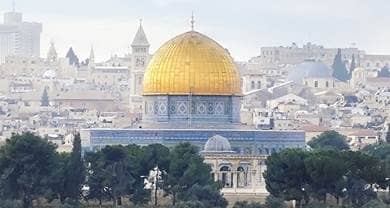
 The mosques at Medina, Mecca, and Jerusalem have special status. There is a hadith that says if a person visits the mosque at Medina, Muhammad will intercede for him or her on the Day of Judgment. The al-Aqsa mosque in Jerusalem (not to be confused with the Dome of the Rock) is said to stand on the site of Muhammad's famous Night Journey. The Dome of the Rock stands on the site of Muhammad's ascent into heaven with the angel Gabriel. The Grand Mosque in Mecca holds the Kaaba, a shrine near its center. For Muslims, this is the most sacred place in the world, called the
  "House of God." The Kaaba pre-dates Islam, and tradition holds that one of Muhammad's first actions upon entering Mecca as its conqueror was to destroy all idols and shrines, dedicating the Kaaba to Allah, the one true God, and performing the Islamic rites of pilgrimage. No matter where they are in the world, Muslims face in the direction of the Kaaba in Mecca when they pray. The dead are buried with their heads pointing in the direction of the Kaaba.
 Kaaba means cube, and that is the shape of the shrine. Its corners align with the four points of the compass. The interior is nearly empty, with only three pillars supporting the roof, and ceiling lamps made of gold and silver. Islamic tradition holds that after he and Eve were expelled from paradise, Adam built the Kaaba, which is a copy of God's heavenly house. Adam's shrine was destroyed in Noah's flood, except for the foundation, and Abraham and Ishmael rebuilt it. Later, Muhammad also rebuilt the Kaaba and was entrusted to place the cornerstone in the building.
 The Black Stone of Mecca, a black rock approximately 12 inches in diameter, is fixed in the wall of the eastern corner of the Kaaba. Tradition holds that the Black Stone was given to Adam when he and Eve were expelled from paradise, and was placed in the Kaaba by Abraham and Ishmael. It is the symbol of God's covenant with Abraham, Ishmael, and the Muslims. Pilgrims to this holy site walk counter-clockwise around the Kaaba seven times in imitation of the angels walking around God's heavenly throne. When possible, pilgrims will touch or kiss the Stone, which absorbs the sins of those who touch it. Islam teaches that the Stone was originally pure white, but has turned black from absorbing the sins of the faithful.
Sufi and Shi'i Muslims have built shrines over the tombs of holy men and women in many parts of the Muslim world. These are also pilgrimage sites, and some have also served as mosques. They are believed to possess special spiritual power, which can be received as a blessing by pilgrims. Some shrines are believed to have healing powers. Because they are segregated in the mosques, some Muslim women opt to pray in a shrine instead.
 For the Shi'a, the shrine of Ali ibn Abi Talib, Muhammad's cousin and son-in-law, and the shrine of Husayn ibn Ali, Muhammad's grandson, are especially holy. Both are located in Iraq—the shrine of Ali in Najaf, and the shrine of Husayn in Karbala. Both are important religious and education centers, and the shrine of Husayn is second in importance to Shi'i pilgrims after Mecca. For Sufi Muslims, the heart, the holder of the soul, is the most important place in the world.
Study Questions:
1. What is a mosque? Where does the inspiration for its design originate?
2. Describe the structure within a mosque, and the ritual that takes place.
3. How does the location of Mecca orient Muslims’ ritual?
4. What is the black stone of Mecca? What is its significance to Islamic faith?
Back to Religion Library
Editor's picks See all columnists
Evangelical
Before You Unplug or Sign Out for Good
Evangelical
What Is the Purpose of Spiritual Gifts, and How Do You Discover Yours?
New Visions
5 Ways to Hear What God is Telling You
Muslim
How Awake Are We? When Waking Up is Falling Asleep
Latter-day Saint
"The Church supports the use of vaccinations"
Evangelical
Luther and the Beauty of Christ
The Soul of Gospel Music Explored in New Netflix Series "Voices of Fire"
Seven Ways to Think About Christian Mysticism

Evangelical
Evangelical
Muslim
Imam Ali’s letter to the Governor- Everlasting Example of Good...
Progressive Christian
Patheos Explore the world's faith through different perspectives on religion and spirituality! Patheos has the views of the prevalent religions and spiritualities of the world.
Ad-Free & Subscriber Log-In Subscription Support
- About Us
- 2026 Calendar
- Videos
- Podcasts
- Library of World Religions
- Faith In Media Tracker
- Advertise With Us
- Write for Us
- Privacy Policy
- Terms of Service
- Do Not Sell My Data
- Contact Us
- Radiant Digital
- Manage Newsletter Subscriptions
- Unsubscribe From Notifications
- Sitemap
Copyright 2008-2026, Patheos. All rights reserved.
Subscription Support Ad-Free & Subscriber Log-In
Follow Patheos