
BuddhistCatholicContemplativeEvangelicalGeneral ChristianHinduJewishLatter-day SaintMuslimNew VisionsProgressive Christian
Beliefs
- Buddhist
- Catholic
- Contemplative
- Evangelical
- General Christian
- Hindu
- Jewish
- Latter-day Saint
- More Voices
- Muslim
- New Visions
- Pagan
- Progressive Christian
Topics
- Religion News
- Food and Religion
- Sports and Religion
- Religious Art
- Religious Music and Entertainment
- Religious Events
- History and Religion
- Style and Religion
- Politics and Religion
- Women in Religion
- Recreation Outdoors and Religion
- Business Finance and Religion
- Careers Workplace and Religion
- Education and Religion
- Family Parenting and Religion
- Health Fitness and Religion
- Home and Religion
- Relationships and Religion
- Technology and Religion
- Travel and Religion
Columnists
- Buddhist Columnists
- Business Finance and Religion Columnists
- Careers Workplace and Religion Columnists
- Catholic Columnists
- Contemplative Columnists
- Education and Religion Columnists
- Evangelists Columnists
- Family Parenting and Religion Columnists
- General Christian Columnists
- Health Fitness and Religion Columnists
- Hindu Columnists
- History and Religion Columnists
- Home and Religion Columnists
- Jewish Columnists
- More Voices Columnists
- Latter Day Columnists
- Muslim Columnists
- New Visions Columnists
- Nonreligious Columnists
- Pagan Columnists
- Politics and Religion Columnists
- Progressive Columnists
- Recreation Outdoors and Religion Columnists
- Relationships and Religion Columnists
- Religion News Columnists
- Religious Art Columnists
- Religious Events Columnists
- Religious Music and Entertainment Columnists
- Sports and Religion Columnists
- Style and Religion Columnists
- Technology and Religion Columnists
- Travel and Religion Columnists
- Women in Religion Columnists
Resource Library
- 2026 Calendar
- Library of World Religions
- The 100 Most Holy Places on Earth
- Patheos Answers
- Podcasts
- Videos
- Faith Leaders Database
- Anglican Episcopalian
- Bahai
- Baptist
- Buddhism
- Christianity
- Confucianism
- Eastern Orthodoxy
- Hinduism
- Holiness and Pentecostal
- ISKCON
- Islam
- Judaism
- Lutheran
- Methodist
- The Church of Jesus Christ of Latter-day Saints
- New Age
- Paganism
- Presbytarian and Reformed
- Protestantism
- Religion Behind the Scenes
- Roman Catholic
- Scientology
- Shia Islam
- Sikhism
- Sufism
- Sunni Islam
- Taoism
- Zen
- See all religions
Research Tools
 Ad-Free & Subscriber Log-In Subscription Support
Ad-Free & Subscriber Log-In Subscription Support
Follow Patheos 

- Trending:
- Forgiveness
- |
- Marriage
- |
- Consciousness
- |
- Death Penalty
- |
- Election
- |
- Halloween
RELIGION LIBRARY
ISKCON (Hare Krishna)
Toggle navigation
Rituals and Worship
Sacred Space
Written by Benjamin E. Zeller
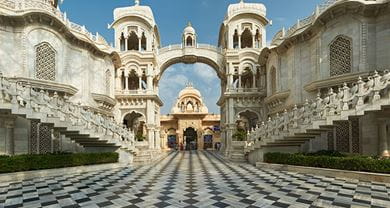
The sacred centers of ISKCON are the temples, of which more than three hundred exist. In addition to the temples, ISKCON operates over fifty farms and rural retreats. Of these religious centers, those in global capitals and major cities serve the most important institutional roles. The movement's major gurus, many of whom also serve on the movement's Governing Body Commission, hold "pulpits" at these temples.
Hare Krishna temples serve the central function of holding images of the deities, always Krishna but nearly always Radha as well. Like other Hindus, ISKCON devotees believe that the gods show grace to humanity by allowing them to worship material images crafted in their forms. As such the images are more than representations or symbols; they are actually Krishna or Radha and are treated as such. Such images, which in ISKCON are normally anthropomorphic sculptures, permit devotees to look upon the physical form of the divine as they make offerings and perform other forms of worship, such as song and dance. They also allow devotees to engage in higher rasas (modes of devotion), such as bathing, cleaning, fanning, and clothing the deities. While some ISKCON devotees might install smaller shrines for Krishna at their homes, generally they seek temples in order to engage in group worship alongside other devotees.
In addition to temples, the International Society for Krishna Consciousness also operates several rural communes and farms. The most famous of these, New Vrindaban in West Virginia (USA), serves as a retreat center for ISKCON devotees, as well as a location for festivals, conferences, and meetings. Since Hare Krishna theology considers cows to be sacred animals, and highly values the keeping of dairy cows, many of these rural centers operate as farms as well. Often they adopt older dairy cows from non-ISKCON facilities so as to provide a humane life to the animals.
Though most of ISKCON membership lives in the Americas and Europe, in keeping with its Hindu origin the movement looks to India as its spiritual center. ISKCON holds the ancient Vedic texts in high regard, and because such texts assume Indian geography and culture, even non-Indian devotees consider India an ideal spiritual location. Additionally, since all of Krishna's avatars appeared in India, the subcontinent represents the sacred space on which God walked. Of all of India, devotees believe that the sites associated with Krishna's pastimes hold special sacredness. Many Hare Krishna devotees try to go on pilgrimage to these sites to experience them directly. It is believed that Krishna rewards devotional acts performed there with special merit.
Chief among those sites, Vrindaban, the birthplace of Krishna and location of his childhood adventures, serves as the most important pilgrimage site in the ISKCON movement. Approximately eighty miles south of Delhi, Vrindaban has benefited from several decades of ISKCON development. It holds the religious retreat where Swami Prabhupada lived before journeying to America, as well as a museum dedicated to his life. In addition to an ISKCON temple itself, Vrindaban features six other temples maintained by other Vaishnava lineages. Devotees visit the temples and worship Krishna by venerating the images installed there.
Of nearly equal value to Vrindaban, the Indian city of Mayapur holds numerous sites associated with Sri Chaitanya, the 16th-century Indian saint who founded the Gaudiya Vaishnava school, and whom ISKCON recognizes as an avatar of Krishna. Eighty miles north of Calcutta, Hare Krishna pilgrims visit Mayapur in order to experience the locations where Chaitanya was born and preached, and those places associated with his disciples. In addition to the temples dedicated to Chaintanya, Mayapur holds shrines to Bhaktivedanta, who is buried here, and his predecessors in the Gaudiya Vaishnava lineage. Hare Krishna pilgrims visiting Mayapur often follow a predetermined pilgrimage route to the sacred sites utilized by other Vaishnava pilgrims, in addition to visiting the shrines specific to the International Society for Krishna Consciousness. ISKCON has built its world headquarters in Mayapur and is currently planning a massive temple complex that the movement claims will be the largest Indian temple built in the past two centuries when it is completed.
Hare Krishna pilgrims visiting India often also visit a third site, the city of Puri along India's East Coast. Puri is the center of the worship of Lord Jagannath, an alternative form of Krishna, and holds the most important temple dedicated to the worship of Jagannath. Puri hosts the original Ratha-Yatra or chariot festival, and devotees seek to visit during this festival, held in midsummer, and worship at the major Puri temples. Additionally, ISKCON devotees visit sites associated with Chaitanya, who spent much of his lifetime in Puri.
Though ISKCON generally looks to the geography of India in its marking of sacred space, in their daily lives devotees also signify their own bodies as sacred through the use of tilaka, marks made of sacred clay that members apply to their bodies. As part of their morning purifying rituals, and sometimes also before attending communal worship, both male and female devotees apply twelve tilaka marks to their bodies. As they do so, they repeat holy mantras, marking the body part as sacred and dedicated to the worship of Krishna. These twelve sites -- the forehead, stomach, chest, throat, side (right and left), arm (right and left), shoulder (right and left), and back (upper and lower) -- create a sacred space within the body, and helps individual ISKCON devotees understand themselves as sacred beings.
Study Questions:
1. What are the sacred centers for ISKCON followers?
2. Do ISKCON temples encourage idolatry? Why or why not?
3. How are pilgrimage sites determined? Which spaces are most important?
4. How does the body engage the sacred?
Back to Religion Library
Editor's picks See all columnists

Evangelical
Before You Unplug or Sign Out for Good

Evangelical
What Is the Purpose of Spiritual Gifts, and How Do You Discover Yours?

New Visions
5 Ways to Hear What God is Telling You

Muslim
How Awake Are We? When Waking Up is Falling Asleep

Latter-day Saint
"The Church supports the use of vaccinations"

Evangelical
Luther and the Beauty of Christ

The Soul of Gospel Music Explored in New Netflix Series "Voices of Fire"

Seven Ways to Think About Christian Mysticism

Evangelical

Evangelical

Muslim
Imam Ali’s letter to the Governor- Everlasting Example of Good...

Progressive Christian
Patheos Explore the world's faith through different perspectives on religion and spirituality! Patheos has the views of the prevalent religions and spiritualities of the world.
Ad-Free & Subscriber Log-In Subscription Support
- About Us
- 2026 Calendar
- Videos
- Podcasts
- Library of World Religions
- Faith In Media Tracker
- Advertise With Us
- Write for Us
- Privacy Policy
- Terms of Service
- Do Not Sell My Data
- Contact Us
- Radiant Digital
- Manage Newsletter Subscriptions
- Unsubscribe From Notifications
- Sitemap
Copyright 2008-2026, Patheos. All rights reserved.
Subscription Support Ad-Free & Subscriber Log-In
Follow Patheos