
BuddhistCatholicContemplativeEvangelicalGeneral ChristianHinduJewishLatter-day SaintMuslimNew VisionsProgressive Christian
Beliefs
- Buddhist
- Catholic
- Contemplative
- Evangelical
- General Christian
- Hindu
- Jewish
- Latter-day Saint
- More Voices
- Muslim
- New Visions
- Pagan
- Progressive Christian
Topics
- Religion News
- Food and Religion
- Sports and Religion
- Religious Art
- Religious Music and Entertainment
- Religious Events
- History and Religion
- Style and Religion
- Politics and Religion
- Women in Religion
- Recreation Outdoors and Religion
- Business Finance and Religion
- Careers Workplace and Religion
- Education and Religion
- Family Parenting and Religion
- Health Fitness and Religion
- Home and Religion
- Relationships and Religion
- Technology and Religion
- Travel and Religion
Columnists
- Buddhist Columnists
- Business Finance and Religion Columnists
- Careers Workplace and Religion Columnists
- Catholic Columnists
- Contemplative Columnists
- Education and Religion Columnists
- Evangelists Columnists
- Family Parenting and Religion Columnists
- General Christian Columnists
- Health Fitness and Religion Columnists
- Hindu Columnists
- History and Religion Columnists
- Home and Religion Columnists
- Jewish Columnists
- More Voices Columnists
- Latter Day Columnists
- Muslim Columnists
- New Visions Columnists
- Nonreligious Columnists
- Pagan Columnists
- Politics and Religion Columnists
- Progressive Columnists
- Recreation Outdoors and Religion Columnists
- Relationships and Religion Columnists
- Religion News Columnists
- Religious Art Columnists
- Religious Events Columnists
- Religious Music and Entertainment Columnists
- Sports and Religion Columnists
- Style and Religion Columnists
- Technology and Religion Columnists
- Travel and Religion Columnists
- Women in Religion Columnists
Resource Library
- 2026 Calendar
- Library of World Religions
- The 100 Most Holy Places on Earth
- Patheos Answers
- Podcasts
- Videos
- Faith Leaders Database
- Anglican Episcopalian
- Bahai
- Baptist
- Buddhism
- Christianity
- Confucianism
- Eastern Orthodoxy
- Hinduism
- Holiness and Pentecostal
- ISKCON
- Islam
- Judaism
- Lutheran
- Methodist
- The Church of Jesus Christ of Latter-day Saints
- New Age
- Paganism
- Presbytarian and Reformed
- Protestantism
- Religion Behind the Scenes
- Roman Catholic
- Scientology
- Shia Islam
- Sikhism
- Sufism
- Sunni Islam
- Taoism
- Zen
- See all religions
Research Tools
 Ad-Free & Subscriber Log-In Subscription Support
Ad-Free & Subscriber Log-In Subscription Support
Follow Patheos 

- Trending:
- Forgiveness
- |
- Marriage
- |
- Consciousness
- |
- Death Penalty
- |
- Election
- |
- Halloween
RELIGION LIBRARY
Hinduism
Toggle navigation
History
Early Developments
Western scholars have typically divided up the history of Hinduism into periods that roughly match the periods used to understand history in the West: ancient, medieval, modern, etc. There are many problems with this, not the least of which is that Hinduism has not developed in a linear manner. Later developments overlap, rather than replace, what came before; there are, therefore, no neat or clear historical breaks.
VEDIC TEXTS
- the Rigveda: hymns
(for the chief priest to recite) - the Yajurveda: formulas
(for the priest to recite) - the Samaveda: formulas
(for the priest to chant) - the Atharvaveda: collection of stories, spells, and charms
The earliest stratum of what can properly be called "Hinduism," of which the Vedas are the core, developed from about 1500 B.C.E. until about 500 B.C.E. Something new emerged at this point, a new religious worldview based not on the power of ritual sacrifice, but on the ideal of asceticism; it is important to note, however, that the Vedic tradition was not replaced, but rather, eventually, came to be understood as underlying (and thus supporting) these later developments. Buddhism and Jainism emerged out of this new religious climate, initially as internal reforms, but eventually as separate religions.
Buddhism in particular posed a challenge to Hinduism, not only in terms of its opposing religious ideals, but also because Buddhism opened new avenues for religious participation to people who, under the earlier system, were largely excluded. Because the Buddha and his followers rejected the ideas of caste distinctions that were central to the Vedic worldview, it attracted supporters from the merchant classes, particularly in the rapidly emerging cities in northern India along the Silk Route. Kings and lesser local rulers, especially, began to give their support to Buddhism, since their lower caste status—in relation to the Brahmins—did not imply a lesser religious status. The result of this, from about the 3rd century B.C.E. until about the 10th century C.E., was the relative ascendency of Buddhism at the expense of Hinduism.
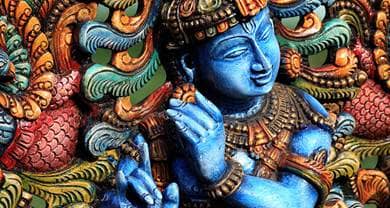
This began to change, however, with the rise of sectarianism within Hinduism. The rise of Vaishnava Hinduism is particularly crucial here. Although Vishnu had long been a central god in Hinduism, by the latter part of the first millennium C.E., Vishnu's character had become particularly associated with kingly virtue. Various forms of Vishnu, particularly Rama, were depicted as the ideal ruler, the restorer and upholder of dharma. Kings began to shift their allegiance away from Buddhism to Vaishnava Hinduism (as well as Shaiva Hinduism), which had gradual but quite dramatic effects: by about 1200 C.E., Buddhism had all but died out in its homeland.
FOUR MAJOR SECTS OF HINDUISM
- Shaiva
- Vaishnava
- Shakta
- Smarta
By the beginning of the second millennium C.E., the Hindu pantheon had begun to dramatically expand, and thousands and thousands of local versions of the gods began to emerge. Multiple forms of Vishnu emerged, as did various "incarnations" of Shiva, as well as numerous forms of Devi, the goddess. Scholars often refer to this as the rise of "sectarian" Hinduism. One important aspect of this rising sectarian devotion was the construction of great temples to various gods and goddesses throughout India. Many of these temples were sponsored by kings and had particular royal associations.
Study Questions:
1. Why is it problematic to speak about Hinduism's development through history?
2. Why did Buddhism detract from Hinduism?
3. How did Vishnu contribute to a resurgence of followers within the Hindu tradition?
4. How did social status contribute to the rise of Hindu deities?
Back to Religion Library
Editor's picks See all columnists

Evangelical
Before You Unplug or Sign Out for Good

Evangelical
What Is the Purpose of Spiritual Gifts, and How Do You Discover Yours?

New Visions
5 Ways to Hear What God is Telling You

Muslim
How Awake Are We? When Waking Up is Falling Asleep

Latter-day Saint
"The Church supports the use of vaccinations"

Evangelical
Luther and the Beauty of Christ

The Soul of Gospel Music Explored in New Netflix Series "Voices of Fire"

Seven Ways to Think About Christian Mysticism

Evangelical

Evangelical

Muslim
Imam Ali’s letter to the Governor- Everlasting Example of Good...

Progressive Christian
Patheos Explore the world's faith through different perspectives on religion and spirituality! Patheos has the views of the prevalent religions and spiritualities of the world.
Ad-Free & Subscriber Log-In Subscription Support
- About Us
- 2026 Calendar
- Videos
- Podcasts
- Library of World Religions
- Faith In Media Tracker
- Advertise With Us
- Write for Us
- Privacy Policy
- Terms of Service
- Do Not Sell My Data
- Contact Us
- Radiant Digital
- Manage Newsletter Subscriptions
- Unsubscribe From Notifications
- Sitemap
Copyright 2008-2026, Patheos. All rights reserved.
Subscription Support Ad-Free & Subscriber Log-In
Follow Patheos