
BuddhistCatholicContemplativeEvangelicalGeneral ChristianHinduJewishLatter-day SaintMuslimNew VisionsProgressive Christian
Beliefs
- Buddhist
- Catholic
- Contemplative
- Evangelical
- General Christian
- Hindu
- Jewish
- Latter-day Saint
- More Voices
- Muslim
- New Visions
- Pagan
- Progressive Christian
Topics
- Religion News
- Food and Religion
- Sports and Religion
- Religious Art
- Religious Music and Entertainment
- Religious Events
- History and Religion
- Style and Religion
- Politics and Religion
- Women in Religion
- Recreation Outdoors and Religion
- Business Finance and Religion
- Careers Workplace and Religion
- Education and Religion
- Family Parenting and Religion
- Health Fitness and Religion
- Home and Religion
- Relationships and Religion
- Technology and Religion
- Travel and Religion
Columnists
- Buddhist Columnists
- Business Finance and Religion Columnists
- Careers Workplace and Religion Columnists
- Catholic Columnists
- Contemplative Columnists
- Education and Religion Columnists
- Evangelists Columnists
- Family Parenting and Religion Columnists
- General Christian Columnists
- Health Fitness and Religion Columnists
- Hindu Columnists
- History and Religion Columnists
- Home and Religion Columnists
- Jewish Columnists
- More Voices Columnists
- Latter Day Columnists
- Muslim Columnists
- New Visions Columnists
- Nonreligious Columnists
- Pagan Columnists
- Politics and Religion Columnists
- Progressive Columnists
- Recreation Outdoors and Religion Columnists
- Relationships and Religion Columnists
- Religion News Columnists
- Religious Art Columnists
- Religious Events Columnists
- Religious Music and Entertainment Columnists
- Sports and Religion Columnists
- Style and Religion Columnists
- Technology and Religion Columnists
- Travel and Religion Columnists
- Women in Religion Columnists
Resource Library
- 2026 Calendar
- Library of World Religions
- The 100 Most Holy Places on Earth
- Patheos Answers
- Podcasts
- Videos
- Faith Leaders Database
- Anglican Episcopalian
- Bahai
- Baptist
- Buddhism
- Christianity
- Confucianism
- Eastern Orthodoxy
- Hinduism
- Holiness and Pentecostal
- ISKCON
- Islam
- Judaism
- Lutheran
- Methodist
- The Church of Jesus Christ of Latter-day Saints
- New Age
- Paganism
- Presbytarian and Reformed
- Protestantism
- Religion Behind the Scenes
- Roman Catholic
- Scientology
- Shia Islam
- Sikhism
- Sufism
- Sunni Islam
- Taoism
- Zen
- See all religions
Research Tools
 Ad-Free & Subscriber Log-In Subscription Support
Ad-Free & Subscriber Log-In Subscription Support
Follow Patheos 

- Trending:
- Forgiveness
- |
- Marriage
- |
- Consciousness
- |
- Death Penalty
- |
- Election
- |
- Halloween
RELIGION LIBRARY
Hinduism
Toggle navigation
Beliefs
Suffering and the Problem of Evil
The key to understanding the existence of suffering and evil in Hinduism is the central concept of karma. Karma is at once the simplest of concepts and the most complex. The word itself simply means "action," and originally referred to the sacrificial action that was at the center of the Vedic world. Karma gradually took on the meaning of both action and the effect of action.
Karma is understood within Hinduism—and Buddhism and Jainism as well—as the fundamental and universal law of cause and effect. When a person does something, it has an effect: good actions have good effects, bad actions have bad effects. Thoughts have effects as well. An individual person carries around these accumulated effects, this karma. Over the course of a single lifetime, an individual performs countless actions, has countless thoughts; all of these bits of karma—good and bad—are something like spiritual baggage, or deposits in a spiritual bank account. When a person dies, all of his or her karma is, in a sense, added up. A "positive balance" leads to a more positive rebirth; a "negative balance" leads to a more negative rebirth.
Two concepts are essential here: the first is that of the atman, the permanent self; the second is that of samsara, the cycle of rebirth or reincarnation. Hinduism holds that just as the world is created, maintained, destroyed, and recreated endlessly, so too people are born, live, die, and are reborn endlessly. Although samsara is often called "reincarnation" in the West, it is important to note that it is not the "person" who is reborn, but the permanent self, the atman (which includes elements of personality).
The quality of each rebirth depends on the accumulated karma of prior rebirths; this karma "sticks" to the atman, and determines what sort of form it will take in each rebirth. Thus if a human being does particularly good deeds while alive, he or she might be reborn as a "better" human being: a particularly good shudra might be reborn as a Brahmin, for example. But if one does particularly "bad" deeds, called papam in Sanskrit, he or she might be reborn into a lower life form—a member of a lower caste, say, or even as an animal or insect. One might also be reborn outside of the earthly realm, as a demon or even, according to some schools, as a god or goddess. According to this worldview, there is no such thing as evil. There are "bad" people, who are bad because they have done or continue to do bad things; bad events happen as a result of karma as well.
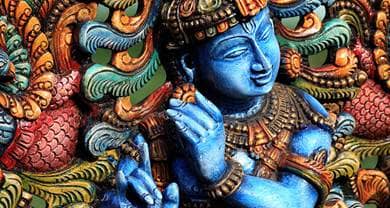
There is another way of understanding things that might appear evil that focuses not on humans but on the gods. Sometimes things happen that do not seem to be the result of any karmic activity: earthquakes, say, or tsunamis, or droughts. One way to understand such events, which of course can be quite catastrophic, is that they are the result of the play of the gods, or lila. Although the gods' lila can be a profoundly positive source, such as the "play" of Krishna with which he combats demons, it can also be negative in the human realm. Ultimately, such divine play is mysterious. Humans cannot possibly understand why the gods do what they do, why they allow bad things to happen to good people. It is simply lila, mysterious.
YUGAS Satya Yuga (or Krita Yuga)
Treta Yuga
Dvapara Yuga
Kali Yuga
A way to think about the issue of evil in Hinduism is found in the image of the cosmic ages. Hinduism breaks each cosmic age—that period between the creation of the universe and its destruction—into huge expanses of time called yugas. In the beginning, when the world has just been created, there is peace and tranquility in the world, perfect dharma, or order. Because human beings possess free will, and because we grasp on to the things of the world out of ignorance of the ultimate reality behind this world—Brahman—the world gradually devolves. Sometimes this is depicted using the image of a cow: when the world is new and dharma is perfect, the cow stands on four legs. As a result of human greed and negative karmic acts, however, the cow eventually loses one leg, then two, then eventually three, leaving it with only a single leg to stand on. The cow, here a symbol for order (dharma), is profoundly unstable, tottering. This is the age we are currently in, the Kali Yuga. Eventually things will become so bad, so adharmic, or disorderly, that the world will go up in flames, and then, eventually, be engulfed in water. Eventually Vishnu will reappear on the waters, and the world will begin again.
What appears to be evil, then, is in this view an inevitable result of the Kali Yuga.
Study Questions:
1. Why is it better to be freed from karma than to continually accumulate good karma?
2. How is rebirth determined? What are some of the outcomes of rebirth in correlation to karma?
3. What is lila? How can it be explained?
4. How do the yugas demonstrate the cyclical nature of Hinduism?
Back to Religion Library
Editor's picks See all columnists

Evangelical
Before You Unplug or Sign Out for Good

Evangelical
What Is the Purpose of Spiritual Gifts, and How Do You Discover Yours?

New Visions
5 Ways to Hear What God is Telling You

Muslim
How Awake Are We? When Waking Up is Falling Asleep

Latter-day Saint
"The Church supports the use of vaccinations"

Evangelical
Luther and the Beauty of Christ

The Soul of Gospel Music Explored in New Netflix Series "Voices of Fire"

Seven Ways to Think About Christian Mysticism

Evangelical

Evangelical

Muslim
Imam Ali’s letter to the Governor- Everlasting Example of Good...

Progressive Christian
Patheos Explore the world's faith through different perspectives on religion and spirituality! Patheos has the views of the prevalent religions and spiritualities of the world.
Ad-Free & Subscriber Log-In Subscription Support
- About Us
- 2026 Calendar
- Videos
- Podcasts
- Library of World Religions
- Faith In Media Tracker
- Advertise With Us
- Write for Us
- Privacy Policy
- Terms of Service
- Do Not Sell My Data
- Contact Us
- Radiant Digital
- Manage Newsletter Subscriptions
- Unsubscribe From Notifications
- Sitemap
Copyright 2008-2026, Patheos. All rights reserved.
Subscription Support Ad-Free & Subscriber Log-In
Follow Patheos