
BuddhistCatholicContemplativeEvangelicalGeneral ChristianHinduJewishLatter-day SaintMuslimNew VisionsProgressive Christian
Beliefs
- Buddhist
- Catholic
- Contemplative
- Evangelical
- General Christian
- Hindu
- Jewish
- Latter-day Saint
- More Voices
- Muslim
- New Visions
- Pagan
- Progressive Christian
Topics
- Religion News
- Food and Religion
- Sports and Religion
- Religious Art
- Religious Music and Entertainment
- Religious Events
- History and Religion
- Style and Religion
- Politics and Religion
- Women in Religion
- Recreation Outdoors and Religion
- Business Finance and Religion
- Careers Workplace and Religion
- Education and Religion
- Family Parenting and Religion
- Health Fitness and Religion
- Home and Religion
- Relationships and Religion
- Technology and Religion
- Travel and Religion
Columnists
- Buddhist Columnists
- Business Finance and Religion Columnists
- Careers Workplace and Religion Columnists
- Catholic Columnists
- Contemplative Columnists
- Education and Religion Columnists
- Evangelists Columnists
- Family Parenting and Religion Columnists
- General Christian Columnists
- Health Fitness and Religion Columnists
- Hindu Columnists
- History and Religion Columnists
- Home and Religion Columnists
- Jewish Columnists
- More Voices Columnists
- Latter Day Columnists
- Muslim Columnists
- New Visions Columnists
- Nonreligious Columnists
- Pagan Columnists
- Politics and Religion Columnists
- Progressive Columnists
- Recreation Outdoors and Religion Columnists
- Relationships and Religion Columnists
- Religion News Columnists
- Religious Art Columnists
- Religious Events Columnists
- Religious Music and Entertainment Columnists
- Sports and Religion Columnists
- Style and Religion Columnists
- Technology and Religion Columnists
- Travel and Religion Columnists
- Women in Religion Columnists
Resource Library
- 2026 Calendar
- Library of World Religions
- The 100 Most Holy Places on Earth
- Patheos Answers
- Podcasts
- Videos
- Faith Leaders Database
- Anglican Episcopalian
- Bahai
- Baptist
- Buddhism
- Christianity
- Confucianism
- Eastern Orthodoxy
- Hinduism
- Holiness and Pentecostal
- ISKCON
- Islam
- Judaism
- Lutheran
- Methodist
- The Church of Jesus Christ of Latter-day Saints
- New Age
- Paganism
- Presbytarian and Reformed
- Protestantism
- Religion Behind the Scenes
- Roman Catholic
- Scientology
- Shia Islam
- Sikhism
- Sufism
- Sunni Islam
- Taoism
- Zen
- See all religions
Research Tools
 Ad-Free & Subscriber Log-In Subscription Support
Ad-Free & Subscriber Log-In Subscription Support
Follow Patheos 

- Trending:
- Forgiveness
- |
- Marriage
- |
- Consciousness
- |
- Death Penalty
- |
- Election
- |
- Halloween
RELIGION LIBRARY
Hinduism
Toggle navigation
Beliefs
Sacred Narratives
There is no single story of a founder in Hinduism, since there is no founder. There is no single story or even collection of stories that lays out the divine realm. There is no single story of creation, since the world is recreated countless times. Indeed, in the vast corpus of Hindu myths there is not only tremendous variety and variation, but there are often what appear to be conflicting stories about the creation of the cosmos, about the deeds of the gods and goddesses, and about the ways humans should interact with these divine beings.
Purusha Shukta: opening verses
(Hymn 10.90 of the Rig Veda) Verse One The Purusha (the Supreme Being) has a thousand heads, a thousand eyes and a thousand feet. He has enveloped this world from all sides and has (even) transcended it by ten angulas or inches. Verse Two All this is verily the Purusha. All that which existed in the past or will come into being in the future (is also the Purusha). Also, he is the Lord of immortality. That which grows profusely by food (is also the Purusha). Verse Three So much is His greatness. However, the Purusha is greater than this. All the beings form only a quarter (part of) Him. The three-quarter part of His, which is eternal, is established in the spiritual domain.
In the Rig Veda, one of the earliest Vedic texts, there are actually several creation stories. One of the best known is contained in the Purusha Shukta, and is sometimes referred to as the "Hymn of Cosmic Man." The myth describes the origin of the cosmos as the result of a primal sacrifice, the sacrifice by the gods of the first person, a giant named Purusha. The gods sacrifice this primal being, and out of the pieces of his body the divisions of the human world, and indeed the world itself, are formed. The Brahmins come from his mouth; the Kshatriyas from his arms; the Vaishyas from his thighs; and the Shudras from his feet. This is often understood to be the first articulation of the caste system, although it is important to note that the myth itself does not present a divisive hierarchical ordering, but one which makes the different parts of society fundamentally interdependent (like the various parts of the human body).
The Purusha Shukta also reflects the Vedic emphasis on sacrifice as a creative act. After describing the formation of the human realm from Purusha's body, the hymn goes to describe the formation of the physical world: the moon comes from his mind, the sun from his eyes, wind from his breath, the earth from his feet, and so on. It ends, "Thus they [the gods] fashioned the worlds."
Each of the major divisions or sects—Shaivism, Vaishnavism, Shaktism, etc.—within Hinduism has its own set of sacred narratives that, although distinct to a particular sect, also contains overlapping elements. The Shaivas, for instance, hold Shiva as the highest form of the divine, and thus emphasize Shiva in their myths and sacred narratives. Many of these myths depict Shiva as a renouncer of the world who abandons the trappings of the world and goes off to the Himalayas to meditate. In some of these myths, a beautiful mountain girl, Parvati, falls in love with the wild-haired ascetic, much to the chagrin of her parents.
In one of the best-known such stories, the myth of Daksa, the power and sometimes unpredictability of Shiva is demonstrated (as well as his reputation as "the destroyer"). Parvati (who is here called Sati) is married to Shiva, although her parents are very much against the marriage. Her father Daksha holds a great sacrifice, and as a slight to Shiva, he does not invite him. Shiva is not bothered by the insult, but Sati is. She goes to her father, and in her extreme anger she commits suicide (in some versions her anger simply causes her to catch fire). Shiva, enraged, destroys the sacrifice and kills Daksha, thus creating cosmic disorder, adharma. The gods then praise Shiva, who relents and restores the sacrifice and brings Daksha back to life (Sati's body is scattered, and she is reborn as Parvati).
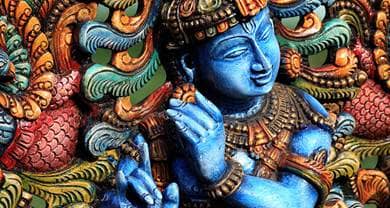
Narratives concerning Vishnu tend to reflect, in contrast, his status as the cosmic maintainer of dharma. Some of the best-known of these narratives are the myths having to do with Vishnu's avataras, the forms he takes to come down to the human realm and restore cosmic and social order. The many, many myths and stories having to do with Krishna are among the most popular and oft-repeated sacred narratives in the Hindu world. Particularly important are the devotional stories and songs in the bhakti tradition that narrate the relationship between Krishna and his human consort, Radha, in the sacred forest of Vrindavana.
The great Hindu epics, the Mahabharata and the Ramayana are often seen as Vaishnava texts, although they contain many myths and rituals oriented to Shiva and the goddesses as well. For many Hindus, the stories and myths in these texts represent the most sacred of all narratives, because they describe the activities of the gods in the human realm. On one level, these are simply great stories. They are told and retold, enacted, sung, and, in the modern realm, filmed. They are also great myths, however, sacred narratives that unveil profound truths, present moral and ethical guidance, and articulate the formation and order of the cosmos.
Three principal sects of Hinduism Sect Supreme Being Name of the followers Where sect is most widespread Texts Shaivism Shiva Shaivas India
Nepal
Sri Lanka Vedas
Bhagavadgita
Upanishads Vaishnavism Vishnu (or his avatars: Rama and Krishna) Vaishnavas India Upanishads
Bhagavad Gita
Puranas Saktism Shakti (or Devi), the Divine Mother Shaktas India Puranas
Tantras
Devimahatmya
For many Hindus, the most sacred narratives are those having a much more local scope. Some of these narratives are contained within the Puranas, a huge collection of diverse religious texts. Many of the Puranas contain stories and myths that are linked to particular places, such as mountains or temples, as well as narratives that have pan-Indian resonance. The Puranas also contain variations of myths found elsewhere. Virtually all of the pan-Indian gods and goddesses appear in the Puranas.
Division of Purana texts
(various divisions and numbers of texts are possible) The Mahapuranas (most important puranas)
- Brahma Puranas: Brahma Purana, Brahmānda Purana, Brahma Vaivarta Purana, Mārkandeya Purana, Bhavishya Purana
- Vishnu Puranas: Vishnu Purana, Bhagavata Purana, Nāradeya Purana, Garuda Purana, Padma Purana, Varaha Purana,Vāmana Purana,Kūrma Purana, Matsya Purana, Kalki Purana
- Shiva Puranas: Shiva Purana, Linga Purana, Skanda Purana, Agni Purana, Vāyu Purana
The Upapuranas: secondary texts (no official list, but include the following)
Sanat-kumara, Narasimha, Brihan-naradiya, Siva-rahasya, Durvasa, Kapila, Vamana, Bhargava, Varuna, Kalika, Samba, Nandi, Surya, Parasara, Vasishtha, Devi-Bhagavata, Ganesha, Mudgala, and Hamsa
The Sthala Puranas: deal with traditions about temples and shrines The Kula Puranas: deal with the origins of various castes Jain and Buddhist Puranas
The Puranic version of the birth of the very popular god Ganesha is one of the most well known of all myths in Hinduism, one version of which is recounted in the Shiva Purana. Shiva's wife, Parvati, was alone while Shiva was away meditating. Parvati intended to take a bath, but was afraid of intruders, so she created Ganesh out of the turmeric, which was used something like soap, she was going to use to bathe. She instructed the boy to stand guard outside of her door. Shiva returned and encountered the strange boy, and demanded that he step aside so that he could enter his home. Ganesh, not knowing his father, refused, and Shiva, enraged, lopped off his son's head.
Parvati was furious and distraught, and she demanded that her husband restore their son to life. Shiva, after searching in vain for the head, was forced to replace it with that of an elephant. This is an etiological myth, namely a sacred narrative that explains the origins of a god or sacred place; it is also a myth that considers Shiva's sometimes unpredictable nature, as well as his power to restore.
Study Questions:
1. How do Hindu scriptures present a creation story?
2. What is the role of violence within many sacred narratives?
3. What are the Puranas, and what do they offer?
Back to Religion Library
Editor's picks See all columnists

Evangelical
Before You Unplug or Sign Out for Good

Evangelical
What Is the Purpose of Spiritual Gifts, and How Do You Discover Yours?

New Visions
5 Ways to Hear What God is Telling You

Muslim
How Awake Are We? When Waking Up is Falling Asleep

Latter-day Saint
"The Church supports the use of vaccinations"

Evangelical
Luther and the Beauty of Christ

The Soul of Gospel Music Explored in New Netflix Series "Voices of Fire"

Seven Ways to Think About Christian Mysticism

Evangelical

Evangelical

Muslim
Imam Ali’s letter to the Governor- Everlasting Example of Good...

Progressive Christian
Patheos Explore the world's faith through different perspectives on religion and spirituality! Patheos has the views of the prevalent religions and spiritualities of the world.
Ad-Free & Subscriber Log-In Subscription Support
- About Us
- 2026 Calendar
- Videos
- Podcasts
- Library of World Religions
- Faith In Media Tracker
- Advertise With Us
- Write for Us
- Privacy Policy
- Terms of Service
- Do Not Sell My Data
- Contact Us
- Radiant Digital
- Manage Newsletter Subscriptions
- Unsubscribe From Notifications
- Sitemap
Copyright 2008-2026, Patheos. All rights reserved.
Subscription Support Ad-Free & Subscriber Log-In
Follow Patheos