
BuddhistCatholicContemplativeEvangelicalGeneral ChristianHinduJewishLatter-day SaintMuslimNew VisionsProgressive Christian
Beliefs
- Buddhist
- Catholic
- Contemplative
- Evangelical
- General Christian
- Hindu
- Jewish
- Latter-day Saint
- More Voices
- Muslim
- New Visions
- Pagan
- Progressive Christian
Topics
- Religion News
- Food and Religion
- Sports and Religion
- Religious Art
- Religious Music and Entertainment
- Religious Events
- History and Religion
- Style and Religion
- Politics and Religion
- Women in Religion
- Recreation Outdoors and Religion
- Business Finance and Religion
- Careers Workplace and Religion
- Education and Religion
- Family Parenting and Religion
- Health Fitness and Religion
- Home and Religion
- Relationships and Religion
- Technology and Religion
- Travel and Religion
Columnists
- Buddhist Columnists
- Business Finance and Religion Columnists
- Careers Workplace and Religion Columnists
- Catholic Columnists
- Contemplative Columnists
- Education and Religion Columnists
- Evangelists Columnists
- Family Parenting and Religion Columnists
- General Christian Columnists
- Health Fitness and Religion Columnists
- Hindu Columnists
- History and Religion Columnists
- Home and Religion Columnists
- Jewish Columnists
- More Voices Columnists
- Latter Day Columnists
- Muslim Columnists
- New Visions Columnists
- Nonreligious Columnists
- Pagan Columnists
- Politics and Religion Columnists
- Progressive Columnists
- Recreation Outdoors and Religion Columnists
- Relationships and Religion Columnists
- Religion News Columnists
- Religious Art Columnists
- Religious Events Columnists
- Religious Music and Entertainment Columnists
- Sports and Religion Columnists
- Style and Religion Columnists
- Technology and Religion Columnists
- Travel and Religion Columnists
- Women in Religion Columnists
Resource Library
- 2026 Calendar
- Library of World Religions
- The 100 Most Holy Places on Earth
- Patheos Answers
- Podcasts
- Videos
- Faith Leaders Database
- Anglican Episcopalian
- Bahai
- Baptist
- Buddhism
- Christianity
- Confucianism
- Eastern Orthodoxy
- Hinduism
- Holiness and Pentecostal
- ISKCON
- Islam
- Judaism
- Lutheran
- Methodist
- The Church of Jesus Christ of Latter-day Saints
- New Age
- Paganism
- Presbytarian and Reformed
- Protestantism
- Religion Behind the Scenes
- Roman Catholic
- Scientology
- Shia Islam
- Sikhism
- Sufism
- Sunni Islam
- Taoism
- Zen
- See all religions
Research Tools
 Ad-Free & Subscriber Log-In Subscription Support
Ad-Free & Subscriber Log-In Subscription Support
Follow Patheos 

- Trending:
- Forgiveness
- |
- Marriage
- |
- Consciousness
- |
- Death Penalty
- |
- Election
- |
- Halloween
RELIGION LIBRARY
Hinduism
Toggle navigation
overview
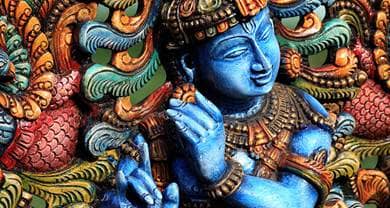
Hinduism is a religion that originated in the Indian subcontinent and is the oldest surviving religion in the world. It is a diverse religion that encompasses a wide range of beliefs and practices, but at its core, Hinduism is a monistic religion that recognizes the ultimate unity of all existence.
Hinduism is based on the belief in one supreme being, known as Brahman, who is the ultimate reality and source of all creation. Hindus believe in the cycle of reincarnation, in which the soul is reborn into a new body after death. The goal of Hinduism is to achieve moksha, or liberation from the cycle of reincarnation and union with Brahman.
Hindus follow a variety of practices, including puja (worship) of deities, yoga, and various rituals. Hinduism also has a rich tradition of texts, including the Vedas, the Upanishads, and the Bhagavad Gita. Hinduism has a strong emphasis on personal devotion and spiritual growth, and there is a wide range of philosophical and spiritual traditions within Hinduism.
Hinduism is the majority religion in India, and it also has a significant presence in other parts of the world, including Nepal, Indonesia, and the Caribbean. It is a complex and multifaceted religion that has evolved over the course of its long history and continues to influence the spiritual and cultural life of millions of people around the world.
Hinduism is a collective term applied to the many philosophical and religious traditions native to India. Hinduism has neither a specific moment of origin nor a specific founder. Rather, the tradition understands itself to be timeless, having always existed. Indeed, its collection of sacred texts is known, as a whole, as Sanatana Dharma, "The Eternal Teaching."
It is thus a complex tradition that encompasses numerous interrelated religious doctrines and practices that have some common characteristics but which lack any unified system of beliefs and practices. Hinduism encompasses a number of major sects, as well as countless subsects with local or regional variations. On one level, it is possible to view these sects as distinct religious traditions, with often very specific theologies and ritual traditions; on another level, however, they often understand themselves to be different means to reach a common end.
The Hindu worldview is grounded in the doctrines of samsara (the cycle of rebirth) and karma (the universal law of cause and effect), and fundamentally holds that one's actions (including one's thoughts) directly determine one's life, both one's current life and one's future lives. Many, but not all, Hindus hold that the cosmos is populated by numerous deities and spiritual beings — gods and goddesses, or devas — who actively influence the world and who interact with humans.
The tradition is typically divided into four major sects: Shaiva (devotees of the god Shiva), Vaishnava (devotees of the god Vishnu), Shakta (devotees of the goddess), and Smarta (those who understand the ultimate form of the divine to be abstract and all encompassing, Brahman).
Learn from Patheos experts on Hinduism here.
Quick Fact Details:
- Formed: The exact beginnings of Hinduism are impossible to determine, since they evolved as time and culture impacted the religious ideas of early India.
- Deity: Many Hindus recognize a vast diversity of gods and goddesses; others believe in a Hindu "trinity" (trimurti): Brahman, Vishnu, Shiva; yet others claim an essential monotheism, believing that all the gods are manifestations of one.
Quick Fact Sources include www.adherents.com, www.bbc.co.uk/religion, The Oxford Handbook of Global Religions (2006), The Encyclopedia of Religion (2005), the Religious Movements Page at the University of Virginia, The Cambridge Illustrated History of Religions (2002), and the Encyclopedia of World Religions (1999).
Suhag Shukla tells us what it means to be Hindu in today's world
Related Content:
Quick Facts
Formed c. 2000 B.C.E. Adherents 1,000,000,000 Deity Polytheistic Sacred Text Vedas, Upanishads, Bhagavad Gita, Epics Origin India Headquarters None
Back to Religion Library
editors picks View all columns

Evangelical
Before You Unplug or Sign Out for Good

Evangelical
What Is the Purpose of Spiritual Gifts, and How Do You Discover Yours?

New Visions
5 Ways to Hear What God is Telling You

Muslim
How Awake Are We? When Waking Up is Falling Asleep

Latter-day Saint
"The Church supports the use of vaccinations"

Evangelical
Luther and the Beauty of Christ

The Soul of Gospel Music Explored in New Netflix Series "Voices of Fire"

Seven Ways to Think About Christian Mysticism

Evangelical

Evangelical

Muslim
Imam Ali’s letter to the Governor- Everlasting Example of Good...

Progressive Christian
Patheos Explore the world's faith through different perspectives on religion and spirituality! Patheos has the views of the prevalent religions and spiritualities of the world.
Ad-Free & Subscriber Log-In Subscription Support
- About Us
- 2026 Calendar
- Videos
- Podcasts
- Library of World Religions
- Faith In Media Tracker
- Advertise With Us
- Write for Us
- Privacy Policy
- Terms of Service
- Do Not Sell My Data
- Contact Us
- Radiant Digital
- Manage Newsletter Subscriptions
- Unsubscribe From Notifications
- Sitemap
Copyright 2008-2026, Patheos. All rights reserved.
Subscription Support Ad-Free & Subscriber Log-In
Follow Patheos