
BuddhistCatholicContemplativeEvangelicalGeneral ChristianHinduJewishLatter-day SaintMuslimNew VisionsProgressive Christian
Beliefs
- Buddhist
- Catholic
- Contemplative
- Evangelical
- General Christian
- Hindu
- Jewish
- Latter-day Saint
- More Voices
- Muslim
- New Visions
- Pagan
- Progressive Christian
Topics
- Religion News
- Food and Religion
- Sports and Religion
- Religious Art
- Religious Music and Entertainment
- Religious Events
- History and Religion
- Style and Religion
- Politics and Religion
- Women in Religion
- Recreation Outdoors and Religion
- Business Finance and Religion
- Careers Workplace and Religion
- Education and Religion
- Family Parenting and Religion
- Health Fitness and Religion
- Home and Religion
- Relationships and Religion
- Technology and Religion
- Travel and Religion
Columnists
- Buddhist Columnists
- Business Finance and Religion Columnists
- Careers Workplace and Religion Columnists
- Catholic Columnists
- Contemplative Columnists
- Education and Religion Columnists
- Evangelists Columnists
- Family Parenting and Religion Columnists
- General Christian Columnists
- Health Fitness and Religion Columnists
- Hindu Columnists
- History and Religion Columnists
- Home and Religion Columnists
- Jewish Columnists
- More Voices Columnists
- Latter Day Columnists
- Muslim Columnists
- New Visions Columnists
- Nonreligious Columnists
- Pagan Columnists
- Politics and Religion Columnists
- Progressive Columnists
- Recreation Outdoors and Religion Columnists
- Relationships and Religion Columnists
- Religion News Columnists
- Religious Art Columnists
- Religious Events Columnists
- Religious Music and Entertainment Columnists
- Sports and Religion Columnists
- Style and Religion Columnists
- Technology and Religion Columnists
- Travel and Religion Columnists
- Women in Religion Columnists
Resource Library
- 2026 Calendar
- Library of World Religions
- The 100 Most Holy Places on Earth
- Patheos Answers
- Podcasts
- Videos
- Faith Leaders Database
- Anglican Episcopalian
- Bahai
- Baptist
- Buddhism
- Christianity
- Confucianism
- Eastern Orthodoxy
- Hinduism
- Holiness and Pentecostal
- ISKCON
- Islam
- Judaism
- Lutheran
- Methodist
- The Church of Jesus Christ of Latter-day Saints
- New Age
- Paganism
- Presbytarian and Reformed
- Protestantism
- Religion Behind the Scenes
- Roman Catholic
- Scientology
- Shia Islam
- Sikhism
- Sufism
- Sunni Islam
- Taoism
- Zen
- See all religions
Research Tools
 Ad-Free & Subscriber Log-In Subscription Support
Ad-Free & Subscriber Log-In Subscription Support
Follow Patheos 

- Trending:
- Forgiveness
- |
- Marriage
- |
- Consciousness
- |
- Death Penalty
- |
- Election
- |
- Halloween
RELIGION LIBRARY
Christianity
Toggle navigation
Beliefs
Sacred Narratives
Since Jesus and the earliest Christians were devout Jews, Christianity shares a great deal of the worldview of Judaism. Among the many Jewish scriptures found in the Christian Bible is the Book of Genesis, which includes the sacred story of the creation of the universe and the fall of humanity. The Book of Exodus relates the sacred story of Moses and contains the Ten Commandments.
The Christian Bible also includes the stories of the prophets of Israel, in whose words Christians see the life and death of Jesus foretold. These scriptures, written before the time of Jesus, are included in the Christian Old Testament.
The New Testament is that portion of the Christian Bible that was written after the time of Jesus' death. The New Testament includes the Gospels, which relate the sacred story of the life and teachings of Jesus. Historically the Church has believed these stories to be literally true. In modern times, some Christians have viewed them as being symbolic. But they are sacred to all Christians because they reveal God's plan for humanity, which includes salvation and eternal life.
The Gospels of Matthew and Luke contain infancy narratives, the stories of the birth and youth of Jesus. According to the story told in Matthew, Jesus' mother, Mary, was a virgin betrothed to a carpenter named Joseph when she discovered she was pregnant. Joseph was going to leave her quietly, but an angel came to him in a dream and told him not to be afraid because Mary's unborn child was from the Holy Spirit. The angel then told Joseph to name the child Jesus and said that the child would save the people. Joseph did what the angel told him to do.
Matthew's Gospel says that Jesus was born in Bethlehem during the reign of Herod, King of Jerusalem. A group of magi (Eastern astrologers or wise men), came to Herod's court, saying that they had seen a star in the sky that, to them, was a sign that the king of the Jews had been born. Upon hearing this, a jealous King Herod slyly told the magi to seek the child and report back. Following the star to Bethlehem, the magi stopped at the place where Jesus was staying. Seeing the child with his mother, the magi were overjoyed and worshipped him. They gave him presents of gold, incense, and myrrh. They then returned to their home without alerting Herod as to the child's location.
An angel came to Joseph in a dream again, and warned Joseph to flee Bethlehem and take the child and his mother to Egypt. Joseph again did what the angel told him. Determined to destroy the infant Jesus, Herod ordered the death of all boys under the age of two living in the vicinity of Bethlehem. Fearing for their lives, Joseph remained with his family in Egypt until Herod died.
After Herod died, an angel told Joseph in a dream to return to the land of Israel. Joseph was afraid to return to Judea, where Herod's son was the ruler, because he had received another warning in a dream. Joseph then took his family to Nazareth and settled there.
In this story, the writer of Matthew shows how the life of Jesus was foretold by quoting the Jewish prophets Isaiah, Jeremiah, Micah, and Hosea. The Gospel of Luke tells a similar story of Jesus' birth, but without the prophecies. Luke's Gospel fills the narrative with poetry and song.
Song of Mary (also called "Magnificat")
from Luke 1:46-55 My soul proclaims the greatness of the Lord,
my spirit rejoices in God my Savior;
he has looked with favor on his lowly servant.
From this day all generations will call me blessed;
the Almighty has done great things for me and holy is his name.
He has mercy on those who fear him,
from generation to generation.
He has shown strength with his arm and has scattered the proud in their conceit,
Casting down the mighty from their thrones
and lifting up the lowly.
He has filled the hungry with good things
and sent the rich away empty.
He has come to the aid of his servant Israel,
to remember his promise of mercy,
The promise made to our ancestors,
to Abraham and his children for ever.
All four Gospels tell the story of Jesus' adult life, arrest and trial, crucifixion, and resurrection. The stories of Jesus' miracles, stories (called parables), sermons, exorcisms, and the raising of the dead are interwoven with reports of his debates with prominent Jews and conversations with his disciples.
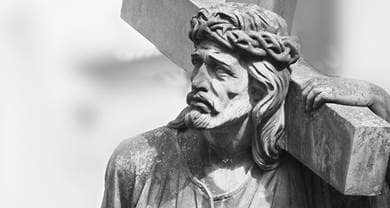
At the end of three years of ministry in and around Roman Palestine, the Gospels report that Jesus was arrested in Jerusalem at the time of Passover. They relate how he was whipped, taunted, nailed to a cross, and left to die.
According to the story, Jesus died on a Friday and was quickly buried shortly before sunset, just as the Sabbath was beginning. After the Sabbath, some of his followers went to care for his body, but his tomb was empty. They began to report appearances of Jesus. His followers were convinced that Jesus was resurrected, or come back to life.
The Book of Acts reports that Jesus remained with his followers for forty days, instructing them in God's plan for them. He promised to send them the Holy Spirit, and cautioned them against calculating the time of his return, saying that no one can know the date or time. He then ascended to the sky until a cloud hid him.
The end of the story of Jesus' life in earth is not quite the end of the story. After Jesus' ascension, Christians believe, Jesus went to reign in heaven with God, whom Jesus called Father. Jesus is also still invisibly present in the world among his followers. Someday, he will return to judge both the living and the dead, and to usher in a golden age on earth.
Study Questions:
1. In what ways do followers of Jesus connect with Jewish narratives?
2. What does the New Testament reveal about Jesus' life?
3. How are the gospels similar? Where do they differ?
4. How does the Christian narrative continue, even after Jesus' death and resurrection?
Back to Religion Library
Editor's picks See all columnists

Evangelical
Before You Unplug or Sign Out for Good

Evangelical
What Is the Purpose of Spiritual Gifts, and How Do You Discover Yours?

New Visions
5 Ways to Hear What God is Telling You

Muslim
How Awake Are We? When Waking Up is Falling Asleep

Latter-day Saint
"The Church supports the use of vaccinations"

Evangelical
Luther and the Beauty of Christ

The Soul of Gospel Music Explored in New Netflix Series "Voices of Fire"

Seven Ways to Think About Christian Mysticism

Evangelical

Evangelical

Muslim
Imam Ali’s letter to the Governor- Everlasting Example of Good...

Progressive Christian
Patheos Explore the world's faith through different perspectives on religion and spirituality! Patheos has the views of the prevalent religions and spiritualities of the world.
Ad-Free & Subscriber Log-In Subscription Support
- About Us
- 2026 Calendar
- Videos
- Podcasts
- Library of World Religions
- Faith In Media Tracker
- Advertise With Us
- Write for Us
- Privacy Policy
- Terms of Service
- Do Not Sell My Data
- Contact Us
- Radiant Digital
- Manage Newsletter Subscriptions
- Unsubscribe From Notifications
- Sitemap
Copyright 2008-2026, Patheos. All rights reserved.
Subscription Support Ad-Free & Subscriber Log-In
Follow Patheos