
BuddhistCatholicContemplativeEvangelicalGeneral ChristianHinduJewishLatter-day SaintMuslimNew VisionsProgressive Christian
Beliefs
- Buddhist
- Catholic
- Contemplative
- Evangelical
- General Christian
- Hindu
- Jewish
- Latter-day Saint
- More Voices
- Muslim
- New Visions
- Pagan
- Progressive Christian
Topics
- Religion News
- Food and Religion
- Sports and Religion
- Religious Art
- Religious Music and Entertainment
- Religious Events
- History and Religion
- Style and Religion
- Politics and Religion
- Women in Religion
- Recreation Outdoors and Religion
- Business Finance and Religion
- Careers Workplace and Religion
- Education and Religion
- Family Parenting and Religion
- Health Fitness and Religion
- Home and Religion
- Relationships and Religion
- Technology and Religion
- Travel and Religion
Columnists
- Buddhist Columnists
- Business Finance and Religion Columnists
- Careers Workplace and Religion Columnists
- Catholic Columnists
- Contemplative Columnists
- Education and Religion Columnists
- Evangelists Columnists
- Family Parenting and Religion Columnists
- General Christian Columnists
- Health Fitness and Religion Columnists
- Hindu Columnists
- History and Religion Columnists
- Home and Religion Columnists
- Jewish Columnists
- More Voices Columnists
- Latter Day Columnists
- Muslim Columnists
- New Visions Columnists
- Nonreligious Columnists
- Pagan Columnists
- Politics and Religion Columnists
- Progressive Columnists
- Recreation Outdoors and Religion Columnists
- Relationships and Religion Columnists
- Religion News Columnists
- Religious Art Columnists
- Religious Events Columnists
- Religious Music and Entertainment Columnists
- Sports and Religion Columnists
- Style and Religion Columnists
- Technology and Religion Columnists
- Travel and Religion Columnists
- Women in Religion Columnists
Resource Library
- 2026 Calendar
- Library of World Religions
- The 100 Most Holy Places on Earth
- Patheos Answers
- Podcasts
- Videos
- Faith Leaders Database
- Anglican Episcopalian
- Bahai
- Baptist
- Buddhism
- Christianity
- Confucianism
- Eastern Orthodoxy
- Hinduism
- Holiness and Pentecostal
- ISKCON
- Islam
- Judaism
- Lutheran
- Methodist
- The Church of Jesus Christ of Latter-day Saints
- New Age
- Paganism
- Presbytarian and Reformed
- Protestantism
- Religion Behind the Scenes
- Roman Catholic
- Scientology
- Shia Islam
- Sikhism
- Sufism
- Sunni Islam
- Taoism
- Zen
- See all religions
Research Tools
 Ad-Free & Subscriber Log-In Subscription Support
Ad-Free & Subscriber Log-In Subscription Support
Follow Patheos 

- Trending:
- Forgiveness
- |
- Marriage
- |
- Consciousness
- |
- Death Penalty
- |
- Election
- |
- Halloween
Latter-day Saint
The Kingdom of God: Here and Now
February 07, 2013 by James Faulconer
Many critics of Christianity portray it as a religion merely of other-worldly transcendence. But as even a cursory glance at the work of thinkers like Thomas Aquinas, Duns Scotus, Nicholas of Cusa, or many other thinkers would show, such critics argue against a straw person and feel proud of themselves when that person burns easily.
Unfortunately, though, the critics' naïve understanding of Christianity is one that Christians themselves have not always avoided and have sometimes encouraged. Think of the many 19th- and early 20th-century hymns and folk songs that long for eternity as an escape from this world.
The hymn "In the Sweet By and By" (1868), for example, bids us live in hope of "a dwelling place" in "a land that is fairer than day" and that we can only see from afar. As sweet as much of this music is, it urges on us a world-denying Christianity. It embodies a view that Nietzsche would describe as self-loathing and that merits Joe Hill's parody:
Long-haired preachers come out every night,
Try to tell you what's wrong and what's right;
But when asked how 'bout something to eat
They will answer in voices so sweet
You will eat, by and by,
In that glorious land above the sky;
Work and pray, live on hay,
You'll get pie in the sky when you die.
Whatever Jesus' actual message or the content of actual Christian theologies, as Nietzsche and Hill note, Christians have sometimes understood their religion to offer them merely a kingdom beyond this world: "a ladder to heaven" in Nietzsche's terms; "pie in the sky when you die" for Joe Hill.
The kind of Christianity that can be inferred from those kinds of hymns and sermons offers our critics an easy target for criticism, whether naïve or sophisticated. But such targets are not genuinely Christian ones.
Without the Incarnation, Christianity might be a teaching in this world for how to obtain a reward in another world. But as we often fail to remember, with the Incarnation Christianity is explicitly a teaching about and for this world. The paradox of the God-man is the paradox of transcendence in rather than beyond immanence.
The earliest Christian Council (Nicaea, 325) was called, among other reasons, to combat the Gnostic heresy that Christianity is really about some other world rather than this one. The Council was called to make it clear that Jesus was fully human and fully divine rather than "an artful dodger into invisible immanence," to quote Ernst Bloch (Atheism in Christianity: The Religion of the Exodus and the Kingdom, 115).
Those whom we now loosely gather under the name "Gnostics" separated God's kingdom from human temporal existence, conflating the latter with the order of alienation from God. At first glance that sounds similar to Christianity: this is a fallen world in which we find ourselves, at least at first, alienated from God. But Gnostics believed that one cannot overcome the alienation in this world except through asceticism and knowing (gnōsis), which could save the soul but not the irredeemable body. The body, after all, was merely one of the traps of this world and, therefore, something to escape.
Gnostics insisted that the place and order of human existence is the creation of the lowest class of the 365 angelic powers, not the work of the Father. According to them, that angelic power is the God of Judaism, called the demiurge, and is antagonistic to the Father. To rescue us from the demiurge and the world in which he has entrapped us, the Father sent his "Christ-Nous" to appear through Jesus of Nazareth.
But, Gnostics claimed that since this Christ-Nous is God he was not and could not have been incarnate. So he also could not have been crucified. Instead, they said, Simon of Cyrene (Mt. 27:32) was crucified in his place. It was against this Gnostic view that the Council of Nicaea argued for Jesus' transcendence in immanence. They insisted that he was both fully human and fully divine.
That idea was not an invention of the Council of Nicaea. Nor was it a belief inferred from philosophical reflection on other beliefs. The Council argued for an already-existing Christian belief. Indeed, the Gospels appear to have been written at least partly to testify of Jesus' dual nature, and 1 John may have been written to counter Gnostic ideas. Christianity has preached transcendence in immanence from the beginning.
But what about scriptures that seem to teach explicitly that Jesus comes to us from an other-worldly, transcendent realm? Among the most obvious are John 8:23 and John 18:36. The first says "I am from above . . . I am not of this world." The second says, "My kingdom is not of this world." It is not difficult to see these as proof-texts for a belief in the wholly transcendent realm of God.
Article Continued On Next Page
Page: 1 of 2
12/2/2022 9:09:20 PM
Mormon
Speaking Silence
Heaven
History
Kingdom
Sacred Texts
Mormonism
more at patheos
1

Acclaimed Author Kurt Andersen Identifies Trump as a Con Man
2

If Birds Talked, They Couldn’t Fly
3

Is There A Biblical Explanation For UFOs?
4
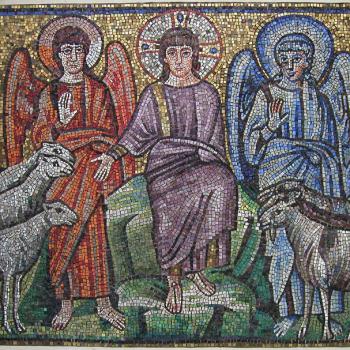
Jesus & the “Sheep” & “Goats” vs. “Faith Alone”

About James Faulconer
James Faulconer is a Richard L. Evans Professor of Religious Understanding at Brigham Young University, where he has taught philosophy since 1975.
Patheos Explore the world's faith through different perspectives on religion and spirituality! Patheos has the views of the prevalent religions and spiritualities of the world.
Ad-Free & Subscriber Log-In Subscription Support
- About Us
- 2026 Calendar
- Videos
- Podcasts
- Library of World Religions
- Faith In Media Tracker
- Advertise With Us
- Write for Us
- Privacy Policy
- Terms of Service
- Do Not Sell My Data
- Contact Us
- Radiant Digital
- Manage Newsletter Subscriptions
- Unsubscribe From Notifications
- Sitemap
Copyright 2008-2026, Patheos. All rights reserved.
Subscription Support Ad-Free & Subscriber Log-In
Follow Patheos