
BuddhistCatholicContemplativeEvangelicalGeneral ChristianHinduJewishLatter-day SaintMuslimNew VisionsProgressive Christian
Beliefs
- Buddhist
- Catholic
- Contemplative
- Evangelical
- General Christian
- Hindu
- Jewish
- Latter-day Saint
- More Voices
- Muslim
- New Visions
- Pagan
- Progressive Christian
Topics
- Religion News
- Food and Religion
- Sports and Religion
- Religious Art
- Religious Music and Entertainment
- Religious Events
- History and Religion
- Style and Religion
- Politics and Religion
- Women in Religion
- Recreation Outdoors and Religion
- Business Finance and Religion
- Careers Workplace and Religion
- Education and Religion
- Family Parenting and Religion
- Health Fitness and Religion
- Home and Religion
- Relationships and Religion
- Technology and Religion
- Travel and Religion
Columnists
- Buddhist Columnists
- Business Finance and Religion Columnists
- Careers Workplace and Religion Columnists
- Catholic Columnists
- Contemplative Columnists
- Education and Religion Columnists
- Evangelists Columnists
- Family Parenting and Religion Columnists
- General Christian Columnists
- Health Fitness and Religion Columnists
- Hindu Columnists
- History and Religion Columnists
- Home and Religion Columnists
- Jewish Columnists
- More Voices Columnists
- Latter Day Columnists
- Muslim Columnists
- New Visions Columnists
- Nonreligious Columnists
- Pagan Columnists
- Politics and Religion Columnists
- Progressive Columnists
- Recreation Outdoors and Religion Columnists
- Relationships and Religion Columnists
- Religion News Columnists
- Religious Art Columnists
- Religious Events Columnists
- Religious Music and Entertainment Columnists
- Sports and Religion Columnists
- Style and Religion Columnists
- Technology and Religion Columnists
- Travel and Religion Columnists
- Women in Religion Columnists
Resource Library
- 2026 Calendar
- Library of World Religions
- The 100 Most Holy Places on Earth
- Patheos Answers
- Podcasts
- Videos
- Faith Leaders Database
- Anglican Episcopalian
- Bahai
- Baptist
- Buddhism
- Christianity
- Confucianism
- Eastern Orthodoxy
- Hinduism
- Holiness and Pentecostal
- ISKCON
- Islam
- Judaism
- Lutheran
- Methodist
- The Church of Jesus Christ of Latter-day Saints
- New Age
- Paganism
- Presbytarian and Reformed
- Protestantism
- Religion Behind the Scenes
- Roman Catholic
- Scientology
- Shia Islam
- Sikhism
- Sufism
- Sunni Islam
- Taoism
- Zen
- See all religions
Research Tools
 Ad-Free & Subscriber Log-In Subscription Support
Ad-Free & Subscriber Log-In Subscription Support
Follow Patheos 

- Trending:
- Forgiveness
- |
- Marriage
- |
- Consciousness
- |
- Death Penalty
- |
- Election
- |
- Halloween
Latter-day Saint
The Christian Alternative to Demonic Happiness and Unendurable Freedom
January 02, 2013 by James Faulconer
Simon Critchley has published a Christmas sermon in the New York Times, a retelling of Dostoevsky's story from The Brothers Karamazov of the Grand Inquisitor and his encounter with Jesus, told so as to make pointed the question of whether Christian faith really is superior to the demonic happiness that the Inquisitor works to make possible. "Is the Grand Inquisitor's lie not a noble one?" Critchley asks. And he answers, "I don't know the answer to this question. Which should we choose: diabolical happiness or unendurable freedom?"
As always Critchley's piece is carefully thought out and superbly written. Nevertheless, its unspoken premise is profoundly mistaken. Like Ivan, he assumes that the options of Dostoevsky's story are the only two. But we cannot forget that the Grand Inquisitor tells both stories, and that the love he has found for humankind is a love that includes the auto de fe, which he has recently attended and to which he will add Jesus. We have to wonder about the honesty of the Inquisitor, with himself as well as with Jesus.
In the story the Inquisitor pits two grand narratives against one another. In one, heroic faith, forged in doubt and self-denial and attainable by only a very few, grants a freedom that few can endure. In that narrative all those who cannot attain such heroism are condemned.
According to the other narrative, some like the Inquisitor know that few human beings can stand the freedom of faith. To create a universal, harmonious church-state they have sacrificed themselves to offer people happiness rather than freedom. In fact, they have freed people from the agony of freedom by offering them fulfillment of desire.
The Inquisitor knows that the happiness he offers will, as Critchley says, amount to moral and spiritual suicide for the rich and murderous envy for the poor. He certainly knows that it has meant the ironically named auto de fe. He knows that the happiness he offers is demonic.
According to the Grand Inquisitor then, we have two choices, the freedom of a few and the condemnation of most to a freedom that is impossible to bear, or the deaths of relatively few with a promise to many of happiness as the temporary fulfillment of desire. On one side, a few saved, with most condemned to the agony of freedom. On the other side, a few condemned to death and most living in the demonic illusion of happiness.
Neither option is all that appealing. No wonder that Critchley cannot choose between them.
But like Ivan, Critchley doesn't give enough significance to Jesus' and Alyosha's kisses. The second of these isn't a matter of plagiarism. It is Kierkegaardian repetition. It isn't mere imitation, which would make it plagiarism. Instead it is the genuine repetition of the same act. It is Ivan's repetition of Jesus' love and hope.
Critchley recognizes that faith is hope for grace, but when he reads the Inquisitor's story he is seduced into letting that drop out of his understanding of Christian freedom. If troth, fidelity, makes the Christian free, then freedom is not radical freedom of conscience. Nor is it radical freedom of action. The choice of Christian freedom is not a heroic act, for that freedom comes through grace.
Christian freedom would be unendurable if it were the pure freedom to make or remake ourselves. But it is not that at all. It is, instead, the freedom to be remade. Christian freedom is not freedom to do anything. It is freedom from ourselves, from who we have been and are. Christian freedom is the freedom of atonement.
Critchley recognizes that the freedom Jesus offers isn't libertarian freedom, but a freedom that comes from fidelity to the person Jesus, the freedom from the burden of sin, a burden that we cannot avoid. But he seems not to remember that as he thinks through the Inquisitor's narratives, and he shifts to freedom as freedom of conscience or freedom of choice or something like them, a matter of will and heroism in any case.
If that were what Christian freedom amounted to, then the perfection commanded Christians would be, at best, a pipe dream and, at worst, the agony envisioned by the Inquisitor.
But when Jesus says "Be ye therefore perfect (teleios)" (Mt. 5:48), what he says can only be understood in the context of what he has just been teaching, the things that lead up to this commandment: blessed are those who are impoverished in spirit, and those who mourn, those who are meek, those who hunger for righteousness, who are merciful, who are pure in heart, who seek peace, who are persecuted for being upright. Jesus promises that those who are weak and who suffer can be blessed (makarios), can be happy. The promise is not made to those with heroic strength of will or character, but to those without it. And the promise is happiness rather than free will.
Article Continued On Next Page
Page: 1 of 2
12/2/2022 9:09:20 PM
Mormon
Speaking Silence
Atonement
Freedom
Morality
Mormonism
more at patheos
1

An Epilogue to Our God Is an Awesome Brand
2

Road to Eternity: War, Endless War
3
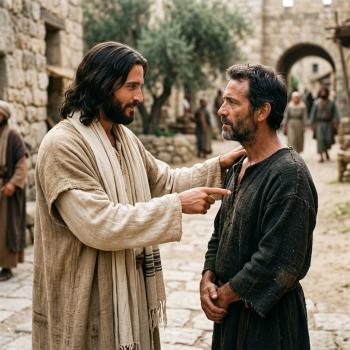
The Gospel That Demands You Speak Up
4

Permanent Trump Secure Border Act Explained

About James Faulconer
James Faulconer is a Richard L. Evans Professor of Religious Understanding at Brigham Young University, where he has taught philosophy since 1975.
Patheos Explore the world's faith through different perspectives on religion and spirituality! Patheos has the views of the prevalent religions and spiritualities of the world.
Ad-Free & Subscriber Log-In Subscription Support
- About Us
- 2026 Calendar
- Videos
- Podcasts
- Library of World Religions
- Faith In Media Tracker
- Advertise With Us
- Write for Us
- Privacy Policy
- Terms of Service
- Do Not Sell My Data
- Contact Us
- Radiant Digital
- Manage Newsletter Subscriptions
- Unsubscribe From Notifications
- Sitemap
Copyright 2008-2026, Patheos. All rights reserved.
Subscription Support Ad-Free & Subscriber Log-In
Follow Patheos