
BuddhistCatholicContemplativeEvangelicalGeneral ChristianHinduJewishLatter-day SaintMuslimNew VisionsProgressive Christian
Beliefs
- Buddhist
- Catholic
- Contemplative
- Evangelical
- General Christian
- Hindu
- Jewish
- Latter-day Saint
- More Voices
- Muslim
- New Visions
- Pagan
- Progressive Christian
Topics
- Religion News
- Food and Religion
- Sports and Religion
- Religious Art
- Religious Music and Entertainment
- Religious Events
- History and Religion
- Style and Religion
- Politics and Religion
- Women in Religion
- Recreation Outdoors and Religion
- Business Finance and Religion
- Careers Workplace and Religion
- Education and Religion
- Family Parenting and Religion
- Health Fitness and Religion
- Home and Religion
- Relationships and Religion
- Technology and Religion
- Travel and Religion
Columnists
- Buddhist Columnists
- Business Finance and Religion Columnists
- Careers Workplace and Religion Columnists
- Catholic Columnists
- Contemplative Columnists
- Education and Religion Columnists
- Evangelists Columnists
- Family Parenting and Religion Columnists
- General Christian Columnists
- Health Fitness and Religion Columnists
- Hindu Columnists
- History and Religion Columnists
- Home and Religion Columnists
- Jewish Columnists
- More Voices Columnists
- Latter Day Columnists
- Muslim Columnists
- New Visions Columnists
- Nonreligious Columnists
- Pagan Columnists
- Politics and Religion Columnists
- Progressive Columnists
- Recreation Outdoors and Religion Columnists
- Relationships and Religion Columnists
- Religion News Columnists
- Religious Art Columnists
- Religious Events Columnists
- Religious Music and Entertainment Columnists
- Sports and Religion Columnists
- Style and Religion Columnists
- Technology and Religion Columnists
- Travel and Religion Columnists
- Women in Religion Columnists
Resource Library
- 2026 Calendar
- Library of World Religions
- The 100 Most Holy Places on Earth
- Patheos Answers
- Podcasts
- Videos
- Faith Leaders Database
- Anglican Episcopalian
- Bahai
- Baptist
- Buddhism
- Christianity
- Confucianism
- Eastern Orthodoxy
- Hinduism
- Holiness and Pentecostal
- ISKCON
- Islam
- Judaism
- Lutheran
- Methodist
- The Church of Jesus Christ of Latter-day Saints
- New Age
- Paganism
- Presbytarian and Reformed
- Protestantism
- Religion Behind the Scenes
- Roman Catholic
- Scientology
- Shia Islam
- Sikhism
- Sufism
- Sunni Islam
- Taoism
- Zen
- See all religions
Research Tools
 Ad-Free & Subscriber Log-In Subscription Support
Ad-Free & Subscriber Log-In Subscription Support
Follow Patheos 

- Trending:
- Forgiveness
- |
- Marriage
- |
- Consciousness
- |
- Death Penalty
- |
- Election
- |
- Halloween
Hindu
Religious Pluralism: The Key to Overcoming Global Conflict and Achieving Peace
January 06, 2013 by Ramesh Rao
At the end of his presentation, Ipson asked the audience what they felt were the answers to reducing conflict and hate. There were the usual suggestions of education, interfaith dialogue, acceptance, and so on. I raised my hand. Once again, there was some uncomfortable shifting in the chairs. I was, after all, the first one in the audience to say that some people learn hate from religion, and Ipson had acknowledged that. He also found that I was the one person in the audience who knew the group, other than the Nazis, who had mandated the wearing of a piece of colored cloth to identify the "other": these were the Taliban, who in Afghanistan had mandated that Hindus wear yellow-colored clothing to identify themselves as Hindus.
:::page break:::
I said that I felt one of the fundamental reasons why there is religion-fuelled conflict is because of the claims made by some members of exclusivist religions: that they are the ones who know the true God, and that it is the command of their religions for them to convert the non-Christian and the non-Muslim. "As soon as you say that my God is not good enough for me, you get my back up, and that has fuelled insanity for the past two millennia," I argued.
The couple of Jewish friends in the audience nodded their heads as well as some of my secular-Christian colleagues and students. Ipson concurred with me.
Two days later the Presbyterian minister, who was in the audience, spoke to me. He argued that I could not falsify the claim that "Jesus was the only son of God," revealing to me, again, the power of well-circulated fallacies. I pointed out to my good friend that he was doing a confused reading of the philosopher Karl Popper's thesis that only that which is falsifiable is scientifically verifiable knowledge. Because I cannot disprove that Jesus was the only son of God does not mean that Jesus is the only son of God, I told my friend. It simply means that your assertion cannot be either proved or disproved, and so it is not a verifiable or scientific claim.
He then argued that it was his fundamental right, under American law, as well as the Universal Declaration of Human Rights, that allowed him to spread the message of his God to others. I told him that I am all for freedom of speech, but that the freedom, if wrongly used to assert unverifiable claims, or to demean and demonize others' faiths led to conflict. Religion-influenced conflict, I said, is the biggest bane of humanity now.
I told him that it is not as if we could argue about the claims of automobile manufacturers, for example, that their cars and trucks are more reliable and provide better gas mileage than their competitors' cars and trucks. "Oh, but we can," he asserted. I asked him if economic analyses showed that Christians are healthier than Muslims or Hindus, or whether Christians earned more than Sikhs, or if Christians were more loving than Buddhists. It seemed as if he was about to mention Samuel Huntington's thesis about the "clash of civilizations" to argue that there was some kind of sociological or cultural evidence that indeed Christians were "better" than others, but we had to end our conversation. However, my friend is not the only one who believes that Christianity is directly or indirectly responsible for what we take to be the good of modern capitalism and free market economies: there are a whole host of Christians making that argument, and indirect claims to the superiority or uniqueness of their God.
:::page break:::
I am a Hindu, and I believe Hindu traditions are pluralistic. I believe that they enable the individual to seek God through different means, on a variety of paths. One can choose to worship God in many ways, and have a favorite deity or many favorite deities. There are nearly twenty Sanskrit terms for the English word "god," and Western scholars who have studied Hinduism have been struck by the fact that the god that was praised in a hymn was praised as "the only one, the supreme, the greatest," and that this praise was not restricted to one god but to various gods in various hymns, indicating the belief that God can take many forms, but is one.
Hinduism has always represented both cultural and religious pluralism. The Rig Veda, the oldest extant Hindu text, is both local in its grounding and universal in its embrace of all humanity, including the whole cosmos. This old, universal view that constitutes Sanatana Dharma, did not present religion and spirituality as something unique and separate to the tribe or group. We do need to keep in mind, however, that what the sages and saints of yore provided for humanity were ways of understanding the primordial, and the lessons to make life meaningful. The lessons and practices of meditation, of discipline, and of sustenance and insight provided people with the practical and theoretical framework for daily living as well as fulfilling the human longing for salvation. This was the message that Swami Vivekananda propagated when he first arrived in the U.S. in 1893. And this was what he said when he spoke to mesmerized audiences in England in 1896:
Article Continued On Next Page
Page: 2 of 3
12/2/2022 9:08:55 PM
Hindu
God in the Age of Kali
History
Interfaith Dialogue
Pluralism
Hinduism
more at patheos
1

2
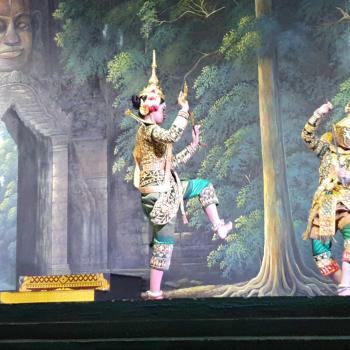
The Four Comforting Myths Hindus Tell Themselves
3

God Warned Us About Trump. We Have No Excuse.
4

When the Disinformation Machine Comes to Your Hometown
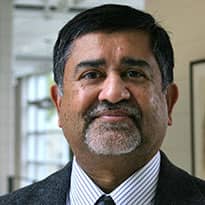
About Ramesh Rao
Ramesh Rao, Professor and Chair, DN3 Program, Columbus State University, Columbus, GA, is the author of two books on Indian politics and society and has written numerous op-eds for newspapers and magazines in India, the U.S., and the U.K. Ramesh served as Human Rights Coordinator and Executive Council member at the Hindu American Foundation between 2004-2013. He spent the first twenty-eight years of his life in India where he worked as a bank officer, a school teacher, and a copy editor. He received his MS in Mass Communication from the University of Southern Mississippi, and his PhD in Communication from Michigan State University. He taught at Truman State University in Kirksville, MO, and Longwood University in Farmville, VA, before he joined Columbus State University. He lives with wife Sujaya, and son Sudhanva in Columbus, GA.
Patheos Explore the world's faith through different perspectives on religion and spirituality! Patheos has the views of the prevalent religions and spiritualities of the world.
Ad-Free & Subscriber Log-In Subscription Support
- About Us
- 2026 Calendar
- Videos
- Podcasts
- Library of World Religions
- Faith In Media Tracker
- Advertise With Us
- Write for Us
- Privacy Policy
- Terms of Service
- Do Not Sell My Data
- Contact Us
- Radiant Digital
- Manage Newsletter Subscriptions
- Unsubscribe From Notifications
- Sitemap
Copyright 2008-2026, Patheos. All rights reserved.
Subscription Support Ad-Free & Subscriber Log-In
Follow Patheos