
BuddhistCatholicContemplativeEvangelicalGeneral ChristianHinduJewishLatter-day SaintMuslimNew VisionsProgressive Christian
Beliefs
- Buddhist
- Catholic
- Contemplative
- Evangelical
- General Christian
- Hindu
- Jewish
- Latter-day Saint
- More Voices
- Muslim
- New Visions
- Pagan
- Progressive Christian
Topics
- Religion News
- Food and Religion
- Sports and Religion
- Religious Art
- Religious Music and Entertainment
- Religious Events
- History and Religion
- Style and Religion
- Politics and Religion
- Women in Religion
- Recreation Outdoors and Religion
- Business Finance and Religion
- Careers Workplace and Religion
- Education and Religion
- Family Parenting and Religion
- Health Fitness and Religion
- Home and Religion
- Relationships and Religion
- Technology and Religion
- Travel and Religion
Columnists
- Buddhist Columnists
- Business Finance and Religion Columnists
- Careers Workplace and Religion Columnists
- Catholic Columnists
- Contemplative Columnists
- Education and Religion Columnists
- Evangelists Columnists
- Family Parenting and Religion Columnists
- General Christian Columnists
- Health Fitness and Religion Columnists
- Hindu Columnists
- History and Religion Columnists
- Home and Religion Columnists
- Jewish Columnists
- More Voices Columnists
- Latter Day Columnists
- Muslim Columnists
- New Visions Columnists
- Nonreligious Columnists
- Pagan Columnists
- Politics and Religion Columnists
- Progressive Columnists
- Recreation Outdoors and Religion Columnists
- Relationships and Religion Columnists
- Religion News Columnists
- Religious Art Columnists
- Religious Events Columnists
- Religious Music and Entertainment Columnists
- Sports and Religion Columnists
- Style and Religion Columnists
- Technology and Religion Columnists
- Travel and Religion Columnists
- Women in Religion Columnists
Resource Library
- 2026 Calendar
- Library of World Religions
- The 100 Most Holy Places on Earth
- Patheos Answers
- Podcasts
- Videos
- Faith Leaders Database
- Anglican Episcopalian
- Bahai
- Baptist
- Buddhism
- Christianity
- Confucianism
- Eastern Orthodoxy
- Hinduism
- Holiness and Pentecostal
- ISKCON
- Islam
- Judaism
- Lutheran
- Methodist
- The Church of Jesus Christ of Latter-day Saints
- New Age
- Paganism
- Presbytarian and Reformed
- Protestantism
- Religion Behind the Scenes
- Roman Catholic
- Scientology
- Shia Islam
- Sikhism
- Sufism
- Sunni Islam
- Taoism
- Zen
- See all religions
Research Tools
 Ad-Free & Subscriber Log-In Subscription Support
Ad-Free & Subscriber Log-In Subscription Support
Follow Patheos 

- Trending:
- Forgiveness
- |
- Marriage
- |
- Consciousness
- |
- Death Penalty
- |
- Election
- |
- Halloween
Faith Figures and Leaders Database
Martin Luther
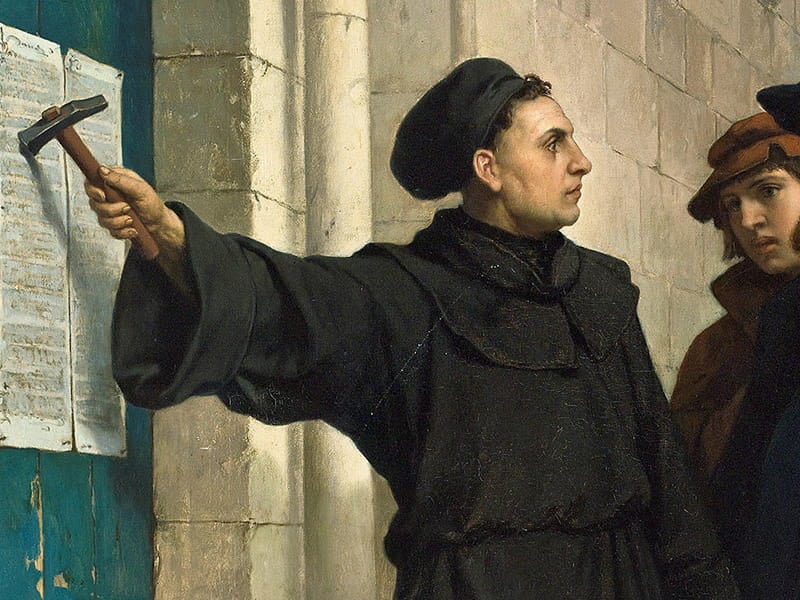
Image source: Public Domain
- Faith: Christianity
- Profession: Monk
- Lived: November 10, 1483 - February 18, 1546 (Reformation)
- Nationality: Mansfeld (present-day Germany)
- Known for: Luther's challenge to church corruption instigated the Reformation
- Fun Fact: Luther never intended to cause a schism. A devout Catholic monk, his goal was to reform the Church away from its corrupt ways.
- Fun Fact: Luther was famous for his colorful insults (many of them unprintable here.) Here's one aimed at the pope: "“May God punish you, I say, you shameless, barefaced liar, devil’s mouthpiece, who dares to spit out, before God, before all the angels, before the dear sun, before all the world, your devil’s filth."
- Fun Fact:
Martin Luther was an Augustinian Catholic monk who loved the faith. He never intended to cause a schism—his goal was to move the Church away from corrupt practices. If Catholic authorities had responded more quickly and reasonably to Luther’s complaints, the reforms may have happened within Catholicism. But they did not, and schism it was—his 99 Theses in 1517 is considered the beginning of the Protestant reformation.
Born in 1483 in Eisleben, Mansfeld (an area now part of Germany), Luther’s father owned copper mines and was a town council member. In college, Luther rejected the law for being unconcerned with truth, and philosophy for being too focused on reason rather than truth. He entered an Augustinian monastery at 21 and several years later was invited to join the new University of Wittenberg, where got his doctorate and eventually chaired the theology department; he became vicar of all Augustinian monasteries in Saxony. Luther was deeply troubled by the aggressive selling of indulgences (cash donations to speed a dead relative through purgatory to heaven) to the poor in his region in order to fund the construction of the magnificent St. Peter’s in Rome. He wrote a letter of complaint to the bishop, emphasizing that salvation comes from God through grace, and therefore cannot be bought, and cannot be granted by church officials. This may have been the end of it, except that it coincided with the new widespread distribution of printing presses. Copies of Luther’s complain letter were translated and printed throughout Europe within months. Eventually, Luther was tried for heresy; untethered now and oppositional, Luther started finding other disagreements, including challenging the pope’s authority to interpret scripture. The pope issues a document ordering Luther to recant, which Luther publicly burned. He was excommunicated and at after refusing to recant at Worms, charged with heresy. Luther had powerful friends however, and they helped him escape and protected him as he continued to write—challenging the legitimacy of monastic orders (he, an ex-monk, married an ex-nun, helping legitimize married clergy in the emerging Protestant movement), compulsory confession, and private mass (a common practice of the wealthy), translating both the Bible and parts of the liturgy into German, and eventually linking the papacy to prophesies of the antichrist. All was published and distributed widely.
Other reformers started entering the picture, advocating much more radical changes, including adult “re-baptism,” the abandonment of liturgy, and views on equality under God that riled up the masses against the power structures of the time. Luther’s wealthy friends, and his own desire to keep the faith closer to Catholicism (especially in not abandoning the Catholic understanding and practice of Communion), led him to fight against these reformers, and even sanction violent suppression of peasant revolts. But the cat was out of the bag, and reform leaders with various agendas went in all sorts of directions.
Luther’s most famous stain is his anti-Semitism. Though his views were typical for the time (Jews had been expelled from the region in which he lived), Luther elaborated theological justifications for condemning Jews as enemies, and with his blunt way of writing, sanctioned violence against them, laying the groundwork for centuries of open anti-Semitism in Germany. Nazis grounded their anti-Jewish messages with quotes from Luther.
He didn’t mean to start the Reformation, and he was colorful, sometimes ornery to the point of hateful, but Martin Luther’s smart and thoughtful takedown of church corruption and practices ignited the most significant religious shift of the last millennium. Protestant sectarianism has been expanding/unravelling for the last 500 years and some believe it has run its course and that a new phase is beginning. What shape that will take, we won’t know until we’re a bit further into it.
(By the way, the Counter-Reformation finally did start within the Catholic church about 30 years later, including proper theological instruction of priests, cleaning up corruption, and new theological movements. Unfortunately, it also included religious wars and the inquisition that denounced Copernicus and Galileo.)
Back to Search Results

Search Our Database Again?
Faith Buddhism Christianity Confucianism Esotericism Hinduism ISKCON Islam Judaism New Thought Nonreligious Scientology Sikhism Society of Friends Taoism The Church of Jesus Christ of Latter-day Saints Zoroastrian
Era Early Church Early Medieval Early Modern Era Great Awakening Late Medieval Middle Ages Modern Era Prehistory Reformation Renaissance The Ancient Era The Common Era
Patheos Explore the world's faith through different perspectives on religion and spirituality! Patheos has the views of the prevalent religions and spiritualities of the world.
Ad-Free & Subscriber Log-In Subscription Support
- About Us
- 2026 Calendar
- Videos
- Podcasts
- Library of World Religions
- Faith In Media Tracker
- Advertise With Us
- Write for Us
- Privacy Policy
- Terms of Service
- Do Not Sell My Data
- Contact Us
- Radiant Digital
- Manage Newsletter Subscriptions
- Unsubscribe From Notifications
- Sitemap
Copyright 2008-2026, Patheos. All rights reserved.
Subscription Support Ad-Free & Subscriber Log-In
Follow Patheos