
BuddhistCatholicContemplativeEvangelicalGeneral ChristianHinduJewishLatter-day SaintMuslimNew VisionsProgressive Christian
Beliefs
- Buddhist
- Catholic
- Contemplative
- Evangelical
- General Christian
- Hindu
- Jewish
- Latter-day Saint
- More Voices
- Muslim
- New Visions
- Pagan
- Progressive Christian
Topics
- Religion News
- Food and Religion
- Sports and Religion
- Religious Art
- Religious Music and Entertainment
- Religious Events
- History and Religion
- Style and Religion
- Politics and Religion
- Women in Religion
- Recreation Outdoors and Religion
- Business Finance and Religion
- Careers Workplace and Religion
- Education and Religion
- Family Parenting and Religion
- Health Fitness and Religion
- Home and Religion
- Relationships and Religion
- Technology and Religion
- Travel and Religion
Columnists
- Buddhist Columnists
- Business Finance and Religion Columnists
- Careers Workplace and Religion Columnists
- Catholic Columnists
- Contemplative Columnists
- Education and Religion Columnists
- Evangelists Columnists
- Family Parenting and Religion Columnists
- General Christian Columnists
- Health Fitness and Religion Columnists
- Hindu Columnists
- History and Religion Columnists
- Home and Religion Columnists
- Jewish Columnists
- More Voices Columnists
- Latter Day Columnists
- Muslim Columnists
- New Visions Columnists
- Nonreligious Columnists
- Pagan Columnists
- Politics and Religion Columnists
- Progressive Columnists
- Recreation Outdoors and Religion Columnists
- Relationships and Religion Columnists
- Religion News Columnists
- Religious Art Columnists
- Religious Events Columnists
- Religious Music and Entertainment Columnists
- Sports and Religion Columnists
- Style and Religion Columnists
- Technology and Religion Columnists
- Travel and Religion Columnists
- Women in Religion Columnists
Resource Library
- 2026 Calendar
- Library of World Religions
- The 100 Most Holy Places on Earth
- Patheos Answers
- Podcasts
- Videos
- Faith Leaders Database
- Anglican Episcopalian
- Bahai
- Baptist
- Buddhism
- Christianity
- Confucianism
- Eastern Orthodoxy
- Hinduism
- Holiness and Pentecostal
- ISKCON
- Islam
- Judaism
- Lutheran
- Methodist
- The Church of Jesus Christ of Latter-day Saints
- New Age
- Paganism
- Presbytarian and Reformed
- Protestantism
- Religion Behind the Scenes
- Roman Catholic
- Scientology
- Shia Islam
- Sikhism
- Sufism
- Sunni Islam
- Taoism
- Zen
- See all religions
Research Tools
 Ad-Free & Subscriber Log-In Subscription Support
Ad-Free & Subscriber Log-In Subscription Support
Follow Patheos 

- Trending:
- Forgiveness
- |
- Marriage
- |
- Consciousness
- |
- Death Penalty
- |
- Election
- |
- Halloween
Catholic
"Rabble? That's Me!": Alfred E. Smith
October 22, 2012 by Pat McNamara
He liked to say he "grew up with the Brooklyn Bridge" on the Lower East Side. As the first Catholic to run for president on a major party ticket, Al Smith's was the classic rags to riches story. It began in gaslight era New York, when Trinity Church was the city's tallest building, and ended in the Empire State Building. Rising from clerk to CEO, Al Smith always considered himself an Irish Catholic kid from the Fourth Ward. He believed it was the best place in the world to grow up, a diverse community where everyone knew and looked out for each another.
An icon of Irish America, Smith was also Italian and German. For his family, the neighborhood's centerpoint was St. James Church, founded fifty years earlier by Felix Varela. From cradle to grave, St. James met every need: religious, educational, and social. Although Al left the parish school early (after his father's death), he was active in the theater group, learning public speaking techniques that served him well in politics.
These were the days of Tammany Hall, the political machine that dominated New York for a century. Although popularly associated with forces of corruption, by Smith's time it was embracing reform. As a young man, Smith would work his way up from the Fulton Street Fish Market through minor offices into the State Assembly. Although his formal education was limited, he committed himself to learning the art of lawmaking, and he succeeded.
The Triangle Fire of 1911, in which 146 factory workers died, marked a turning point for Smith: from politician to advocate. As part of the investigative commission, what he saw changed his life: single mothers working 120 hours a week and children working eighteen hours a day. When one child was asked how long she had been working, she answered "Ever since I was." Among other things, the commission helped ban child labor under fourteen, made sprinklers mandatory in factories, and required seats for all, irrespective of gender or color.
Imbued with what one biographer calls "common sense and a belief in decency," Smith became an identifiable public figure, with his brown derby and cigar, his ability to captivate a crowd, and what a peer called "his 100 percent frankness." A biographer notes that "the stage was his to command." A friend said that "vitality goes out from him like a flood." From the assembly he aspired to the governorship. Beginning in 1918, he served four terms. Here he came into his own politically, as a champion of the common man and woman.
As governor, he fought against discrimination, for workers' rights, and for decent housing. When a colleague complained about "rabble" moving into his community, Smith replied: "Rabble? That's me you're talking about." By 1924, he was emerging as a national leader in the Democratic Party during a Republican-dominated decade. (Taking credit for the era's prosperity, Republicans promised a "chicken in every pot.") Although Prohibition was the law of the land, Smith supported its repeal. And he unsuccessfully fought to have the Ku Klux Klan outlawed.
Anti-Catholicism was sweeping the nation at a level unseen since the days of the Know-Nothings. Oregon attempted to ban Catholic schools. Florida's governor warned of a Vatican takeover, and the Klan spread nationwide, stressing the Catholic "menace" to America. (At its height, national membership reached five million.) But nothing typified the era's religious hostility like the 1928 presidential campaign, when Alfred E. Smith dared run for the nation's highest office.
In Oklahoma, a minister said a vote for Smith was a vote against Christ. (When an opponent referred to papal encyclicals, Smith reputedly asked a friend, "What the hell is an encyclical?") Protestants envisioned the pope taking over the country. One journal predicted
. . . a confessional box in the White House, and the secrets of the Government whispered into the ear of a representative of the Vatican . . . [Smith] will be as a President what he has been as a Governor, the pliant tool of the most Christless system of tyranny the world has ever known.
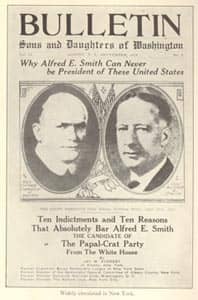
Although he received the largest popular vote of any Democratic candidate, he still lost by a wide margin. Most scholars agree that the religious factor (along with a decade of Republican prosperity) sealed Smith's fate.
His defeat was a serious blow to Catholics, reminding them that they were still outsiders. The question still remained: could Catholics be "real" Americans? Would their religious obligations conflict with their political ones? It would be another three decades before John F. Kennedy answered that question definitively.
In the aftermath of the election, a jaded Smith moved away from politics, becoming president of the corporation that built the Empire State Building. In 1932, he attempted to win the Democratic nomination once more, but lost to Franklin D. Roosevelt. Some think he never quite forgave Roosevelt for this, and during the 1930s he opposed many of the president's measures. Smith called him "the kindest man that ever lived, but don't get in his way."
Article Continued On Next Page
Page: 1 of 2
12/2/2022 9:05:40 PM
Catholic
In Ages Past
History
Christianity
Roman Catholicism
more at patheos
1

Adventurous Lectionary - Pentecost 4 - June 21, 2026
2

The Gospel of Matthew: The Coventry Carol
3

4

About Pat McNamara
Dr. Pat McNamara is a published historian. He blogs about American Catholic History at McNamara's Blog.
Patheos Explore the world's faith through different perspectives on religion and spirituality! Patheos has the views of the prevalent religions and spiritualities of the world.
Ad-Free & Subscriber Log-In Subscription Support
- About Us
- 2026 Calendar
- Videos
- Podcasts
- Library of World Religions
- Faith In Media Tracker
- Advertise With Us
- Write for Us
- Privacy Policy
- Terms of Service
- Do Not Sell My Data
- Contact Us
- Radiant Digital
- Manage Newsletter Subscriptions
- Unsubscribe From Notifications
- Sitemap
Copyright 2008-2026, Patheos. All rights reserved.
Subscription Support Ad-Free & Subscriber Log-In
Follow Patheos