
BuddhistCatholicContemplativeEvangelicalGeneral ChristianHinduJewishLatter-day SaintMuslimNew VisionsProgressive Christian
Beliefs
- Buddhist
- Catholic
- Contemplative
- Evangelical
- General Christian
- Hindu
- Jewish
- Latter-day Saint
- More Voices
- Muslim
- New Visions
- Pagan
- Progressive Christian
Topics
- Religion News
- Food and Religion
- Sports and Religion
- Religious Art
- Religious Music and Entertainment
- Religious Events
- History and Religion
- Style and Religion
- Politics and Religion
- Women in Religion
- Recreation Outdoors and Religion
- Business Finance and Religion
- Careers Workplace and Religion
- Education and Religion
- Family Parenting and Religion
- Health Fitness and Religion
- Home and Religion
- Relationships and Religion
- Technology and Religion
- Travel and Religion
Columnists
- Buddhist Columnists
- Business Finance and Religion Columnists
- Careers Workplace and Religion Columnists
- Catholic Columnists
- Contemplative Columnists
- Education and Religion Columnists
- Evangelists Columnists
- Family Parenting and Religion Columnists
- General Christian Columnists
- Health Fitness and Religion Columnists
- Hindu Columnists
- History and Religion Columnists
- Home and Religion Columnists
- Jewish Columnists
- More Voices Columnists
- Latter Day Columnists
- Muslim Columnists
- New Visions Columnists
- Nonreligious Columnists
- Pagan Columnists
- Politics and Religion Columnists
- Progressive Columnists
- Recreation Outdoors and Religion Columnists
- Relationships and Religion Columnists
- Religion News Columnists
- Religious Art Columnists
- Religious Events Columnists
- Religious Music and Entertainment Columnists
- Sports and Religion Columnists
- Style and Religion Columnists
- Technology and Religion Columnists
- Travel and Religion Columnists
- Women in Religion Columnists
Resource Library
- 2026 Calendar
- Library of World Religions
- The 100 Most Holy Places on Earth
- Patheos Answers
- Podcasts
- Videos
- Faith Leaders Database
- Anglican Episcopalian
- Bahai
- Baptist
- Buddhism
- Christianity
- Confucianism
- Eastern Orthodoxy
- Hinduism
- Holiness and Pentecostal
- ISKCON
- Islam
- Judaism
- Lutheran
- Methodist
- The Church of Jesus Christ of Latter-day Saints
- New Age
- Paganism
- Presbytarian and Reformed
- Protestantism
- Religion Behind the Scenes
- Roman Catholic
- Scientology
- Shia Islam
- Sikhism
- Sufism
- Sunni Islam
- Taoism
- Zen
- See all religions
Research Tools
 Ad-Free & Subscriber Log-In Subscription Support
Ad-Free & Subscriber Log-In Subscription Support
Follow Patheos 

- Trending:
- Forgiveness
- |
- Marriage
- |
- Consciousness
- |
- Death Penalty
- |
- Election
- |
- Halloween
Catholic
Boniface Wimmer and the Benedictines in America
July 30, 2012 by Pat McNamara
By the start of the 19th century, the Benedictine Order in Europe had almost reached its nadir. The French Revolution had destroyed many of its great houses, while Napoleon and his minions confiscated others. Over the next few decades, however, the order underwent a rebirth on both the continent and abroad. By the late 1800s, America, for one, had a vast network of Benedictine monasteries, schools, and churches, all due largely to one determined monk labeled "the greatest Catholic missionary of nineteenth century America."
He was born Sebastian Wimmer in Bavaria, a tavern keeper's son, on January 14, 1809. As a young man he considered careers in the military and the law before discovering a vocation to the priesthood. At age twenty-two he was ordained for the Diocese of Regensburg, but soon he was increasingly attracted toward the communal life of a religious order. (As a diocesan priest, he felt "entirely left to myself.")
In 1832 he entered St. Michael's, a thousand-year-old monastery in Metten. He was named Boniface for the saint who evangelized Germany. He taught in the monastic school, but his interest was turning toward America, where thousands of German Catholics were sailing yearly. Wimmer dreamed of establishing the order in there, just as his namesake had in Germany. (While individual Benedictines were working in America, no communal life yet existed.)
Mocked as a dreamer by his fellow monks, he refused to accept rejection. He was determined, he told his superiors:
If I cannot work in America as a Benedictine, I will go in another habit . . . I can be delayed and retarded, but not stopped. I can be persecuted with suspicion and distrust . . . but I will go my way because I freely believe that God wills it.
"I have firm convictions," he added, "and others will have to follow me." In 1845, he wrote, "it cannot be a matter of indifference how our countrymen are situated in America." The Benedictines were ideally suited to missionary work, he added, citing their early work in evangelizing northern Europe. Furthermore, he insisted that the order's rule was
. . . so constituted that it can readily adapt itself to all times and circumstances. The contemplative and the practical are harmoniously blended; agriculture, manual labor, literature, missionary work, education were drawn into the circle of activity which St. Benedict placed before his disciples.
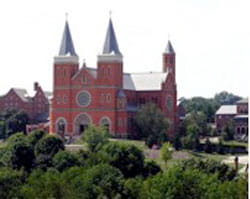
In the summer of 1846, Father Boniface got permission to sail, with fourteen brothers and four seminarians. In Latrobe, Pennsylvania, Bishop Michael O'Connor of Pittsburgh offered land, a house, and a parish. Thus, in a two-story schoolhouse, as Wimmer's biographer Jerome Oetgen notes, was "formally inaugurated Benedictine monastic life on the continent of North America." In time, Wimmer said, "I understand English now to the extent that I can preach just barely, hear confessions, catechize, and argue with the Protestants."
Out of these humble beginnings grew St. Vincent's Abbey, a seminary, a college for lay students, all geared largely toward the German-American community. (In 1860, he started a brewery that produced "St. Vincent Beer," raising objections from some temperance-minded bishops. It closed in 1920.) By 1850, there were sixty members in the Latrobe community. "There is no place in America," Wimmer boasted, "where prayer ascends to heaven so constantly!"
But Wimmer planned to extend the Benedictine way of life nationwide, beyond the German community. Within a few years of Latrobe's founding, he was getting requests from bishops from all parts of the country. During the 1850s, monasteries and schools opened in rural and urban areas: Newark, New Jersey; Atchison, Kansas; Collegeville, Minnesota. He expanded:
Our customary tendency to move forward must continue. Forward, always forward, everywhere forward. We cannot be held back by debts, by the difficulties of the times, by unfortunate years. Man's extremity is God's opportunity . . . Everywhere there is need for priests, especially in the Far West.
Wimmer had a dynamic understanding of the Benedictine rule: "Christ said, 'Go and teach all nations.' Stability is a beautiful virtue, but it should not develop into immobility."
A strong-minded individual, Wimmer could be unrelentingly authoritarian. As Benedictine historian Joel Rippinger notes, he "could ruthlessly squash the suggestions of any subordinate whose opinions were not in accord with his own." (At a time when most clergy were clean-shaven, Wimmer sported a full beard. After Pope Blessed Pius praised it during an audience, Wimmer mandated beards for all his monks.)
In the years following the Civil War, Wimmer's monks spread South and West, expanding their evangelization efforts to Native Americans and African-Americans. Monasteries were founded in Alabama and North Carolina, to work with "these entirely neglected Negroes" and to enter a region "where there are very Catholics . . . How wonderful!" In the Indian Territory (now Oklahoma), Father Isidore Robot started St. Gregory's monastery, now home to St. Gregory's University, the state's only Catholic institute of higher learning.
Abbot Boniface Wimmer died at St. Vincent's on the morning of December 8, 1887. To a large extent he had successfully implemented his vision of the order as an effective educational and missionary institution nationwide: monasteries and convents; schools and colleges; hospitals, parishes, and retreat houses. Today, thanks to the priests, religious, and laypeople who live the order's charism in their daily lives, the spirit of St. Benedict is alive and well in the United States.
12/2/2022 9:05:38 PM
Catholic
In Ages Past
Benedictine
History
Monasticism
Christianity
Roman Catholicism
more at patheos
1
Making the Truth Laugh: An April Fools Day Reflection
2

Putting the Remnants of Toxic Religion Where They Belong
3

Why Free Will and God’s Sovereignty is Worth Discussing
4
How To Avoid Politics Theologically: A Lesson From Pope Leo

About Pat McNamara
Dr. Pat McNamara is a published historian. He blogs about American Catholic History at McNamara's Blog.
Patheos Explore the world's faith through different perspectives on religion and spirituality! Patheos has the views of the prevalent religions and spiritualities of the world.
Ad-Free & Subscriber Log-In Subscription Support
- About Us
- 2026 Calendar
- Videos
- Podcasts
- Library of World Religions
- Faith In Media Tracker
- Advertise With Us
- Write for Us
- Privacy Policy
- Terms of Service
- Do Not Sell My Data
- Contact Us
- Radiant Digital
- Manage Newsletter Subscriptions
- Unsubscribe From Notifications
- Sitemap
Copyright 2008-2026, Patheos. All rights reserved.
Subscription Support Ad-Free & Subscriber Log-In
Follow Patheos