
BuddhistCatholicContemplativeEvangelicalGeneral ChristianHinduJewishLatter-day SaintMuslimNew VisionsProgressive Christian
Beliefs
- Buddhist
- Catholic
- Contemplative
- Evangelical
- General Christian
- Hindu
- Jewish
- Latter-day Saint
- More Voices
- Muslim
- New Visions
- Pagan
- Progressive Christian
Topics
- Religion News
- Food and Religion
- Sports and Religion
- Religious Art
- Religious Music and Entertainment
- Religious Events
- History and Religion
- Style and Religion
- Politics and Religion
- Women in Religion
- Recreation Outdoors and Religion
- Business Finance and Religion
- Careers Workplace and Religion
- Education and Religion
- Family Parenting and Religion
- Health Fitness and Religion
- Home and Religion
- Relationships and Religion
- Technology and Religion
- Travel and Religion
Columnists
- Buddhist Columnists
- Business Finance and Religion Columnists
- Careers Workplace and Religion Columnists
- Catholic Columnists
- Contemplative Columnists
- Education and Religion Columnists
- Evangelists Columnists
- Family Parenting and Religion Columnists
- General Christian Columnists
- Health Fitness and Religion Columnists
- Hindu Columnists
- History and Religion Columnists
- Home and Religion Columnists
- Jewish Columnists
- More Voices Columnists
- Latter Day Columnists
- Muslim Columnists
- New Visions Columnists
- Nonreligious Columnists
- Pagan Columnists
- Politics and Religion Columnists
- Progressive Columnists
- Recreation Outdoors and Religion Columnists
- Relationships and Religion Columnists
- Religion News Columnists
- Religious Art Columnists
- Religious Events Columnists
- Religious Music and Entertainment Columnists
- Sports and Religion Columnists
- Style and Religion Columnists
- Technology and Religion Columnists
- Travel and Religion Columnists
- Women in Religion Columnists
Resource Library
- 2026 Calendar
- Library of World Religions
- The 100 Most Holy Places on Earth
- Patheos Answers
- Podcasts
- Videos
- Faith Leaders Database
- Anglican Episcopalian
- Bahai
- Baptist
- Buddhism
- Christianity
- Confucianism
- Eastern Orthodoxy
- Hinduism
- Holiness and Pentecostal
- ISKCON
- Islam
- Judaism
- Lutheran
- Methodist
- The Church of Jesus Christ of Latter-day Saints
- New Age
- Paganism
- Presbytarian and Reformed
- Protestantism
- Religion Behind the Scenes
- Roman Catholic
- Scientology
- Shia Islam
- Sikhism
- Sufism
- Sunni Islam
- Taoism
- Zen
- See all religions
Research Tools
 Ad-Free & Subscriber Log-In Subscription Support
Ad-Free & Subscriber Log-In Subscription Support
Follow Patheos 

- Trending:
- Forgiveness
- |
- Marriage
- |
- Consciousness
- |
- Death Penalty
- |
- Election
- |
- Halloween
 Zach Hoag Is Uncategorized
- Home
- Choosing My Religion? [Anderson Campbell]
Choosing My Religion? [Anderson Campbell]
Last updated on: August 16, 2018 at 2:21 pm by Anderson Campbell
Choosing My Religion? [Anderson Campbell] 2018-08-16T14:21:42-05:00 Anderson Campbell
Patheos Explore the world's faith through different perspectives on religion and spirituality! Patheos has the views of the prevalent religions and spiritualities of the world.
 I think I might be failing as a good, Christian father.
I’ve identified as a Christian for nearly as long as I can remember. I grew up in Georgia, “Bible belt” territory. Our household rhythms revolved around faith in God. We prayed at mealtimes and before bed. We were heavily involved in our Southern Baptist church, in which my father served as a deacon. We attended every Sunday, sometimes twice, and every Wednesday evening.
When I was seven years old, I declared to my mother that I wanted to be a Christian and be baptized. In my particular Baptist tradition of Christianity, one is not considered a Christian until they have made a verbal “profession of faith.” I remember kneeling at my parents’ bedside and praying a prayer that went something like this: Dear God, I confess that I am a sinner. I believe that Jesus died on the cross for my sins and rose from the dead so that I could have my sins forgiven and go to heaven. Please forgive my sins. Please come to live in my heart, Jesus. I accept you as my personal Lord and Savior. Amen. After that prayer, my mother hugged me and we told my dad about it when he got home from work.
I was baptized within a few weeks. I waded into the warm water of the baptismal pool, outfitted in a white baptismal robe that was a bit too big for my scrawny frame. The water came up to my chin, so I stepped up onto the milk crate that was submerged in the pool so that those seated in the sanctuary could see me better. The pastor asked if I’d accepted Jesus Christ as my personal lord and savior. I told him I had. He then placed one arm on my back and raised the other in the air, as if about to be sworn in by a judge, and said, “Then I baptize you, my brother, Andy, in the name of the Father, and of the Son, and of the Holy Ghost. Buried with Christ in baptism, raised to walk in newness of life.” The hand he’d held aloft he brought to my chest, placed it on my crossed arms, and dipped me backwards into the water. The whole routine is symbolic of the death, burial, and resurrection of Jesus Christ. When I entered into the baptismal pool, I did so as a sinner, “dead” in my sins. When I was dipped backwards into the water, I was symbolically buried, like Jesus was buried after his crucifixion. When I was raised out of the water, I was “resurrected” to a new life, my sins symbolically washed away by the water.
I’d been instructed to hold my nose, bend my knees, and let the pastor bring me back up from under the water. The whole ordeal would take less than fifteen seconds. All that coaching flew out the window as soon as the water rushed over my face. I’d forgotten to pinch my nose and water poured into my sinuses. I freaked out, thinking I was drowning. My legs locked straight, my feet kicked out of the water, and my hands flailed around, looking for something to grab onto. Then, just as quickly as it started, it was over. I was out of the water, sputtering a bit and trying to get my nose clear. That was my official entry into the faith.
In the years that followed, my brothers and I participated in Sunday School, Royal Ambassadors for Christ (a kind of Christian scouting group), midweek Bible study groups, children’s choir, and summer Vacation Bible School day camps. When I was older, I was very active in our church’s youth group. Every summer I went to a Christian youth camp in Panama City, Florida, and came back with a renewed vigor for my faith and airbrushed t-shirts containing Bible references. I had my doubts and questions about the faith I had inherited. Was the Bible really “inerrant” and meant to be interpreted literally at all times? Did God really create the world in seven days? How does one measure a day before the earth was created? Would people really burn in hell if they’d never heard about Jesus? How was that their fault? Is sex before marriage really a sin? Where is that in the Bible? While we’re on that subject, what counts as “sex” anyway? Yet despite the questions and the lack of satisfying answers I received, I don’t ever recall a time in my life where I didn’t self-identify as a Christian.
Now, I have children of my own. For the entirety of both of my daughters’ lives, I’ve been involved in some sort of Christian ministry job. My oldest daughter, Sydney, was born during my final year of seminary. Since then, I’ve been a church planter, a college minister, a staff pastor at a megachurch, and a seminary professor. How could my faith not rub off on them? When Sydney was eight, I recalled my baptism and the prayer I’d prayed as a child. It occurred to me that I’d never really talked to Sydney about what she believes about God and Jesus. Maybe it was time to have that conversation.
I found Sydney reading a book, tucked into the top bunk of the bed she shared with her younger sister.
“Sydney, I have a question for you,” I began.
“Sure, what is it daddy?” she said.
“Do you believe in God?” I asked.
“Oh, yes,” she said. “I believe in God. I pray to him sometimes, especially when I’m nervous or anxious.”
“What about Jesus? What do you think about him?”
“He’s God’s son. He died on a cross and was resurrected to make things right with God again,” she said. Dang. This kid is smart; smarter than I was at her age. Feeling pretty confident about where this conversation was headed, I pressed on.
“So, would you say that you’re a Christian like mommy and daddy? A follower of Jesus? Because if you do, maybe you want to get baptized. I got baptized when I was about your age,” I said.
She paused. She looked up from the book she’d been paging through as we talked, met my eyes, then looked at the ceiling, as if considering her response. “No. Not yet. That’s a big decision and I’m not sure I’m ready for that.”
I wasn’t quite sure what to say. I felt a bit deflated. I heard myself reply, “You’re right, honey. That is a big decision, one that only you can make. Maybe someday you will.” I kissed her forehead and tucked her in. As I turned out the light and shut the bedroom door behind me I wondered, Am I doing something wrong as a father? Aren’t I supposed to be passing my faith along to my kids? Wary of being too heavy handed with my beliefs around my kids and fearful of driving them away from Christianity, perhaps I’d overcorrected and not let them see my faith enough.
 Sydney is one of those kids who is a deep thinker. She is sometimes maddeningly slow to make a decision, but once her mind is made up on something, she won’t be swayed. Somehow, even at her young age, she understood the gravity of the question I’d asked her, and she wasn’t ready to weigh in one way or another quite yet.
I sat down on the couch next to my wife, April, and recounted the conversation I’d just had with Sydney. She listened and nodded in all the appropriate places. When I was finished she said, “Dude, you need to chill out. Give her some space and some time. If, and when, she decides to be a follower of Jesus, she’ll do it in her own way and on her own time. And when she does, she won’t budge on it.”
I knew she was right.
A few weeks later, I was tucking the girls in for bed again and noticed that the book Sydney was reading was a lot bigger than usual. She’d dragged a Bible up into her bed. It wasn’t a kids’ picture Bible, either. It was a hardback, fully annotated Bible for students. She sat there in her bed, the book taking up her entire lap, carefully reading the tiny text.
“Hey sweet pea. Whatcha reading?” I asked.
“Some stories out of the Bible,” she said.
“Yeah? Anything good?” I asked.
“Esther,” she said.
Esther? Really? My eight-year-old daughter was reading the Old Testament book of Esther? What kid does that? What adult does that?
The book of Esther is an interesting one. For centuries, a debate has raged about whether or not the book of Esther should be included in the Jewish scriptures or in the Christian Bible. The controversy centers on the fact that God isn’t explicitly mentioned anywhere in the book. Not one place. But God is working in the background of the story the whole time.
The book is follows the story of a young woman named Esther and her appointment as the Queen of Persia. Unbeknownst to the king, Esther is a Jew. She was raised by her parents’ cousin Mordecai, a Jew from the diaspora created when the Babylonian King Nebuchadnezzar took the Jews captive.
At the same time he chose Esther for his wife, King Xerxes gave a Persian named Haman a big title and a lot of wealth. Haman let all this power and influence go to his head. He wanted to be worshipped like a demigod wherever he went. One day he passed by Mordecai, who refused to bow in his presence. This really pissed off Haman. So he went to King Xerxes to have Mordecai and all the Jews killed. King Xerxes granted Haman his request. The thing is, the good king had no idea that his beloved Queen Esther was a Jew.
Mordecai told Esther the whole sordid tale and how, if she didn’t change the King’s mind, she would die along with all the rest of the Jews in Persia. Mordecai said to her, “Who knows but that you have come to your royal position for such a time as this?” (Esther 4:14, New International Version).
In the end, Esther ended up persuading the King not to carry out Haman’s genocide. Though never mentioned by name, it is evident that the God of the Jews was very much present in the story of Esther, knitting circumstances together that led to the protection of the Jews, not their demise.
In my own childhood conversion, God was very much present in the foreground. I expected a similar sort of story to unfold in Sydney’s life. When I didn’t see that happening, I panicked. But God is there in her life. I see evidence of it all the time. When our neighbor died of cancer this year, it was Sydney who asked if we could light a candle and pray for her and her husband. She is quick to forgive others, even when they are in the wrong. Whenever she is in a group of her peers, she seeks out those on the fringes and invites them into whatever activity she’s involved in.
Sydney may never have the kind of come-to-Jesus conversion that I had as a kid. She might be one of those people who just grow up believing in God and Jesus without ever being able to point to a specific moment of decision. But that doesn’t mean that I’ve failed as a father or that God isn’t present in her life. It just means that God is working in the background instead of the foreground.
The best thing I can do is chill out and trust God with her faith.
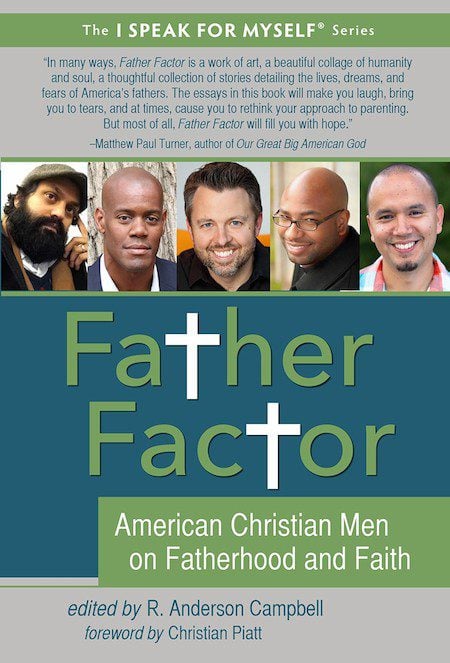
Epilogue: I originally wrote this essay in the spring of 2012 for inclusion in the forthcoming book, Father Factor: American Christian Men on Fatherhood and Faith (White Cloud Press, 2014). It is a collection of essays from 40 American Christian men under 40 years old writing about fathers and faith. I served as the editor for this volume (it is the fifth in the I Speak for Myself series of books) and I couldn’t be happier with how the collection turned out. It is diverse, challenging, and uplifting, all at once. Fellow Antioch Session contributor Scott Emery also has a piece in the volume. We’d be honored if you’d check it out.
Since I originally penned the essay, Sydney’s faith has continued to shift and grow. The summer of 2014 on one of the hottest days of the year, she casually mentioned to her mother and I that she’d prayed and asked God into her heart.
I guess she came to a place where she was just ready.
The publication date for Father Factor was originally supposed to be Father’s Day week of 2014. Due to a bunch of circumstances, that didn’t happen. Instead it got pushed back to October 14, 2014. Just five days later, five days after this essay hits the streets, Sydney will be baptized in front of our friends and family. God is good. God is very good.

Browse Our Archives
Select a Category Uncategorized
Select a Month December 2018 August 2018 July 2018 July 2017 May 2017 January 2017 November 2016 October 2016 August 2016 July 2016 May 2016 April 2016 March 2016 February 2016 January 2016 December 2015 November 2015 October 2015 September 2015 August 2015 July 2015 June 2015 May 2015 April 2015 February 2015 January 2015 December 2014 November 2014 October 2014 September 2014 August 2014 July 2014 June 2014 May 2014 April 2014 March 2014 February 2014 January 2014 December 2013 October 2013 September 2013 August 2013 July 2013 June 2013 May 2013 April 2013 March 2013 February 2013 January 2013 December 2012 November 2012 September 2012 August 2012 July 2012 June 2012 March 2012 December 2011 November 2011 October 2011 September 2011 August 2011 March 2011
Follow Us!
TAKE THE
Religious Wisdom Quiz
What is the correct chronological order of Paul's travels mentioned in his letters to the Corinthians?
Select your answer to see how you score.
Macedonia, Corinth, Jerusalem, Asia Corinth, Jerusalem, Macedonia, Asia Asia, Jerusalem, Corinth, Macedonia Jerusalem, Macedonia, Corinth, Asia
Support this
Column


Related posts from Zach Hoag Is Uncategorized

3 Kinds of Evangelicals (Whether They Want That...

A God in the Dirt [Andrew Arndt]
Learning to Make Disciples...AA Style [Fr. Tony Bleything]

Ecclesial Anamnesis and the Need to Remember [Nicholas...
TRENDING AT PATHEOS General Christian

Seventy and Five Years Old: God Still Starts...
There is a small detail tucked into Genesis 12 that I skipped...

A Biblical Vision of Success in Christian Life...
The Concern and Quest Recent trends and tendencies I note around me...

Indigenous Peoples’ Day and the Church
Indigenous' Peoples Day or Columbus Day? Depending on where you live...

When Spiritual Growth Looks Like Losing Ground
Four Passive Spiritual Disciplines: An Introduction When I was a college freshman,...

Faith and Finding Your Current Season
“To everything there is a season,” Ecclesiastes tells us, “and a time...

Did Jesus Fear God's Wrath in Gethsemane?
That Time Jesus Was Terrified Before we begin, let me say at...
view all General Christian blogs
Ad-Free & Subscriber Log-In Subscription Support
- About Us
- 2026 Calendar
- Videos
- Podcasts
- Library of World Religions
- Faith In Media Tracker
- Advertise With Us
- Write for Us
- Privacy Policy
- Terms of Service
- Do Not Sell My Data
- Contact Us
- Radiant Digital
- Manage Newsletter Subscriptions
- Unsubscribe From Notifications
- Sitemap
Copyright 2008-2026, Patheos. All rights reserved.
Subscription Support Ad-Free & Subscriber Log-In
Follow Patheos