
BuddhistCatholicContemplativeEvangelicalGeneral ChristianHinduJewishLatter-day SaintMuslimNew VisionsProgressive Christian
Beliefs
- Buddhist
- Catholic
- Contemplative
- Evangelical
- General Christian
- Hindu
- Jewish
- Latter-day Saint
- More Voices
- Muslim
- New Visions
- Pagan
- Progressive Christian
Topics
- Religion News
- Food and Religion
- Sports and Religion
- Religious Art
- Religious Music and Entertainment
- Religious Events
- History and Religion
- Style and Religion
- Politics and Religion
- Women in Religion
- Recreation Outdoors and Religion
- Business Finance and Religion
- Careers Workplace and Religion
- Education and Religion
- Family Parenting and Religion
- Health Fitness and Religion
- Home and Religion
- Relationships and Religion
- Technology and Religion
- Travel and Religion
Columnists
- Buddhist Columnists
- Business Finance and Religion Columnists
- Careers Workplace and Religion Columnists
- Catholic Columnists
- Contemplative Columnists
- Education and Religion Columnists
- Evangelists Columnists
- Family Parenting and Religion Columnists
- General Christian Columnists
- Health Fitness and Religion Columnists
- Hindu Columnists
- History and Religion Columnists
- Home and Religion Columnists
- Jewish Columnists
- More Voices Columnists
- Latter Day Columnists
- Muslim Columnists
- New Visions Columnists
- Nonreligious Columnists
- Pagan Columnists
- Politics and Religion Columnists
- Progressive Columnists
- Recreation Outdoors and Religion Columnists
- Relationships and Religion Columnists
- Religion News Columnists
- Religious Art Columnists
- Religious Events Columnists
- Religious Music and Entertainment Columnists
- Sports and Religion Columnists
- Style and Religion Columnists
- Technology and Religion Columnists
- Travel and Religion Columnists
- Women in Religion Columnists
Resource Library
- 2026 Calendar
- Library of World Religions
- The 100 Most Holy Places on Earth
- Patheos Answers
- Podcasts
- Videos
- Faith Leaders Database
- Anglican Episcopalian
- Bahai
- Baptist
- Buddhism
- Christianity
- Confucianism
- Eastern Orthodoxy
- Hinduism
- Holiness and Pentecostal
- ISKCON
- Islam
- Judaism
- Lutheran
- Methodist
- The Church of Jesus Christ of Latter-day Saints
- New Age
- Paganism
- Presbytarian and Reformed
- Protestantism
- Religion Behind the Scenes
- Roman Catholic
- Scientology
- Shia Islam
- Sikhism
- Sufism
- Sunni Islam
- Taoism
- Zen
- See all religions
Research Tools
 Ad-Free & Subscriber Log-In Subscription Support
Ad-Free & Subscriber Log-In Subscription Support
Follow Patheos 

- Trending:
- Forgiveness
- |
- Marriage
- |
- Consciousness
- |
- Death Penalty
- |
- Election
- |
- Halloween
 Zach Hoag Is Uncategorized
- Home
- Of Monsters and Mars: How Brian Zahnd is Saving Evangelical Faith (A Review)
Of Monsters and Mars: How Brian Zahnd is Saving Evangelical Faith (A Review)
Last updated on: August 16, 2018 at 2:21 pm by Zach Hoag
Of Monsters and Mars: How Brian Zahnd is Saving Evangelical Faith (A Review) 2018-08-16T14:21:43-05:00 Zach Hoag
Patheos Explore the world's faith through different perspectives on religion and spirituality! Patheos has the views of the prevalent religions and spiritualities of the world.
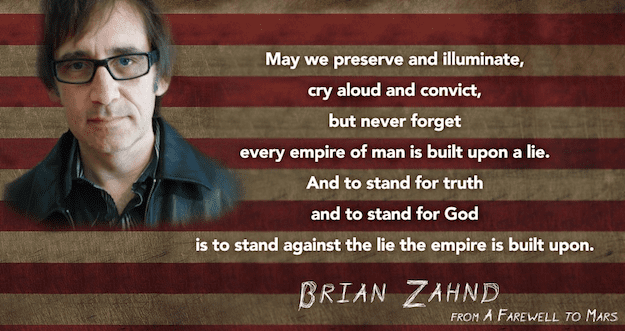
It would be a mistake to call Brian Zahnd’s new book, A Farewell to Mars, “a book about pacifism.” It would be an even bigger mistake to call it “a book about Christian pacifism.” Brian says as much when he clarifies that he doesn’t claim the pacifist label at all. He is not a pacifist but a Christian – a follower of Jesus, including Jesus’s radical and very political ideas (Ch. 1).
In other words, the gospel of peace shouldn’t be thought of as some extraneous add-on to Christian identity, best left to the social justice-y liberals and dreadlocked new monastics. However, labels aside, I think that even the idea of Christian pacifism, or nonviolence, or what have you, simply doesn’t get at the totality, and the import, of this book. What Brian (my pastor-at-large) has given us here is not just another argument for nonviolent theology. It is much bigger than that. It is a sweeping case for the survival – and, I believe, the thriving and flourishing – of evangelical faith in our time, and it is one that just may galvanize a resurgence among those who have been floundering amidst the changing tides.
In other words, A Farewell to Mars has the potential to save evangelical faith.
It has been instrumental in saving mine.
Why Evangelical?
Brian Zahnd is a charismatic. Or a Pentecostal. Or whatever. And so am I, having roots in the same soil Zahnd springs from, the soil of the Jesus Movement of the 1970’s and the explosive renewal that followed in the evangelical church (and beyond, ecumenically) throughout the 1980’s and 90’s. I’m not sure if Brian would agree with this assessment, but “evangelical” was not a term that was ever used in my charismatic upbringing – or if it was, it was used somewhat pejoratively to refer to those churches that were not “Spirit-filled.” Spirit-filled churches had it right; those evangelicals had it wrong. However, our energetic spirituality, revitalizing as it was to a formerly “dead” church, was yet a representation of evangelical faith. In the good sense, we had faithfulness to the Scriptures, a passion for personal relationship with Jesus by his Spirit, a belief in the centrality of the church, and a mandate for evangelism and service at the core of our identity. In the bad sense, we had conservative politics and militaristic narratives and narrow-minded biblicism and exclusionary moralism right there at the same core.
The subtitle of Brian’s book tells us more than we might think: “An Evangelical Pastor’s Journey Toward the Biblical Gospel of Peace.” This is an important watchword to the wise reader, lest she assume the author is just another in a long line of defectors, of those who are now spiritual but not religious, or perhaps just proudly progressive (or another variation on that theme). That is not to say anything about the latter, but simply to make the point: it is a thing to leave evangelicalism.
But here, from the outset, we see that there is evangelical identity and, more to the point, intention behind this book. A Farewell to Mars is a book for the future of evangelicalism, an evangelicalism journeying toward something but also not abandoning itself in the process. Indeed, the thing it is moving toward is that gospel of peace, given to us by that Preacher of peace – and that is a remarkable thing given the compromised (recent) history of evangelicalism. Certainly, there is now a glut of information from the perspective of post-evangelicalism, deconstructing and critiquing the all-too-Constantinian marriage of church and political power, mostly of the conservative variety. But what is likely missing in the post-evangelical critique is precisely what Zahnd’s present work is offering us – not merely an analysis of what lay behind but a discernible vision of what lies ahead.
Thus, this book avoids the twin tendencies of carelessly abandoning evangelical identity and obsessing over its deconstruction with no vision for the future. It is faithful, and it is looking forward. Perhaps one other thing is of note here. As someone who has studied and lived the emerging/missional church story of the last decade and change, Brian’s book feels unbelievably timely. To those detractors who don’t sense this, I can only say the prophetic word here is perhaps most poignant for a particular tribe, and that tribe happens to have been engaged in all kinds of theological and ecclesiological struggle and warfare since the turn of the century. Evangelicalism has been caught in a hurricane, a dust storm (or maybe a rummage sale, in gentler terms), with Christian identity itself up for grabs. And the release of A Farewell to Mars hits at a moment when the dust seems to be settling, and the storms that have hollowed out the existing theological creekbeds into wider and deeper forms have subsided, leaving the streams to fill and flow again.
While many who began in evangelical waters now find themselves swimming elsewhere, Zahnd is signaling a renewed, healthy waterway for those seeking to remain faithful to scripture, passionate about personal relationship with Jesus by his Spirit, committed to the centrality of the church, and focused on evangelism and service – while also moving beyond the unholy compromise of evangelicalism and empire.
It’s a deeper and wider evangelical stream, flowing decidedly toward the gospel of peace.
The Objections
The objections to Christian pacifism are at least as old as Constantine, and they are the same objections that people have brought against the present work. If arguments in favor of nonviolence are not new, neither are the arguments against it; and it just may be that the thrust of Farewell is saying something new if we have ears to hear. Brian anticipates the objections right off the bat, but draws our attention to the deepest root:
Can humanity possess the capacity for self-destruction and not resort to it? The jury is still out. But this much is certain— if we think the ideas of Jesus about peace are irrelevant in the age of genocide and nuclear weapons, we have invented an utterly irrelevant Christianity!
Because the stakes are now so intolerably high, people with a modicum of common sense have come to realize we must at last talk seriously about how to live together peaceably on our little blue planet. Our capacity for self-destruction demands this. (Ch. 1.)
There are certainly great tensions around questions of “how to deal” with atrocities at the hands of ISIS or IDF or Russia, but if we take a few steps back we must recognize the ultimacy of the cycle of violence: it will always, only, beget more violence. Today’s rebel freedom fighters armed and trained by Western nations will become the next decade’s terrorists or genocidal maniacs and turn their guns back on “us.” The oppressed who fight back in great revolutions will become tomorrow’s oppressors, subjugating those who threaten their security. The bombs meant to defend the innocent end up killing innocent others and thereby become the seeds that will spring up into violent retaliation in time.
Sure, you can argue that violence is an immediate necessary evil.
But does Christianity say anything to this ultimate reality which has the potential to destroy us all? Or is it irrelevant?
Godwin’s Law always makes it into conversations about pacifism, and Brian anticipates this too. In reference to the necessity of the Allied response to German genocide, Zahnd writes:
We should think deeply upon the fact that the Nazi blitzkriegs were waged by baptized soldiers. Had the church held to pre -Constantine convictions, Hitler would never have gotten off the ground. Before we appeal to Hitler as the ultimate argument against Christian nonviolence, we first have to ask how Hitler was able to amass a following of Christians in the first place. After all, it wasn’t atheists and pagans who formed the German Christian movement that lent support to Hitler in the 1930s. (Ch. 7.)
And beautifully, in Ch. 2, he reflects on the work of Holocaust survivor Emil Fackenheim, who went on to write To Mend the World:
The title comes from the Jewish theological concept of tikkun olam—“repairing the world.” Tikkun olam is the idea that although the world is broken, it is not beyond repair— that it’s God’s intention to work through humanity in order to repair his creation. In To Mend the World…Fackenheim tells his fellow Jews they must now add one more law to their ancient Torah— a 614th commandment. Commandment 614 is simply this: Thou shalt not give Hitler any posthumous victories. Elaborating on the 614th Commandment, Fackenheim says, “We are forbidden to despair of the world as the place which is to become the kingdom of God, lest we help make it a meaningless place in which God is dead or irrelevant and everything is permitted.”
He ends that chapter with this:
We refuse to conspire with the beasts of empire who keep the world confined to the death culture of Babylon. There’s always another Armageddon looming on the horizon, threatening to perpetuate the bloody ways of Cain and throw more Abels in a mass grave. But we are not to cooperate with that vision. We are to resist it. We are to anticipate a future created by the Prince of Peace through the very lives we live. We are to work in concert with Jesus Christ as he labors to repair the world. Yes, tikkun olam!
Evangelicalism and Empire
The two greatest accomplishments of this book are identifying evangelicalism’s problem as empire, and identifying empire’s problem as violence. More can be (and is) said about both evangelicalism and empire, but these are the main issues; and in recent history they have been all but overlooked. In fact, evangelicalism, the kind I grew up in, traces its issues all the way back to the days of Constantine – when Christendom, the merging of Christ and the military kingdoms of man, was born.
Brian hits these themes hard from the first chapter on, beginning with a compelling view of the biblical narrative as centering on violence (Cain kills Abel) through empire (Cain builds a city). He works out that narrative through the life of Jesus, and the particular political climate in which his earthly life took shape, one in which an empire ruled and God’s people were tempted to fight the empire just like the empire. He poetically expounds the Sermon on the Mount. He tackles the Gospels and the gospel in the Epistles, and traces the preaching of peace even through the eschatalogical finale of Revelation. But perhaps it all comes into sharpest focus in the personal narrative of Chapter 4.
There, Pastor Brian talks about his regrettable “war prayer” after 9/11, in which he invoked God’s endorsement on U.S. military retaliation, much to the delight of those present. He talks about how he preached a sermon once called “Jesus, Jerusalem, and Jihad” and declared, “We are at war with Islam.” And he talks about how war becomes sacred when evangelicalism embraces the violence of empire:
My new direction was that I began to see the kingdom of Christ as God’s alternative society. My new direction was to believe that peacemakers are the children of God. And I learned a bitter lesson. I learned that it is much easier to unite people around a Jesus who hates our enemies and blesses our wars than it is to unite people around a Jesus who calls us to love our enemies and pray for those who persecute us. It broke my heart to learn that people are not as easily drawn to a gospel of peace as they are to a rally for war. But I couldn’t blame them. I had been the same way. I had endorsed war in the name of the Lord. I had prayed war prayers. I had preached war sermons. And if people became angry when I started praying peace prayers and preaching peace sermons, I couldn’t be surprised . I had been the same way. Believing in a war-waging Messiah is easy. Believing in the Prince of Peace is hard.
But believing in the Prince of Peace is precisely what will save evangelical faith.
Moved to Resist the Crowd
It’s interesting that the most moving, and enlightening, chapter for me was Chapter 3, “Christ Against the Crowd.” I’ve written about this before, so I won’t belabor it here. I will say, though, that what moved me most about this chapter was the way in which it brought empire violence into the everyday, exposing the currents that ripple all around – and through – us all the time.
Having experienced this as both a participant in the crowd’s activity and a recipient of it, I can say that Brian’s father and Soeren Kierkegaard are correct: the angry and fear-driven crowd is indeed untruth, and its scapegoating mechanism is the single greatest force for empire violence in God’s world. It is satanic, the tool of the accuser – even if it is aiming at the good:
Jesus does not lead his people to join an angry crowd. Jesus never leads anything other than a gentle and peaceable minority. Jesus hides from the triumphalistic crowd that tries to force him to be their war-waging king. Jesus weeps over the nationalistic crowd whose hosannas are meant to egg him into violent revolution. The crowd is antichrist.
And it is here that Zahnd reveals the essence of the gospel itself, a truth about the cross that our evangelical faith must recover if it is to be saved:
Jesus died for our sins. Jesus died at the hands of humans under the satanic impulse to blame. Jesus died as an innocent victim of the demonic scapegoat system that the crowd always resorts to. And he died with forgiveness on his lips. Jesus took the blame to do away with blaming. Jesus bore the accusation to do away with accusing. Jesus became the scapegoat banished to the wilderness of death. But then something new happened.
The banished scapegoat came back! Three days later Jesus was vindicated by God the Father in resurrection! But in his return from the wilderness of death, Jesus did not speak of revenge; instead he spoke of peace and forgiveness. (See John 20: 19– 23.) Yes, Jesus forgives us, but he also calls us to forsake the evil practice of turning people into scapegoats. Jesus says to a humanity that has built its civilizations upon the blood of sacrificial victims, “I forgive you, but we’re not going to play this way anymore.” No more cruelty. No more blame. No more scapegoating. No more sacrificing. No more trying to shape the world by the violent sacrifice of collective murder. Jesus is the Lamb of God who ends sacrifice!
Two Debates and a Conclusion
Recently, my pastor-at-large participated in two debates, one about the atonement as explained above, and another about Calvinism’s version of the gospel. Like A Farewell to Mars, these debates were significant beyond their primary subject matter. They were significant because they deal with the matter of evangelicalism’s very survival.
Is God is the kind of Monster that demands sacrifice above all else – including the sacrifice of his son – in order to not torture the entire human race in hell for eternity? Is he the one who predestines only a select few for mercy, and predestines the vast majority for fiery torture? Is God the one who sanctions wars for the righteous nations, slaughtering his scapegoated enemies? Is God like Mars, the one soldiers might worship in temples shaped like fighter jets, filled with icons that sacramentalize weapons of war (Ch. 8)?
We have reached a clear impasse, I think, at which the storms of cultural change have exposed the great compromise of evangelicalism with the empire. At the core of the gospel and atonement, in the expectations of eschatology, on the subject of God’s very character, there has been a clinging to violent power that we know, deep down, is only and ultimately destructive. As Brian’s famous saying goes, God is like Jesus; God has always been like Jesus; there was never a time when he was not like Jesus; we haven’t always known this; but now we do. Our evangelical faith must begin to look like Jesus again. It must be the faith of that Preacher of peace, or else it will not be saved. It simply will not be.
In reading this book I, too, “caught a glimpse of truth out of the corner of my eye” (Ch. 1). It is the truth of my own abiding commitment to biblical authority, a vibrant relationship with Jesus by his Spirit, the centrality of the church, and a passion for evangelism and service, despite the storm that has been raging, despite the changing tides (and despite my own tossing about from time to time).
It is the truth that after witnessing the compromise of evangelicalism and empire all my life, I can yet see a way forward, a way of peace.
And even if it is only a glimpse now, it is…beautiful.
—
Here’s the final stanza of Pastor Brian’s poem from the end of Chapter 1:
I glimpsed this truth out of the corner of my eye.
To believe this truth will set you free.
And you thought it was just Sunday school banality or empty religious sentimentality to pray
Thy Empire come
Thy Policy be done.
You had no idea it was dissident and subversive,
because every empire of men is built upon a lie.
The lie that the empire has God on its side.
I glimpsed this truth out of the corner of my eye.
And if you ask me my politics, I will say, Jesus is Lord!
I glimpsed this truth out of the corner of my eye.
Next Post

October 1, 2014 A God in the Dirt [Andrew Arndt]
Browse Our Archives
Select a Category Uncategorized
Select a Month December 2018 August 2018 July 2018 July 2017 May 2017 January 2017 November 2016 October 2016 August 2016 July 2016 May 2016 April 2016 March 2016 February 2016 January 2016 December 2015 November 2015 October 2015 September 2015 August 2015 July 2015 June 2015 May 2015 April 2015 February 2015 January 2015 December 2014 November 2014 October 2014 September 2014 August 2014 July 2014 June 2014 May 2014 April 2014 March 2014 February 2014 January 2014 December 2013 October 2013 September 2013 August 2013 July 2013 June 2013 May 2013 April 2013 March 2013 February 2013 January 2013 December 2012 November 2012 September 2012 August 2012 July 2012 June 2012 March 2012 December 2011 November 2011 October 2011 September 2011 August 2011 March 2011
Follow Us!
TAKE THE
Religious Wisdom Quiz
Where was Jesus praying the night before He was crucified?
Select your answer to see how you score.
Galilee Tarsus The Garden of Gethsemane Antioch
Support this
Column


Related posts from Zach Hoag Is Uncategorized


What to Do When Following Your Dreams Leads...

CharismaNews Posts Islamophobic Hate Speech: A Betrayal of...

Come With Me: Brian Zahnd's Water To Wine...
TRENDING AT PATHEOS General Christian

Seventy and Five Years Old: God Still Starts...
There is a small detail tucked into Genesis 12 that I skipped...

A Biblical Vision of Success in Christian Life...
The Concern and Quest Recent trends and tendencies I note around me...

Indigenous Peoples’ Day and the Church
Indigenous' Peoples Day or Columbus Day? Depending on where you live...

When Spiritual Growth Looks Like Losing Ground
Four Passive Spiritual Disciplines: An Introduction When I was a college freshman,...

Faith and Finding Your Current Season
“To everything there is a season,” Ecclesiastes tells us, “and a time...

Did Jesus Fear God's Wrath in Gethsemane?
That Time Jesus Was Terrified Before we begin, let me say at...
view all General Christian blogs
Ad-Free & Subscriber Log-In Subscription Support
- About Us
- 2026 Calendar
- Videos
- Podcasts
- Library of World Religions
- Faith In Media Tracker
- Advertise With Us
- Write for Us
- Privacy Policy
- Terms of Service
- Do Not Sell My Data
- Contact Us
- Radiant Digital
- Manage Newsletter Subscriptions
- Unsubscribe From Notifications
- Sitemap
Copyright 2008-2026, Patheos. All rights reserved.
Subscription Support Ad-Free & Subscriber Log-In
Follow Patheos