
BuddhistCatholicContemplativeEvangelicalGeneral ChristianHinduJewishLatter-day SaintMuslimNew VisionsProgressive Christian
Beliefs
- Buddhist
- Catholic
- Contemplative
- Evangelical
- General Christian
- Hindu
- Jewish
- Latter-day Saint
- More Voices
- Muslim
- New Visions
- Pagan
- Progressive Christian
Topics
- Religion News
- Food and Religion
- Sports and Religion
- Religious Art
- Religious Music and Entertainment
- Religious Events
- History and Religion
- Style and Religion
- Politics and Religion
- Women in Religion
- Recreation Outdoors and Religion
- Business Finance and Religion
- Careers Workplace and Religion
- Education and Religion
- Family Parenting and Religion
- Health Fitness and Religion
- Home and Religion
- Relationships and Religion
- Technology and Religion
- Travel and Religion
Columnists
- Buddhist Columnists
- Business Finance and Religion Columnists
- Careers Workplace and Religion Columnists
- Catholic Columnists
- Contemplative Columnists
- Education and Religion Columnists
- Evangelists Columnists
- Family Parenting and Religion Columnists
- General Christian Columnists
- Health Fitness and Religion Columnists
- Hindu Columnists
- History and Religion Columnists
- Home and Religion Columnists
- Jewish Columnists
- More Voices Columnists
- Latter Day Columnists
- Muslim Columnists
- New Visions Columnists
- Nonreligious Columnists
- Pagan Columnists
- Politics and Religion Columnists
- Progressive Columnists
- Recreation Outdoors and Religion Columnists
- Relationships and Religion Columnists
- Religion News Columnists
- Religious Art Columnists
- Religious Events Columnists
- Religious Music and Entertainment Columnists
- Sports and Religion Columnists
- Style and Religion Columnists
- Technology and Religion Columnists
- Travel and Religion Columnists
- Women in Religion Columnists
Resource Library
- 2026 Calendar
- Library of World Religions
- The 100 Most Holy Places on Earth
- Patheos Answers
- Podcasts
- Videos
- Faith Leaders Database
- Anglican Episcopalian
- Bahai
- Baptist
- Buddhism
- Christianity
- Confucianism
- Eastern Orthodoxy
- Hinduism
- Holiness and Pentecostal
- ISKCON
- Islam
- Judaism
- Lutheran
- Methodist
- The Church of Jesus Christ of Latter-day Saints
- New Age
- Paganism
- Presbytarian and Reformed
- Protestantism
- Religion Behind the Scenes
- Roman Catholic
- Scientology
- Shia Islam
- Sikhism
- Sufism
- Sunni Islam
- Taoism
- Zen
- See all religions
Research Tools
 Ad-Free & Subscriber Log-In Subscription Support
Ad-Free & Subscriber Log-In Subscription Support
Follow Patheos 

- Trending:
- Forgiveness
- |
- Marriage
- |
- Consciousness
- |
- Death Penalty
- |
- Election
- |
- Halloween
 Zach Hoag Is Uncategorized
- Home
- The War Is Over; It’s Time to Stop Fighting [Anderson Campbell]
The War Is Over; It’s Time to Stop Fighting [Anderson Campbell]
Last updated on: August 16, 2018 at 2:21 pm by Anderson Campbell
The War Is Over; It’s Time to Stop Fighting [Anderson Campbell] 2018-08-16T14:21:45-05:00 Anderson Campbell
Patheos Explore the world's faith through different perspectives on religion and spirituality! Patheos has the views of the prevalent religions and spiritualities of the world.
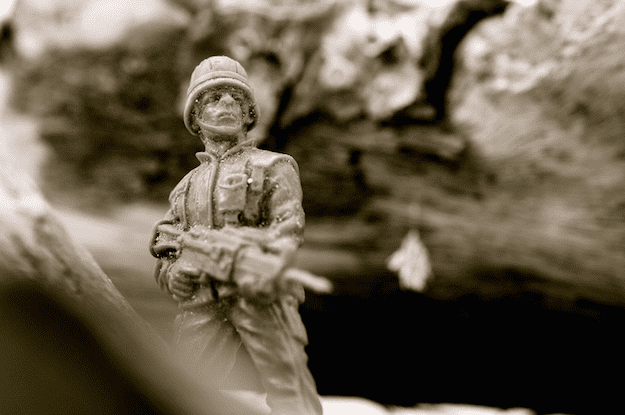
 It was the day after Christmas, 1944. In Europe, the Battle of the Bulge was in full swing. On the other side of the world Hiroo Onoda, an elite Japanese soldier and intelligence officer, was dropped behind enemy lines on Lubang Island in the Philippines. His mission was to link up with a small group of soldiers already on the island and conduct guerrilla warfare and covert operations. The departing orders from Onoda’s commander, Major Taniguchi, were clear:
You are absolutely forbidden to die by your own hand. It may take three years, it may take five, but whatever happens, we’ll come back for you. Until then, so long as you have one soldier, you are to continue to lead him. You may have to live on coconuts. If that’s the case, live on coconuts! Under no circumstances are you [to] give up your life voluntarily.
In February of 1945, Allied forces took the island, forcing the Japanese soldiers to split up and flee into the jungle mountains. Over the next several months most of them were killed off. But not Onoda.
Teamed with three other soldiers, Onoda continued to carry out his mission. They ate whatever they could find in the jungle or pillage from farms and villages. They plundered enemy stockpiles to refill their weapon stocks.
August 15, 1945, Japan surrendered to Allied forces ending World War II. No one ever told Onoda and his compatriots. They’d heard nothing of the destruction of Hiroshima and Nagasaki by atomic bombs. No news of the fall of Berlin had reached them. As far as they knew, the war was still on.
In October of the same year the small band of men came across a leaflet that saying, “The war ended August 15th. Come down from the mountains!” They discussed its reliability and concluded that this was most likely a piece of Allied propaganda designed to flush them out of hiding. It had been less than a year since they arrived on the island, too little time for the war to have ended, they concluded. So they carried on fighting.
Despite seeing more and more locals in civilian clothes (another sly tactic of the enemy, they reasoned) they kept fighting. They were convinced that the war was still underway because every time they fired on the “civilians,” search parties were dispatched to hunt them down. They carried on fighting.
After five years in the jungle, one of the men slipped away to surrender. Another five years later, another of the men was killed in a skirmish. Just two were left. They carried on gathering intelligence and carrying out small raids on the “enemy” for another 17 years, until in October 1972, when Onoda’s partner was killed by a Filipino patrol. Onoda was then alone.
In 1974, a college student from Japan set out to find Onoda. Japanese search parties had attempted to locate Onoda several times but had failed. Onoda was quite good at staying hidden after 29 years of guerrilla warfare in the jungles.
The Japanese college student was able to succeed where the search parties had failed. He located Onoda and did his best to persuade Onoda that the war was over and it was safe to return home. Onoda would not be moved. His orders had been clear: carry out his mission until he was either killed or until his commanding officer returned for him or ordered him otherwise.
Returning to Japan empty handed, the student looked up Major Taniguchi. He was retired and working in a book store. The student convinced Taniguchi to travel with him to the Philippines to reason with Onoda.
When they finally found Onoda again, Taniguchi told him that Japan had lost the war some 29 years earlier and it was time for him to put down his weapons and surrender. Onoda was despondent. He’d wasted 29 years of his life, killed or injured hundreds of innocent people, and labored under a delusion. But the war was over; it was time to stop fighting.
March 10, 1975, Onoda came out of the jungle in full military dress and surrendered to Philippine President Ferdinand Marcos. He was pardoned for his war crimes and allowed to return to Japan. He would later write an autobiography about his ordeal, titled No Surrender, My Thirty-Year War. Hiroo Onoda died in January, 2014 at the age of 91.[1]
Christians are not unlike Onoda. We have a knack for fighting wars that are already over. We refuse to see the signs of defeat (or victory!) all around us and keep on entering into skirmishes and all-out battles. In the midst of all this we inflict unnecessary wounds on innocent bystanders, mistaking them for hostile enemies. Often, that becomes a self-fulfilling act, creating enemies out of people who previously meant us no ill will.
Once you’ve been fighting for so long, though, it is hard to not fight anymore. You need to be discharged. Richard Rohr writes of “discharging the loyal soldier” as a critical step in transitioning from the first half of life into the second half of life.
The loyal soldier serves you well in the first half of your life. You find a sense of place, purpose, and position while your identity is forming. But nearly always, you will come to confuse the voice of the loyal soldier with the voice of God.
The loyal soldier cannot continue to carry you forward. That is why it is necessary to discharge the loyal soldier from duty. Doing so is a painful, uncomfortable, and necessary. Rohr writes, “When you first discharge your loyal soldier, it will feel like a loss of faith or loss of self. But it is only the death of the false self, and is often the very birth of the soul.”[2]
So, what wars are you fighting that are already over? The “culture” war? Worship wars? Attendance wars? Bible translation wars? Modesty wars? Funding wars? Perhaps today you need to hear Jesus loud and clear, telling you that the war is over; it’s time to stop fighting. You are discharged. Regardless of what you’ve been told, regardless of what you see around you to the contrary, Jesus stands victorious. The war is over; it’s time to stop fighting. It’s time to surrender.
If you need to discharge your loyal soldier, have in mind those wars you’ve been waging and then pray the words of this hymn (a childhood favorite of mine) by Judson W. Van DeVenter:
All to Jesus I surrender,
All to him I freely give;
I will ever love and trust him,
In his presence daily live.
I surrender all,
I surrender all,
All to thee, my blessed Savior,
I surrender all.
—
[1] For more on Hiroo Onoda see “A Japanese Soldier Who Continued Fighting WWII 29 Years After the Japanese Surrendered, Because He Didn’t Know”
[2] Richard Rohr, Falling Upward. 48.
[Image by Davidd, CC via Flickr]
Previous Post

July 18, 2014
Ending Well [Levi Holland]
Next Post
July 28, 2014 Israel, the Internet, and Purging the Scapegoat
Browse Our Archives
Select a Category Uncategorized
Select a Month December 2018 August 2018 July 2018 July 2017 May 2017 January 2017 November 2016 October 2016 August 2016 July 2016 May 2016 April 2016 March 2016 February 2016 January 2016 December 2015 November 2015 October 2015 September 2015 August 2015 July 2015 June 2015 May 2015 April 2015 February 2015 January 2015 December 2014 November 2014 October 2014 September 2014 August 2014 July 2014 June 2014 May 2014 April 2014 March 2014 February 2014 January 2014 December 2013 October 2013 September 2013 August 2013 July 2013 June 2013 May 2013 April 2013 March 2013 February 2013 January 2013 December 2012 November 2012 September 2012 August 2012 July 2012 June 2012 March 2012 December 2011 November 2011 October 2011 September 2011 August 2011 March 2011
Follow Us!
TAKE THE
Religious Wisdom Quiz
Who saw a vision of a pot boiling toward the north?
Select your answer to see how you score.
Jeremiah Habakkuk Isaiah Zechariah
Support this
Column


Related posts from Zach Hoag Is Uncategorized

3 Kinds of Evangelicals (Whether They Want That...

A God in the Dirt [Andrew Arndt]
Choosing My Religion? [Anderson Campbell]
Learning to Make Disciples...AA Style [Fr. Tony Bleything]
TRENDING AT PATHEOS General Christian

Seventy and Five Years Old: God Still Starts...
There is a small detail tucked into Genesis 12 that I skipped...

A Biblical Vision of Success in Christian Life...
The Concern and Quest Recent trends and tendencies I note around me...

Indigenous Peoples’ Day and the Church
Indigenous' Peoples Day or Columbus Day? Depending on where you live...

When Spiritual Growth Looks Like Losing Ground
Four Passive Spiritual Disciplines: An Introduction When I was a college freshman,...

Faith and Finding Your Current Season
“To everything there is a season,” Ecclesiastes tells us, “and a time...

Did Jesus Fear God's Wrath in Gethsemane?
That Time Jesus Was Terrified Before we begin, let me say at...
view all General Christian blogs
Ad-Free & Subscriber Log-In Subscription Support
- About Us
- 2026 Calendar
- Videos
- Podcasts
- Library of World Religions
- Faith In Media Tracker
- Advertise With Us
- Write for Us
- Privacy Policy
- Terms of Service
- Do Not Sell My Data
- Contact Us
- Radiant Digital
- Manage Newsletter Subscriptions
- Unsubscribe From Notifications
- Sitemap
Copyright 2008-2026, Patheos. All rights reserved.
Subscription Support Ad-Free & Subscriber Log-In
Follow Patheos