
BuddhistCatholicContemplativeEvangelicalGeneral ChristianHinduJewishLatter-day SaintMuslimNew VisionsProgressive Christian
Beliefs
- Buddhist
- Catholic
- Contemplative
- Evangelical
- General Christian
- Hindu
- Jewish
- Latter-day Saint
- More Voices
- Muslim
- New Visions
- Pagan
- Progressive Christian
Topics
- Religion News
- Food and Religion
- Sports and Religion
- Religious Art
- Religious Music and Entertainment
- Religious Events
- History and Religion
- Style and Religion
- Politics and Religion
- Women in Religion
- Recreation Outdoors and Religion
- Business Finance and Religion
- Careers Workplace and Religion
- Education and Religion
- Family Parenting and Religion
- Health Fitness and Religion
- Home and Religion
- Relationships and Religion
- Technology and Religion
- Travel and Religion
Columnists
- Buddhist Columnists
- Business Finance and Religion Columnists
- Careers Workplace and Religion Columnists
- Catholic Columnists
- Contemplative Columnists
- Education and Religion Columnists
- Evangelists Columnists
- Family Parenting and Religion Columnists
- General Christian Columnists
- Health Fitness and Religion Columnists
- Hindu Columnists
- History and Religion Columnists
- Home and Religion Columnists
- Jewish Columnists
- More Voices Columnists
- Latter Day Columnists
- Muslim Columnists
- New Visions Columnists
- Nonreligious Columnists
- Pagan Columnists
- Politics and Religion Columnists
- Progressive Columnists
- Recreation Outdoors and Religion Columnists
- Relationships and Religion Columnists
- Religion News Columnists
- Religious Art Columnists
- Religious Events Columnists
- Religious Music and Entertainment Columnists
- Sports and Religion Columnists
- Style and Religion Columnists
- Technology and Religion Columnists
- Travel and Religion Columnists
- Women in Religion Columnists
Resource Library
- 2026 Calendar
- Library of World Religions
- The 100 Most Holy Places on Earth
- Patheos Answers
- Podcasts
- Videos
- Faith Leaders Database
- Anglican Episcopalian
- Bahai
- Baptist
- Buddhism
- Christianity
- Confucianism
- Eastern Orthodoxy
- Hinduism
- Holiness and Pentecostal
- ISKCON
- Islam
- Judaism
- Lutheran
- Methodist
- The Church of Jesus Christ of Latter-day Saints
- New Age
- Paganism
- Presbytarian and Reformed
- Protestantism
- Religion Behind the Scenes
- Roman Catholic
- Scientology
- Shia Islam
- Sikhism
- Sufism
- Sunni Islam
- Taoism
- Zen
- See all religions
Research Tools
 Ad-Free & Subscriber Log-In Subscription Support
Ad-Free & Subscriber Log-In Subscription Support
Follow Patheos 

- Trending:
- Forgiveness
- |
- Marriage
- |
- Consciousness
- |
- Death Penalty
- |
- Election
- |
- Halloween
 Zach Hoag Is Uncategorized
- Home
- Tell Your Dad He is Broken. Deeply Broken.
Tell Your Dad He is Broken. Deeply Broken.
Last updated on: August 16, 2018 at 2:21 pm by Zach Hoag
Tell Your Dad He is Broken. Deeply Broken. 2018-08-16T14:21:58-05:00 Zach Hoag
Patheos Explore the world's faith through different perspectives on religion and spirituality! Patheos has the views of the prevalent religions and spiritualities of the world.
Pastor Steve McCoy recently tweeted this and ignited something of a firestorm on the internets:
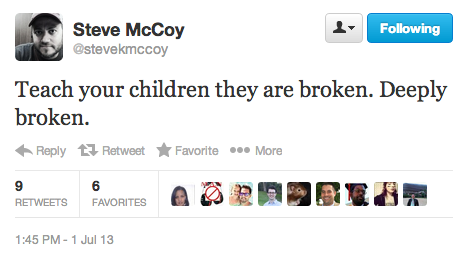
And honestly, I understand the backlash. Especially from a therapeutic perspective, it just sounds wrong. The emphasis – deeply – almost immediately triggers images of fundamentalist spiritual and emotional abuse of kids, abuse that is very real, abuse that I experienced as a child, abuse that I have witnessed firsthand in several church environments.
But here’s the thing. I’ve used the word ‘brokenness’ to describe the theological idea of humanity’s sinfulness. Like, a lot. Honestly, I wrote a book that relied heavily on the brokenness metaphor when describing the serial killer Dexter, highlighting his ‘dark passenger’ as an extreme example of our sinful shadow self. There is a scene in that show where Dexter’s sister Deb falls apart and, in tears, exclaims, “I’m what’s wrong! I am broken!” It is a powerful revelation of the truth of her situation, and it is a truth revealed in our own lives whenever we encounter devastating failure or contradiction within ourselves.
The sticky wicket, though, is in the application. It is one thing to affirm the general theological truth that human beings are broken people, flawed people, failing people, fragmented people, often-running-away-from-wholeness people. That we can be damned destructive sometimes, and that this is what’s wrong with the world. It’s one thing to affirm that theological reality of fallenness and then follow it up with the far more alarming truth: that smack dab in the midst of our brokenness, we, all of us, are the very beloved of God. That the good news is the end of shame, and Jesus says we are enough.
That’s one thing.
But it’s quite another to change that theological conversation into a specifically adapted message to children, complete with a pointed emphasis that seems to almost push against belovedness itself. Specifically teaching children that they are deeply broken is an exercise in shame precisely because their brokenness is not yet their own. No matter what your doctrine of original sin might be, the beauty, the miracle, of childhood is that they have not become so wounded, nor tempted, as to have properly entered the human condition of “brokenness.” This is why Jesus was so clear: become like a child, then you can enter the kingdom. Return to the place before brokenness – the place where God was near and we were truly alive and breathed in our belovedness. The place before what has always been true became clouded by the tree of knowledge.
So, Steve, my suggestion is this. It would be better to teach our kids to just be the beloved, because that is precisely who they know they are better than we know it ourselves.
And, perhaps we, as dads, ought to remember the lesson that we are the ones who are broken – and the more we can accept our own belovedness in the midst of that brokenness, the less brokenness we will actually pass on to our children.
nothing but the blood the gospel according to dexter
Previous Post

July 2, 2013
Calling Out Celebrity Christianity & Counterfeit Justice
Next Post
July 15, 2013 Do No Harm: Paul in Context, pt. 1
Browse Our Archives
Select a Category Uncategorized
Select a Month December 2018 August 2018 July 2018 July 2017 May 2017 January 2017 November 2016 October 2016 August 2016 July 2016 May 2016 April 2016 March 2016 February 2016 January 2016 December 2015 November 2015 October 2015 September 2015 August 2015 July 2015 June 2015 May 2015 April 2015 February 2015 January 2015 December 2014 November 2014 October 2014 September 2014 August 2014 July 2014 June 2014 May 2014 April 2014 March 2014 February 2014 January 2014 December 2013 October 2013 September 2013 August 2013 July 2013 June 2013 May 2013 April 2013 March 2013 February 2013 January 2013 December 2012 November 2012 September 2012 August 2012 July 2012 June 2012 March 2012 December 2011 November 2011 October 2011 September 2011 August 2011 March 2011
Follow Us!
TAKE THE
Religious Wisdom Quiz
What does "Gad" mean in Hebrew?
Select your answer to see how you score.
Fortune Joyful Chosen One Warrior
Support this
Column


Related posts from Zach Hoag Is Uncategorized

Tonight's the Night - Writing About Binge-Watching the...

Mad Dad: What the Wrath of God Cannot...
Addendum: Steven Furtick Needs Your Seat

TRENDING AT PATHEOS General Christian

Seventy and Five Years Old: God Still Starts...
There is a small detail tucked into Genesis 12 that I skipped...

A Biblical Vision of Success in Christian Life...
The Concern and Quest Recent trends and tendencies I note around me...

Indigenous Peoples’ Day and the Church
Indigenous' Peoples Day or Columbus Day? Depending on where you live...

When Spiritual Growth Looks Like Losing Ground
Four Passive Spiritual Disciplines: An Introduction When I was a college freshman,...

Faith and Finding Your Current Season
“To everything there is a season,” Ecclesiastes tells us, “and a time...

Did Jesus Fear God's Wrath in Gethsemane?
That Time Jesus Was Terrified Before we begin, let me say at...
view all General Christian blogs
Ad-Free & Subscriber Log-In Subscription Support
- About Us
- 2026 Calendar
- Videos
- Podcasts
- Library of World Religions
- Faith In Media Tracker
- Advertise With Us
- Write for Us
- Privacy Policy
- Terms of Service
- Do Not Sell My Data
- Contact Us
- Radiant Digital
- Manage Newsletter Subscriptions
- Unsubscribe From Notifications
- Sitemap
Copyright 2008-2026, Patheos. All rights reserved.
Subscription Support Ad-Free & Subscriber Log-In
Follow Patheos