
BuddhistCatholicContemplativeEvangelicalGeneral ChristianHinduJewishLatter-day SaintMuslimNew VisionsProgressive Christian
Beliefs
- Buddhist
- Catholic
- Contemplative
- Evangelical
- General Christian
- Hindu
- Jewish
- Latter-day Saint
- More Voices
- Muslim
- New Visions
- Pagan
- Progressive Christian
Topics
- Religion News
- Food and Religion
- Sports and Religion
- Religious Art
- Religious Music and Entertainment
- Religious Events
- History and Religion
- Style and Religion
- Politics and Religion
- Women in Religion
- Recreation Outdoors and Religion
- Business Finance and Religion
- Careers Workplace and Religion
- Education and Religion
- Family Parenting and Religion
- Health Fitness and Religion
- Home and Religion
- Relationships and Religion
- Technology and Religion
- Travel and Religion
Columnists
- Buddhist Columnists
- Business Finance and Religion Columnists
- Careers Workplace and Religion Columnists
- Catholic Columnists
- Contemplative Columnists
- Education and Religion Columnists
- Evangelists Columnists
- Family Parenting and Religion Columnists
- General Christian Columnists
- Health Fitness and Religion Columnists
- Hindu Columnists
- History and Religion Columnists
- Home and Religion Columnists
- Jewish Columnists
- More Voices Columnists
- Latter Day Columnists
- Muslim Columnists
- New Visions Columnists
- Nonreligious Columnists
- Pagan Columnists
- Politics and Religion Columnists
- Progressive Columnists
- Recreation Outdoors and Religion Columnists
- Relationships and Religion Columnists
- Religion News Columnists
- Religious Art Columnists
- Religious Events Columnists
- Religious Music and Entertainment Columnists
- Sports and Religion Columnists
- Style and Religion Columnists
- Technology and Religion Columnists
- Travel and Religion Columnists
- Women in Religion Columnists
Resource Library
- 2026 Calendar
- Library of World Religions
- The 100 Most Holy Places on Earth
- Patheos Answers
- Podcasts
- Videos
- Faith Leaders Database
- Anglican Episcopalian
- Bahai
- Baptist
- Buddhism
- Christianity
- Confucianism
- Eastern Orthodoxy
- Hinduism
- Holiness and Pentecostal
- ISKCON
- Islam
- Judaism
- Lutheran
- Methodist
- The Church of Jesus Christ of Latter-day Saints
- New Age
- Paganism
- Presbytarian and Reformed
- Protestantism
- Religion Behind the Scenes
- Roman Catholic
- Scientology
- Shia Islam
- Sikhism
- Sufism
- Sunni Islam
- Taoism
- Zen
- See all religions
Research Tools
 Ad-Free & Subscriber Log-In Subscription Support
Ad-Free & Subscriber Log-In Subscription Support
Follow Patheos 

- Trending:
- Forgiveness
- |
- Marriage
- |
- Consciousness
- |
- Death Penalty
- |
- Election
- |
- Halloween
 The Semi-Official Blog of Zack Hunt
- Home
- Progressive Christian
- Good Friday: The Day God Died
Good Friday: The Day God Died
Last updated on: April 14, 2017 at 9:46 am by Zack Hunt
Good Friday: The Day God Died 2017-04-14T09:46:10-06:00 Zack Hunt
Patheos Explore the world's faith through different perspectives on religion and spirituality! Patheos has the views of the prevalent religions and spiritualities of the world.
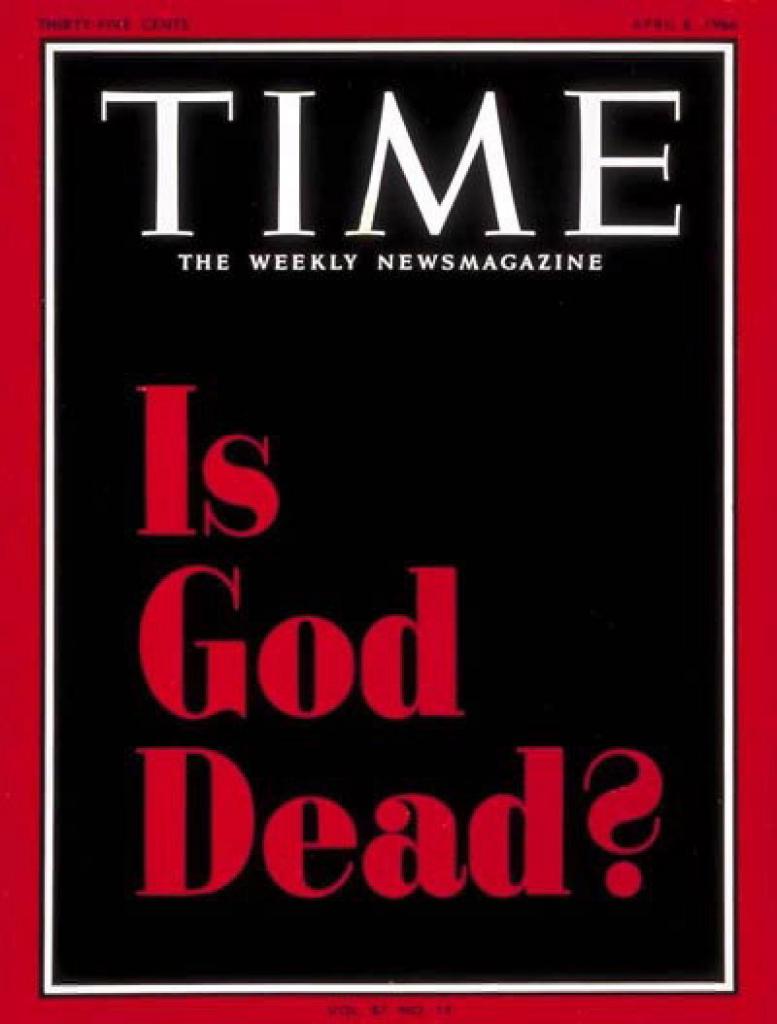 (
(On April 8, 1966, Time magazine created an uproar with a stark, black and red cover that asked “Is God Dead?”
Laity and clergy alike were outraged.
Time received somewhere around 3,500 angry letters to the editor, the most it had ever received for a single article. The idea that God could die was outrageously unthinkable to some and outright blasphemy to others. Which was incredibly ironic considering the day Time published its infamous edition.
April 8, 1966 was Good Friday.
The day God died.
We don’t usually speak about Good Friday in such a provocative way. Instead, we talk about the death of Jesus. Doing so may not seem like a big deal on the surface, but there’s a subtle heresy at play. In speaking of the death of Jesus on Friday, we – whether intentionally or not – acknowledge that the man from Nazareth died, but we protect God from any real suffering, let alone death. While the idea of God being incapable of suffering, much less death, may seem like orthodoxy 101, such a separation of Jesus’ human and divine nature is an ancient heresy known as nestorianism.
Actual orthodoxy declares that Jesus was/is “truly god and truly man,” and therefore his human and divine nature are inseparably intertwined.
This is easy enough to accept when Jesus is hanging out with his disciples doing cool stuff like walking on water and raising people from the dead, but when it comes time to talk about the crucifixion, our insistence on the dual nature of Christ conspicuously become less insistent.
The idea that death could enter into the life of God is simply too scandalous.
We need God to be above that, bigger than that, more powerful than that.
God needs to be Superman times a thousand – invincible, all powerful, and immortal – or how else could God be God?
And yet, as the German theologian Jürgen Moltmann reminds us, it wasn’t just a man from Nazareth that hung on the cross.
It was God.
When the crucified Jesus is called the “image of the invisible God,” the meaning is that this is God, and God is like this. God is not greater than he is in this humiliation. God is not more glorious than he is in this self-surrender. God is not more powerful than he is in this helplessness. God is not more divine than he is in his humanity. The nucleus of everything that Christian theology says about ‘God’ is to be found in this Christ event. – The Crucified God, 205
The One who hung on that tree so long ago wasn’t just a poor carpenter from a backwater town. It was the Lord of all creation. It was the One who said “Let there be light” that was abandoned in the darkness. It was the One who breathed life into dirt who took his last breath on that cross.
It was God who died on the cross on Good Friday.
That doesn’t mean God ceased to exist anymore than we cease to exist when we die, but make no mistake.
God died on Good Friday.
And it’s a scandal we still struggle with today, not just because of what it says about God, but also because of what it says about us and the life we are called to live as followers of a crucified God.
It’s a scandal of disappointment and embarrassment
A crucified God is a total and complete rejection of the John Wayne Jesus we crave in American Christianity. The kind of super manly, guns a-blazing action hero we fetishize in so many corners of the American church is nowhere to be found on the cross. What we find instead is a humble carpenter who rides into town on a donkey, only to be arrested, beaten, and stripped of both clothes and dignity before ultimately being put to death in the most humiliating way possible.
For a Church that is increasingly insecure about its eroding power and influence in the world and desperately wants to portray Jesus as an über-manly hero who stands ready to lead the charge as we vanquish our enemies and wrestle control of the world from their cold dead heads, it’s disappointing, uncomfortable, and embarrassing to be confronted with the truth that we worship a crucified God who said “no” to conquest, choosing instead to die naked and alone for the enemies we seek to vanquish.
It’s a scandal of unwanted inclusion
We may hang crosses prominently in the front of our churches, but the cross has become a sanitized symbol that makes few, if any demands on our lives.
Though we may revere it as an important symbol, we have forgotten that,
The symbol of the cross in the church points to the God who was crucified not between two candles on an altar, but between two thieves in the place of the skull, where the outcasts belong, outside the gates of the city…It is a symbol which therefore leads out of the church and out of religious longing into the fellowship of the oppressed and abandoned. On the other hand, it is a symbol which calls the oppressed and godless into the church and through the church into the fellowship of the crucified God. – The Crucified God, 40
While we sanctify discrimination in the name of religious freedom, the crucified God declares that God stands with the outcast and abandoned, even and especially when they have been cast out and abandoned in the name of God.
It’s a scandal of radical self-denial
The crucifixion of God is a visceral reminder that the cross is the way of Jesus. There is no Christianity without a crucified Christ and therefore there is no discipleship without picking up our own cross and all the suffering and loss that comes with it.
But radical self-denial and painful self-sacrifice has no place in a me-centric society or in a Church which has realized that biblical weight loss strategies, financial peace, and beating the drums of theological war (and actual war) are all far more effective at filling the pews than calling people to live a cruciform life.
And so, the identity of the one hanging on cross remains a scandal today.
Not so much because we can’t agree on the theological nuances of hypostatic union, but because we still can’t accept a crucified God whose power is made perfect in weakness.
Because we don’t want to embrace unwanted neighbors, let alone serve them in any way.
And because as much as we may preach self-denial, actually living a self-sacrificing life that puts others’ needs before our own is simply too much to ask.
The latter half of this post originally appeared in a Good Friday reflection I wrote a couple of years ago.
Previous Post
April 13, 2017
The Streaker In The Garden Of Gethsemane
Next Post

May 1, 2017 My Cancer Story: 1 Year Later
Browse Our Archives
Select a Category Book Review Classifieds Commentary Fundie Friday Funny Pictures Music Video News Prophecy Technology Televangelist Throwback Thursday Tract Tuesday Tracts Uncategorized Videos
Select a Month June 2019 May 2019 April 2019 March 2019 February 2019 January 2019 December 2018 November 2018 October 2018 August 2018 June 2018 May 2018 March 2018 February 2018 January 2018 October 2017 September 2017 August 2017 July 2017 June 2017 May 2017 April 2017 March 2017 February 2017 January 2017 December 2016 November 2016 September 2016 July 2016 June 2016 May 2016 April 2016 March 2016 February 2016 January 2016 December 2015 November 2015 October 2015 September 2015 August 2015 July 2015 June 2015 May 2015 April 2015 March 2015 February 2015 January 2015 December 2014 November 2014 October 2014 September 2014 August 2014 July 2014 June 2014 May 2014 April 2014 March 2014 February 2014 January 2014 December 2013 November 2013 October 2013 September 2013 August 2013 July 2013 June 2013 May 2013 April 2013 March 2013 February 2013 January 2013 December 2012 November 2012 October 2012 September 2012 August 2012 July 2012 June 2012 May 2012 April 2012 March 2012 February 2012 January 2012 December 2011 November 2011 October 2011 September 2011 August 2011 July 2011 June 2011 May 2011 April 2011 March 2011 February 2011 January 2011 December 2010 November 2010 October 2010 September 2010 August 2010
Follow Us!
TAKE THE
Religious Wisdom Quiz
Which major world religion traces its ancestry back to Abraham, along with Christianity and Judaism?
Select your answer to see how you score.
Islam Hinduism Sikhism Buddhism
Related posts from The Semi-Official Blog of Zack Hunt

The End Is Nigh! Get Your Rapture Survival...
The Semi-Official Blog of Zack Hunt

Is It Really Well With My Soul?
The Semi-Official Blog of Zack Hunt

Daddy, Is Your Friend Going To Come Back...
The Semi-Official Blog of Zack Hunt
I Want To Speak At Your Event And...
The Semi-Official Blog of Zack Hunt
TRENDING AT PATHEOS Progressive Christian

Why Christians Have a Sacred Duty to Vote:...
The Bible offers strong support for the sacred duty to vote. Here...

What Being a Modern-Day Apostle Means to Me
In my last column, I discussed the ins and outs of modern-day...

Did Ancient China Once Worship the God of...
Across human history, a common thread weaves through the origins of the...

Love Your Neighbor – Including Earth-Kin: Lev. 19,...
God’s command to love your neighbor means acting in an ethical and...

Lead a Church Study of “Jesus and Lao...
Guest writer Jack Thomas (The Irreverent Reverend) reflects on leading his church...

Principles for Understanding the Apostolic Ministry Today
Whenever people discover that my formal ministry title is "apostle," as in...
view all Progressive Christian blogs
Ad-Free & Subscriber Log-In Subscription Support
- About Us
- 2026 Calendar
- Videos
- Podcasts
- Library of World Religions
- Faith In Media Tracker
- Advertise With Us
- Write for Us
- Privacy Policy
- Terms of Service
- Do Not Sell My Data
- Contact Us
- Radiant Digital
- Manage Newsletter Subscriptions
- Unsubscribe From Notifications
- Sitemap
Copyright 2008-2026, Patheos. All rights reserved.
Subscription Support Ad-Free & Subscriber Log-In
Follow Patheos