
BuddhistCatholicContemplativeEvangelicalGeneral ChristianHinduJewishLatter-day SaintMuslimNew VisionsProgressive Christian
Beliefs
- Buddhist
- Catholic
- Contemplative
- Evangelical
- General Christian
- Hindu
- Jewish
- Latter-day Saint
- More Voices
- Muslim
- New Visions
- Pagan
- Progressive Christian
Topics
- Religion News
- Food and Religion
- Sports and Religion
- Religious Art
- Religious Music and Entertainment
- Religious Events
- History and Religion
- Style and Religion
- Politics and Religion
- Women in Religion
- Recreation Outdoors and Religion
- Business Finance and Religion
- Careers Workplace and Religion
- Education and Religion
- Family Parenting and Religion
- Health Fitness and Religion
- Home and Religion
- Relationships and Religion
- Technology and Religion
- Travel and Religion
Columnists
- Buddhist Columnists
- Business Finance and Religion Columnists
- Careers Workplace and Religion Columnists
- Catholic Columnists
- Contemplative Columnists
- Education and Religion Columnists
- Evangelists Columnists
- Family Parenting and Religion Columnists
- General Christian Columnists
- Health Fitness and Religion Columnists
- Hindu Columnists
- History and Religion Columnists
- Home and Religion Columnists
- Jewish Columnists
- More Voices Columnists
- Latter Day Columnists
- Muslim Columnists
- New Visions Columnists
- Nonreligious Columnists
- Pagan Columnists
- Politics and Religion Columnists
- Progressive Columnists
- Recreation Outdoors and Religion Columnists
- Relationships and Religion Columnists
- Religion News Columnists
- Religious Art Columnists
- Religious Events Columnists
- Religious Music and Entertainment Columnists
- Sports and Religion Columnists
- Style and Religion Columnists
- Technology and Religion Columnists
- Travel and Religion Columnists
- Women in Religion Columnists
Resource Library
- 2026 Calendar
- Library of World Religions
- The 100 Most Holy Places on Earth
- Patheos Answers
- Podcasts
- Videos
- Faith Leaders Database
- Anglican Episcopalian
- Bahai
- Baptist
- Buddhism
- Christianity
- Confucianism
- Eastern Orthodoxy
- Hinduism
- Holiness and Pentecostal
- ISKCON
- Islam
- Judaism
- Lutheran
- Methodist
- The Church of Jesus Christ of Latter-day Saints
- New Age
- Paganism
- Presbytarian and Reformed
- Protestantism
- Religion Behind the Scenes
- Roman Catholic
- Scientology
- Shia Islam
- Sikhism
- Sufism
- Sunni Islam
- Taoism
- Zen
- See all religions
Research Tools
 Ad-Free & Subscriber Log-In Subscription Support
Ad-Free & Subscriber Log-In Subscription Support
Follow Patheos 

- Trending:
- Forgiveness
- |
- Marriage
- |
- Consciousness
- |
- Death Penalty
- |
- Election
- |
- Halloween
 The Semi-Official Blog of Zack Hunt
- Home
- Progressive Christian
- Are Bible Verses The Worst Thing Ever?
Are Bible Verses The Worst Thing Ever?
Last updated on: January 23, 2015 at 12:08 pm by Zack Hunt
Are Bible Verses The Worst Thing Ever? 2015-01-23T12:08:26-06:00 Zack Hunt
Patheos Explore the world's faith through different perspectives on religion and spirituality! Patheos has the views of the prevalent religions and spiritualities of the world.
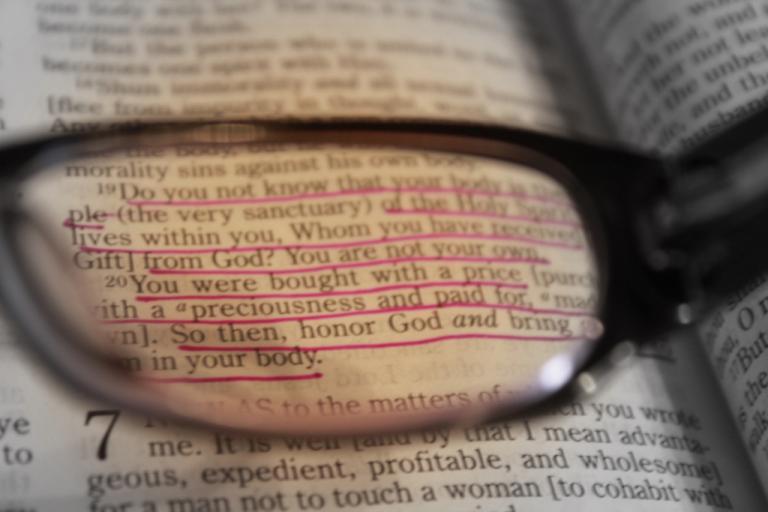 (Credit: Chineka, Flickr Creative Commons)
Bribing kids with candy (or other prizes) to memorize Bible verses is an ancient tradition in the Church.
And by ancient, I mean it dates back to at least the 1980s when I was a kid and like every other red-blooded American I just assume everything from my childhood is the way it’s always been and, therefore, the way it always should be.
In theory, teaching our children to memorize scripture is a wonderful thing. After all, if our faith is biblically based, then knowing a thing or two about the Bible would probably come in handy from time to time.
But in practice, our love for Bible verses can be incredibly problematic.
In fact, Bible verses might be the worst thing ever.
I know that may sound strange, perhaps even bordering on the blasphemous, but hang with me for a moment and I promise I won’t lead you into the flames.
Believe it or not, the chapters and verses that divide our modern Bibles into today didn’t exist for the first 1,000 years or so of Christianity. Which was awful for Sunday School kids back then, because they had to memorize entire books of the Bible just to get a piece of butterscotch candy they didn’t really want in the first place.
When the books of the Bible were first written down, they were read and discussed in much greater length than we typically do today. Sure, the Psalms were often read or sung one at time and specific Levitical laws were analyzed and debated over individually or just a few at a time, but when Nehemiah rediscovered the book of Deuteronomy, he didn’t have Ezra read selected portions. He read the entire thing to the people of Israel. Likewise, Paul’s letters in the New Testament were intended to be read in their entirety to the congregation to whom he was writing – just like we would read an entire letter today. Or, maybe an entire email. Does anybody still write letters?
Sure, particular stories like that of Noah and his ark were told without slogging through the entire book of Genesis, but it wasn’t until the 13th century when a guy named Stephen Langton, a Cardinal and Archbishop of Canterbury, began dividing up the Bible into more easily accessible portions that our modern chapters began to appear. Verses followed later as a way to further subdivide these newly created chapters into easy to cite passages of scripture.
I imagine at the time it seemed like a wonderful revolution in biblical studies. Scholars could converse more easily with each other about what part of scripture was being debated and children could rack up the candy far more quickly now that they had less to memorize.
Nearly a thousand years later, however, chapters and verses have become decidedly less wonderful.
On the most basic level (and this isn’t anything new; it began the moment Langton got to work), chapters and verses chop up scripture in ways it was never intended, allowing modern readers to focus on small portions of a much bigger conversation and thereby miss the crucial context for understanding the verse we’re focused on. Context is everything and without it a particular verse can be warped, twisted, or cut and pasted with other verses to create a meaning the original author never intended.
It’s this proof-texting, ripping verses out of their proper context to prove a point – that leads to legalism, fundamentalism, and all sorts of other -isms that turn the Bible into a weapon of war instead of a message of peace.
On one end of the problematic spectrum you’ve got a verse like Jeremiah 29:11, “For I know the plans I have for you, says the Lord. Plans to prosper you and not to harm you, plans to give you hope and a future.” There are few things we love more than quoting that verse at graduation ceremonies, but the thing is, it doesn’t really have anything to do with us. At least not directly. God was speaking specifically to the children of Israel while they were in exile. It was a promise to them that one day their exile would end. It wasn’t a divine promise to an 18 year old American high school student that they would become rich and famous after graduation. But by virtue of its verse-edness (Is that word? Well, it is now), all context and proper understanding for that passage has been lost and today it’s become little more than a proof-text for the prosperity gospel.
But verses can create bigger problems than that.
Take Paul’s infamous words from 1 Corinthians 14:34, “Women should be silent in the church.” Or 1 Timothy 2:12 in which he wrote, “I do not permit a woman to teach or to assume authority over a man; she must be quiet.” Despite the fact that Paul also wrote that all are one in Christ Jesus, involved women in places of leadership in his ministry, and ignoring the fact that Jesus also made women a central part of his ministry (including choosing women to be the first ones to proclaim the resurrection), the isolation of these verses allows them to be stripped of both their biblical and historical context in order to relegate women to second class citizenship in the Church.
But verses can create even bigger problems than that.
We consider ourselves to be fairly enlightened people today, folks who understand and value the importance of things like equality and justice. The idea that one person could be the property of another person is universally deplored in the Church today…but that wasn’t always the case
And, of course, that’s just the tip of the iceberg of the myriad of ways in which the creation of chapters and verses has empowered us to justify our legalism, sanctify our bigotry, and proof-text our oppression of people we don’t like.
Now, as someone who spent the better part of a decade studying the faith in the academy, I am fully aware of how helpful the division of scripture can be in that sort of setting. Likewise, having been on both sides of the pulpit, I realize that going through an entire book like Matthew or Acts on a Sunday morning (at least in the way we’re used to in modern sermons) is neither possible for the preacher nor particularly appealing for the congregation.
So, yes, there are certainly times in which chapters and verses can be helpful as reference points so long as as we understand how incredibly narrow our perspective is in that moment and how limited our understanding of that passage will be if we do not venture out further into the text.
However, I am convinced that the benefits, insights, and understanding that can be gleaned from being forced to retell an entire story and wade through its context and commentary, far outweighs whatever convenience chapters and verses might afford. And again, that is to say nothing of the very real problems that a “plain reading” of those chapters and verses has created and continues to create in the lives of very real people.
Now, I acknowledge that there is no going back to a time without chapters and verses (though there is a noble attempt to turn back the clock
If we can do that, not only will we have a better understanding of the Bible, but maybe, just maybe, we’ll also do a better job of being disciples of Jesus.
So, is dividing the Bible into chapters and verses the worst thing ever?
Maybe not and maybe things would have turned out the same either way, but considering how they’ve empowered and continue to empower people to sanctify the oppression, exploitation, marginalization, enslavement, abuse, and even death of countless souls, I think the world would probably be much better off if Bible verses had never been created.
Previous Post

January 21, 2015
Can An NBA Team Act Like Jesus?
Next Post

January 26, 2015 A Beautiful Way To Help Those In Need Chase Away The Chill Of Winter
Browse Our Archives
Select a Category Book Review Classifieds Commentary Fundie Friday Funny Pictures Music Video News Prophecy Technology Televangelist Throwback Thursday Tract Tuesday Tracts Uncategorized Videos
Select a Month June 2019 May 2019 April 2019 March 2019 February 2019 January 2019 December 2018 November 2018 October 2018 August 2018 June 2018 May 2018 March 2018 February 2018 January 2018 October 2017 September 2017 August 2017 July 2017 June 2017 May 2017 April 2017 March 2017 February 2017 January 2017 December 2016 November 2016 September 2016 July 2016 June 2016 May 2016 April 2016 March 2016 February 2016 January 2016 December 2015 November 2015 October 2015 September 2015 August 2015 July 2015 June 2015 May 2015 April 2015 March 2015 February 2015 January 2015 December 2014 November 2014 October 2014 September 2014 August 2014 July 2014 June 2014 May 2014 April 2014 March 2014 February 2014 January 2014 December 2013 November 2013 October 2013 September 2013 August 2013 July 2013 June 2013 May 2013 April 2013 March 2013 February 2013 January 2013 December 2012 November 2012 October 2012 September 2012 August 2012 July 2012 June 2012 May 2012 April 2012 March 2012 February 2012 January 2012 December 2011 November 2011 October 2011 September 2011 August 2011 July 2011 June 2011 May 2011 April 2011 March 2011 February 2011 January 2011 December 2010 November 2010 October 2010 September 2010 August 2010
Follow Us!
TAKE THE
Religious Wisdom Quiz
Who was the first man created, according to the Bible?
Select your answer to see how you score.
Abraham Jacob Adam Moses
Related posts from The Semi-Official Blog of Zack Hunt

The End Is Nigh! Get Your Rapture Survival...
The Semi-Official Blog of Zack Hunt

Is It Really Well With My Soul?
The Semi-Official Blog of Zack Hunt

Daddy, Is Your Friend Going To Come Back...
The Semi-Official Blog of Zack Hunt

I Want To Speak At Your Event And...
The Semi-Official Blog of Zack Hunt
TRENDING AT PATHEOS Progressive Christian

Why Christians Have a Sacred Duty to Vote:...
The Bible offers strong support for the sacred duty to vote. Here...

What Being a Modern-Day Apostle Means to Me
In my last column, I discussed the ins and outs of modern-day...

Did Ancient China Once Worship the God of...
Across human history, a common thread weaves through the origins of the...

Love Your Neighbor – Including Earth-Kin: Lev. 19,...
God’s command to love your neighbor means acting in an ethical and...

Lead a Church Study of “Jesus and Lao...
Guest writer Jack Thomas (The Irreverent Reverend) reflects on leading his church...

Principles for Understanding the Apostolic Ministry Today
Whenever people discover that my formal ministry title is "apostle," as in...
view all Progressive Christian blogs
Ad-Free & Subscriber Log-In Subscription Support
- About Us
- 2026 Calendar
- Videos
- Podcasts
- Library of World Religions
- Faith In Media Tracker
- Advertise With Us
- Write for Us
- Privacy Policy
- Terms of Service
- Do Not Sell My Data
- Contact Us
- Radiant Digital
- Manage Newsletter Subscriptions
- Unsubscribe From Notifications
- Sitemap
Copyright 2008-2026, Patheos. All rights reserved.
Subscription Support Ad-Free & Subscriber Log-In
Follow Patheos