
BuddhistCatholicContemplativeEvangelicalGeneral ChristianHinduJewishLatter-day SaintMuslimNew VisionsProgressive Christian
Beliefs
- Buddhist
- Catholic
- Contemplative
- Evangelical
- General Christian
- Hindu
- Jewish
- Latter-day Saint
- More Voices
- Muslim
- New Visions
- Pagan
- Progressive Christian
Topics
- Religion News
- Food and Religion
- Sports and Religion
- Religious Art
- Religious Music and Entertainment
- Religious Events
- History and Religion
- Style and Religion
- Politics and Religion
- Women in Religion
- Recreation Outdoors and Religion
- Business Finance and Religion
- Careers Workplace and Religion
- Education and Religion
- Family Parenting and Religion
- Health Fitness and Religion
- Home and Religion
- Relationships and Religion
- Technology and Religion
- Travel and Religion
Columnists
- Buddhist Columnists
- Business Finance and Religion Columnists
- Careers Workplace and Religion Columnists
- Catholic Columnists
- Contemplative Columnists
- Education and Religion Columnists
- Evangelists Columnists
- Family Parenting and Religion Columnists
- General Christian Columnists
- Health Fitness and Religion Columnists
- Hindu Columnists
- History and Religion Columnists
- Home and Religion Columnists
- Jewish Columnists
- More Voices Columnists
- Latter Day Columnists
- Muslim Columnists
- New Visions Columnists
- Nonreligious Columnists
- Pagan Columnists
- Politics and Religion Columnists
- Progressive Columnists
- Recreation Outdoors and Religion Columnists
- Relationships and Religion Columnists
- Religion News Columnists
- Religious Art Columnists
- Religious Events Columnists
- Religious Music and Entertainment Columnists
- Sports and Religion Columnists
- Style and Religion Columnists
- Technology and Religion Columnists
- Travel and Religion Columnists
- Women in Religion Columnists
Resource Library
- 2026 Calendar
- Library of World Religions
- The 100 Most Holy Places on Earth
- Patheos Answers
- Podcasts
- Videos
- Faith Leaders Database
- Anglican Episcopalian
- Bahai
- Baptist
- Buddhism
- Christianity
- Confucianism
- Eastern Orthodoxy
- Hinduism
- Holiness and Pentecostal
- ISKCON
- Islam
- Judaism
- Lutheran
- Methodist
- The Church of Jesus Christ of Latter-day Saints
- New Age
- Paganism
- Presbytarian and Reformed
- Protestantism
- Religion Behind the Scenes
- Roman Catholic
- Scientology
- Shia Islam
- Sikhism
- Sufism
- Sunni Islam
- Taoism
- Zen
- See all religions
Research Tools
 Ad-Free & Subscriber Log-In Subscription Support
Follow Patheos 

- Trending:
- Advent
- |
- Forgiveness
- |
- Thanksgiving
- |
- Election
- |
- Seasonal Holidays
- |
- Marriage

- Home
- Evangelical
- Will the Real Santa Claus Please Stand Up?
Will the Real Santa Claus Please Stand Up?
Last updated on: December 27, 2021 at 5:27 pm by Esther O’Reilly
Will the Real Santa Claus Please Stand Up? 2021-12-27T17:27:52-05:00 Esther O’Reilly
Patheos Explore the world's faith through different perspectives on religion and spirituality! Patheos has the views of the prevalent religions and spiritualities of the world.
Ho, ho, ho. Merry beginning of Christmas, you low Protestant plebs! In the spirit of the ongoing season, I’d like to update this little corner with some thoughts on that touchiest of evergreen third-rail topics: Santa Claus.
Santa Claus has been enjoying some good press recently thanks to Neil DeGrasse Tyson, who made a heavily ratioed Christmas Eve tweet reminding everyone that Santa’s reindeer would have been vaporized into oblivion long before they could complete a delivery trip around the planet…in case we weren’t aware. Twitter had a romp with this, of course, in the grand Twitter tradition of mercilessly roasting Neil DeGrasse Tyson. Perhaps my favorite was a straight-faced reply thread calmly explaining that Neil is applying an outdated scientific framework to Santa’s sleigh, which requires a quantum physics analysis. You see, once Santa is observed by a child, the wave function collapses, which is why children can never catch him. The whole thing was delightful.
Still, glorious as it was to enjoy all this fun at Neil DeGrasse Tyson’s expense, I remain as personally crotchety as I’ve always been on the merits of teaching your kids to believe in Santa Claus. Yes, insert grumpy Clint Eastwood GIF here. I’m not a fan, guys, sorry to say. This might earn me some boos from certain quarters, which doesn’t shock me. It seems that every year, without fail, some would-be Chesterton starts posting about why actually, parents who withhold the Santa Claus Myth from their kids are just being stick-in-the-mud fundie spoil-sports who don’t understand the awesome power of Story. Jesus told parables, after all. Why are Christians so hung up about this, when Christians should be the first to throw themselves into an unfettered celebration of creative make-believe?
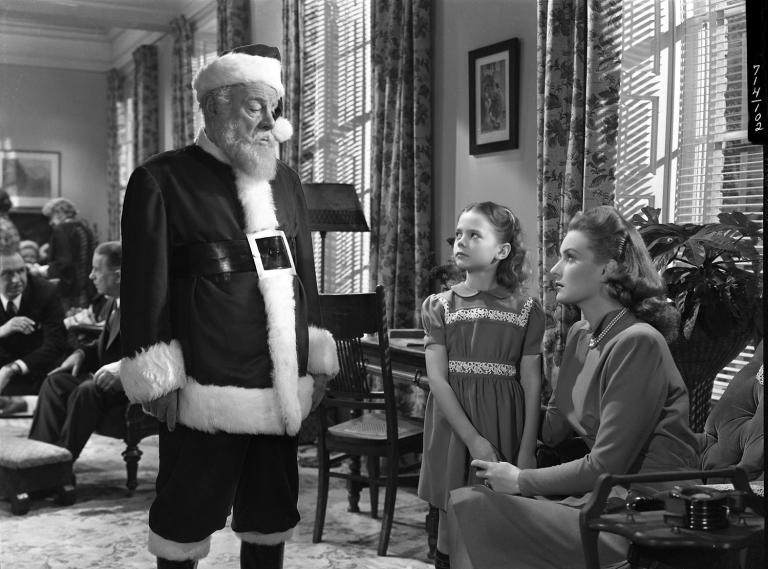
Recently, I caved and watched the original Miracle on 34th Street for the first time, a movie which seems to define the phrase “having your cake and eating it too.” For anyone who doesn’t know the plot, it’s a charming fable aping the structure of Christ’s incarnation and rejection, but without anything so grim as a crucifixion to make the analogy complete. As the real Kris Kringle makes his benevolent way around New York, children are thrilled, adults’ skepticism is tested, and one little girl and her mother learn the true meaning of faith.
The movie’s adorable heroine, precocious 8-year-old Susie (Natalie Wood), has been thoroughly trained in cold rationalism. She’s That Kid, the one who priggishly spoils the fun for kids who are still in a state of suspended disbelief. And not only does she doubt Santa, she can’t even play basic pretend games with her friends. When Kris teaches her how to imitate a monkey, it’s a revelation for her. All of this, we learn, is transferred jadedness from her mother Doris (Maureen O’Hara), a divorcee who has learned the hard way not to wait for wishes to come true. In the end, the mother’s own faith is sweetly restored by the earnest young lawyer who vindicates Kris in court while falling in love with her. The lawyer also gets the movie’s famous one-line definition of faith: “believing when common sense tells you not to.”
The movie is emphatic that this is the real take-home message, even as an actual evidential case mounts for Kris’s authenticity. A Lewisian trilemma could be applied, as Kris seems manifestly not to be a “bad man” in either sense of the word. Meanwhile, Susie suspects something is up when he takes a small Dutch girl on his knee and begins fluently chatting in her native tongue. Yet, curiously, the precise extent of Kris’s powers is left in soft focus. We never see him perform a concrete “miracle,” although it’s hinted at the very end that he might have teleported from one place to another. His method of supplying gifts repeatedly seems to consist of giving the right parent the right store tip in the nick of time. Before the conclusion, Susie’s budding faith is momentarily shattered when Kris is unable to make the Cape Cod of her dreams materialize immediately. He tells her that he is sorry, that he tried his best but he just couldn’t make it happen. Her mother tries to buoy her up by repeating that she has to keep believing anyway. “You mean it’s like if at first you don’t succeed, try, try again,” Susie replies bitterly. “I thought so.”
This importantly blurs together two very different conceptions of “faith.” There is “faith” as defined in the tagline, meaning belief beyond evidence, beyond common sense. But then there is the kind of faith C. S. Lewis defines, while explicitly rejecting this definition. Faith is not about believing “beyond what the evidence warrants.” Rather, it is about holding on to what you know to be true “in spite of shifting moods.” That is a very different kind of thing. But for Susie, in her moment of disappointment, they are inextricably bound up together. Yet a couple scenes later, she can be found sitting forlornly on the couch, repeating under her breath, “I believe, I believe, it’s silly but I believe.”
In the end, Kris once again performs a non-miraculous nudge by giving young Fred the directions to Susie’s dream house, where Fred promises to buy it and proposes to Doris on the spot. In thinking back over these accumulated “nudges,” I was reminded of the way Michael Ruse frames Christ’s “miracle” of the loaves and fishes—that most likely the true “miracle” was not that Jesus literally multiplied the food, which would be the crudest form of jiggery-pokery, but that he inspired the crowds to bring out and share what they had with each other. In the same way, the makers of the film seem to want to avoid directly ascribing miraculous power to Kris, emphasizing that human love and brotherhood is the real reason for the season. Kris Kringle is a Christ figure, but only according to a watered-down modernist vision of Christ—Christ by way of Tübingen. Let people have Christ, it seems to whisper, just as we let the children have Santa. Are they really so different?
This is the sort of subliminal cultural messaging that makes Christian parents uneasy with the Santa myth. They’re not wrong to feel that discomfort. The messaging is unmistakably there. And C. S. Lewis isn’t quite the ally some seem to think he is in making their case to the contrary.
Of course, there’s more than one way to “let the children have Santa.” One can allow the fable to filter naturally to them by osmosis. One can make a game of it when they’re still too little to ask precocious questions. And, contra the strawman of rigid repressed Susie, one can nurture a child’s imagination in all sorts of ways that don’t involve elaborately blurring the distinction between fable and reality. But in the end, fables are meant to be held lightly, as no more than what they are. And faith, as the writer of Hebrews has it, should be presented not as a closing of the mind, but as the substance of things hoped for with good reason, from that place where heart and mind unite. It may not be a faith that is always easy to maintain, as Lewis well knows and recognizes. God may choose not to grant prayer, not to make wishes come true. But it is precisely because Christ and Kris Kringle are not one and the same that we are made able, even in these most painful moments, to keep saying, “I believe. I believe. It’s not silly, and I believe.”
Previous Post

November 22, 2021
Kyle Rittenhouse Was No Fool
Next Post

January 11, 2022 Marvelised Evangelism: How the Babylon Bee Failed Elon Musk
Browse Our Archives
Select a Category 3 star 3.5 star 4 star 4.5 star Anatomy of a Song Behind the Songs Blog Stuff Book Reviews CCM CCM vs. SG CD Reviews Christians in Entertainment Christmas Essential 12 Christmas Favorites Christmas Top Fives Concert Reviews Concerts Culture Devotional Thoughts Faith and Culture From the Vault Fun Gospel Singers Gospel Songs Great Music Guest Posts Harmony Master Classes History Holidays Humor Hymns Interviews Marriage in the Movies Monday Morning Humor Movie Reviews Movies Music NQC Odds and Ends Old Movies, New Eyes Old Southern Gospel News Old Stuff Open Threads Other Genres Perfect Tenor Performances Polls Questions and Answers Recently Added SG vs. The Rest of the World Sing It Again Songs Songwriting Southern Gospel Surprise Sunday The Definitive Hymns Theology Toe-to-Toe Top 10 Lists Top 5 Top 5 Lists Two Sisters Review Uncategorized Video Posts Youtube Finds
Select a Month August 2026 February 2025 August 2024 June 2024 May 2024 April 2024 March 2024 October 2023 March 2023 February 2023 December 2022 October 2022 September 2022 August 2022 July 2022 June 2022 May 2022 March 2022 February 2022 January 2022 December 2021 November 2021 September 2021 August 2021 July 2021 June 2021 May 2021 April 2021 March 2021 February 2021 January 2021 December 2020 November 2020 October 2020 September 2020 August 2020 June 2020 March 2020 February 2020 December 2019 November 2019 October 2019 September 2019 August 2019 July 2019 June 2019 May 2019 April 2019 March 2019 February 2019 January 2019 December 2018 November 2018 October 2018 September 2018 August 2018 July 2018 April 2018 September 2017 August 2017 May 2017 February 2017 December 2016 November 2016 September 2016 August 2016 July 2016 June 2016 May 2016 April 2016 March 2016 February 2016 January 2016 December 2015 November 2015 October 2015 September 2015 August 2015 July 2015 June 2015 May 2015 April 2015 March 2015 February 2015 January 2015 December 2014 November 2014 October 2014 September 2014 August 2014 July 2014 June 2014 May 2014 April 2014 March 2014 February 2014 January 2014 December 2013 November 2013 October 2013 September 2013 August 2013 July 2013 June 2013 May 2013 April 2013 March 2013 February 2013 January 2013 December 2012 November 2012 October 2012 September 2012 August 2012 July 2012 June 2012 May 2012 April 2012 March 2012 February 2012 January 2012 December 2011 November 2011 October 2011 September 2011 August 2011 July 2011 June 2011 May 2011 April 2011 March 2011 February 2011
Follow Us!
TAKE THE
Religious Wisdom Quiz
What punishment did God send after David counted the fighting men of Israel?
Select your answer to see how you score.
Famine Flood Plague Defeat in battle
Related posts from Young Fogey

Should You Turn Your Testimony Into Content?

Paul Kingsnorth's Erasmus Lecture, Revisited

The Conservative Case for Sauron

TRENDING AT PATHEOS Evangelical

Noah’s Ark Archaeologists: Gopher Wood or Should We...
Ancient wood, a boat-shaped formation and dates that invite a second look:...

Smart people saying smart things (11.24.26)
Please take time to listen to Perry Bacon, Sarah Posner, Adam Serwer,...

The Contingency of Our Technology
Last week we were hit with a raft of massive technology outages....

In 1939, President Franklin D. Roosevelt moved Thanksgiving from November 30 to...

Reasons for Restraint: Ricardo Gonzalez, Florida and Dec...
The Morning of January 3 I begin with the dead. On the...

I published this column for Thanksgiving 2012 in the Deseret News....
view all Evangelical blogs
Ad-Free & Subscriber Log-In Subscription Support
- About Us
- 2026 Calendar
- Videos
- Podcasts
- Library of World Religions
- Faith In Media Tracker
- Advertise With Us
- Write for Us
- Privacy Policy
- Terms of Service
- Do Not Sell My Data
- Contact Us
- Radiant Digital
- Manage Newsletter Subscriptions
- Unsubscribe From Notifications
- Sitemap
Copyright 2008-2026, Patheos, part of the Radiant Digital network of media brands. All rights reserved.
Subscription Support Ad-Free & Subscriber Log-In
Follow Patheos