
BuddhistCatholicContemplativeEvangelicalGeneral ChristianHinduJewishLatter-day SaintMuslimNew VisionsProgressive Christian
Beliefs
- Buddhist
- Catholic
- Contemplative
- Evangelical
- General Christian
- Hindu
- Jewish
- Latter-day Saint
- More Voices
- Muslim
- New Visions
- Pagan
- Progressive Christian
Topics
- Religion News
- Food and Religion
- Sports and Religion
- Religious Art
- Religious Music and Entertainment
- Religious Events
- History and Religion
- Style and Religion
- Politics and Religion
- Women in Religion
- Recreation Outdoors and Religion
- Business Finance and Religion
- Careers Workplace and Religion
- Education and Religion
- Family Parenting and Religion
- Health Fitness and Religion
- Home and Religion
- Relationships and Religion
- Technology and Religion
- Travel and Religion
Columnists
- Buddhist Columnists
- Business Finance and Religion Columnists
- Careers Workplace and Religion Columnists
- Catholic Columnists
- Contemplative Columnists
- Education and Religion Columnists
- Evangelists Columnists
- Family Parenting and Religion Columnists
- General Christian Columnists
- Health Fitness and Religion Columnists
- Hindu Columnists
- History and Religion Columnists
- Home and Religion Columnists
- Jewish Columnists
- More Voices Columnists
- Latter Day Columnists
- Muslim Columnists
- New Visions Columnists
- Nonreligious Columnists
- Pagan Columnists
- Politics and Religion Columnists
- Progressive Columnists
- Recreation Outdoors and Religion Columnists
- Relationships and Religion Columnists
- Religion News Columnists
- Religious Art Columnists
- Religious Events Columnists
- Religious Music and Entertainment Columnists
- Sports and Religion Columnists
- Style and Religion Columnists
- Technology and Religion Columnists
- Travel and Religion Columnists
- Women in Religion Columnists
Resource Library
- 2026 Calendar
- Library of World Religions
- The 100 Most Holy Places on Earth
- Patheos Answers
- Podcasts
- Videos
- Faith Leaders Database
- Anglican Episcopalian
- Bahai
- Baptist
- Buddhism
- Christianity
- Confucianism
- Eastern Orthodoxy
- Hinduism
- Holiness and Pentecostal
- ISKCON
- Islam
- Judaism
- Lutheran
- Methodist
- The Church of Jesus Christ of Latter-day Saints
- New Age
- Paganism
- Presbytarian and Reformed
- Protestantism
- Religion Behind the Scenes
- Roman Catholic
- Scientology
- Shia Islam
- Sikhism
- Sufism
- Sunni Islam
- Taoism
- Zen
- See all religions
Research Tools
 Ad-Free & Subscriber Log-In Subscription Support
Follow Patheos 

- Trending:
- Advent
- |
- Forgiveness
- |
- Thanksgiving
- |
- Election
- |
- Seasonal Holidays
- |
- Marriage

- Home
- New Visions
- History and Religion
- What Does Consciousness Have to Do with Spirituality?
What Does Consciousness Have to Do with Spirituality?
Last updated on: May 25, 2026 at 9:33 am by Larry Jordan
What Does Consciousness Have to Do with Spirituality? 2026-05-25T09:33:19-05:00 Larry Jordan
Patheos Explore the world's faith through different perspectives on religion and spirituality! Patheos has the views of the prevalent religions and spiritualities of the world.
Consciousness is certainly one of the most challenging and interesting topics that I have encountered in my spiritual journey. Perhaps Ultimate Reality (God) is the mind of the Universe.
In my writing, Ultimate Reality is probably NOT personal, possibly NOT supernatural, and perhaps NOT even intentional. I use this neutral term to describe the “ground of being,” NOT a being, and there is nothing “woo woo” about it. In fact, there are striking parallels between Eastern mysticism and quantum physics, which is our best description of the physical universe.
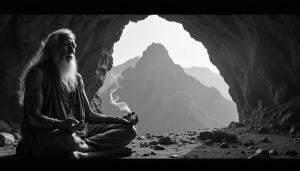
“My time in the cave had shown me another way to look at consciousness: less as a scientific or philosophical puzzle to be solved and more as a practice…” Image from StockCake/AI-generated, in the public domain
In The Way, I say that the Western worldview is generally based on “materialism.” Materialism suggests that consciousness originates from energy and matter. The other way to look at things, which is more common in the Eastern worldview, is “idealism.” Idealism suggests that energy and matter originate from consciousness, not vice versa. Consciousness is fundamental.
According to philosopher David Chalmers, there is the “hard problem” of consciousness. How could something material, like an organism, produce something immaterial, like a thought? Likewise, there is the “other hard problem” of consciousness. How could something immaterial, like a thought, produce something material, like an organism?
Idealism seems puzzling at first. However, recall that solid objects are not really “solid,” and that empty space is not really “empty.” And, ultimately, we process sensations in our brains, even when we “hear” with our ears and “see” with our eyes. Sir James Jeans, an astrophysicist, once wrote, “The universe begins to look more like a great thought than like a great machine.”
Perhaps Ultimate Reality (God) is the Mind of the Universe
In Western traditions, consciousness is NOT well-understood or widely-discussed. But in Eastern traditions, consciousness is an essential aspect of Ultimate Reality. In fact, in Hindu philosophy, satchitananda is a Sanskrit term meaning “being, consciousness, bliss,” which describes the nature of Ultimate Reality or the supreme consciousness.
In Buddhism, consciousness is a dynamic, ever-changing process of awareness that arises and falls away as conditions change. We perceive consciousness through the five senses, as well as through the mind, in ideas, memories and thoughts. In Case 30 of The Gateless Gate, Damei (Daibai) asked Mazu (Baso), “What is Buddha?” Mazu said, “This very mind is Buddha.”
As Geoffrey Shugen Arnold explains, “The universe asks; the universe itself responds. This is miraculous awareness. Mind is Buddha. This is the mind of the universe. It is the one great body that fills heaven and earth. Where is the self to be found? This is why the search for enlightenment or nirvana beyond this mind is impossible. There is nothing outside of it.”
In Taoism, the Tao is the cosmic, ever-flowing source of life. Taoists believe that individual awareness is NOT separate from the Universe; it is an extension of the whole, without separation.
Imagine that Ultimate Reality is NOT a personal being, but the impersonal “ground of being.” Perhaps St. Paul was talking about this ground of being when he quoted a pagan philosopher, saying, “In him, we live and move and have our being.”
Perhaps Ultimate Reality (God) is the mind of the universe, and the universe is a great thought. Here, Ultimate Reality does NOT create consciousness; Ultimate Reality is Consciousness. Also, here, we do NOT have a relationship with Consciousness; we participate in Consciousness.
A World Appears
I took a year-long break when I wrote The Way, so I could concentrate on “consciousness” and understand it well enough to write about it. Recently, I read A World Appears by Michael Pollan. Pollan is a science writer, not a scientist, and his writing is accessible and insightful. He asks great questions and arrives at tentative conclusions about a broad and deep subject.
Pollan explores the concept of sentience, a precursor to consciousness. He reports that organisms without brains (such as plants) demonstrate sentience when they communicate with each other and when they respond to their environments. Also, he studies the concept of feelings. Some neurologists argue that feelings beget consciousness; consciousness does NOT beget feelings.
Others assert that uncertainty begets homeostasis, which begets consciousness. Homeostasis refers to the process of maintaining internal stability while experiencing external instability. Here, homeostasis might apply to any “self-organizing system,” such as a colony, an ecosystem, a tropical storm, or a virus. It might be possible to embed these processes into artificial intelligence, too.
Pollan writes, “I was beginning to see that there exists a place, one way, way out there, where the reductive logic of the brain-as-computer meets the magic of transcendence.” Later, he wonders, “So where does that leave us? Exactly where we already were: in the exitless labyrinth of consciousness.”
Pollan looks at the concept of thought from three different perspectives, namely thoughts as a “stream of consciousness,” as discrete thoughts, and as spontaneous or unconscious thoughts. Then, he studies the concept of self. He suggests that experiences and memories constitute the self and that the self may be an illusion that is not essential to consciousness.
Pollan’s writing, like my writing, is reporting. Pollan’s book suggests that the state-of-the-art thinking about consciousness looks beyond brain-as-computer and beyond self-as-intentional agent. He asks intriguing questions about whether other living beings (such as plants and animals) and non-living systems (such as computers and tropical storms) experience consciousness.
“My Time in the Cave…”
Pollan concludes with a stay in a cave on a Buddhist retreat, where he attempts to strip away his sense of self. In the cave, Pollan writes, “The moment of being fully, freshly present to the universe stopped me cold and made me wonder if all my hard thinking about consciousness had missed something crucial about it…. the less of it I was actually experiencing—whatever it was….
“My time in the cave had shown me another way to look at consciousness: less as a scientific or philosophical puzzle to be solved and more as a practice, a way to once again be altogether here, present to life and to this vault of stars.” To me, it was fitting that Pollan ended his inquiry by attending a Buddhist retreat and meditating on spiritual practice and transcendence.
Similarly, in The Way, I said, “The mystics describe a state of cosmic consciousness or unity consciousness, in which we can transcend our egoic selves and attain a sense that everyone is related, and everything is connected. This cosmic consciousness is sometimes known as ‘Buddha nature’ in Buddhism or ‘Christ consciousness’ in Christianity.”
When we discuss consciousness, we can get tangled up in semantics. Is consciousness wakefulness? Or is it sentience? Is it awareness? Or is it self-awareness? In the Eastern worldview, consciousness is something like the ground of being. Pollan seems to agree by dispelling the concept of self, emphasizing experience over intellect and focusing on transcendence.
Consciousness is certainly one of the most challenging and interesting topics that I have encountered in my spiritual journey. Perhaps Ultimate Reality (God) is the mind of the universe.
If you want to keep up with the latest from You Might Be Right, please subscribe.
The Way received a 2024 Nautilus Book Award.
If you enjoyed this article, please leave a comment at the bottom of this page.
Thanks for reading You Might Be Right!!
New Visions
More Voices
Education and Religion
About Larry Jordan
Larry Jordan is a follower of Jesus with a Zen practice. He wrote “The Way,” informed by the Eastern religions, the mystics, and the quantum physicists. "The Way" won a 2024 Nautilus Book Award. You can read more about the author here.
Previous Post

May 16, 2026
Can We Choose NOT to Live in Anger and Fear?
Next Post

May 30, 2026 Is Connection the Fundamental Force of the Universe?
Recent Comments
"Thank you for your very insightful perspective on the Golden Rule.Ran across a comment earlier ..."
The Golden Rule Demands More than ..."
"Thanks, good to know. I'll check it out!!"
Reflections on My Spiritual Reconstruction
"Loved your deconstruction and reconstruction articles. thank youI have a Patheos column too - Lotus ..."
Reflections on My Spiritual Reconstruction
"We are all spiritually connected. It is a privilege to be pilgrims on journey at ..."
Reflections on Interspirituality
Browse Our Archives
Select a Category Uncategorized
Select a Month November 2026 October 2026 September 2026 August 2026 July 2026 June 2026 May 2026 April 2026 March 2026 February 2026 January 2026 December 2025 November 2025 October 2025 September 2025 August 2025 July 2025 June 2025 May 2025 April 2025 March 2025 February 2025 January 2025 December 2024 November 2024 October 2024 September 2024 August 2024 July 2024 June 2024 May 2024 April 2024 March 2024 February 2024
Follow Us!
TAKE THE
Religious Wisdom Quiz
True or False: Hebrews teaches that the blood of bulls and goats can take away sins.
Select your answer to see how you score.
TRUE FALSE
Books by This Author Books by Larry Jordan
Related posts from You Might Be Right

Spirituality without Supernaturalism

"The Deconstruction Space is a Mess"


Existential Health: Being Available, Engaged and Present
TRENDING AT PATHEOS History and Religion

Smart people saying smart things (11.24.26)
Please take time to listen to Perry Bacon, Sarah Posner, Adam Serwer,...

The Contingency of Our Technology
Last week we were hit with a raft of massive technology outages....

In 1939, President Franklin D. Roosevelt moved Thanksgiving from November 30 to...

Reasons for Restraint: Ricardo Gonzalez, Florida and Dec...
The Morning of January 3 I begin with the dead. On the...

I published this column for Thanksgiving 2012 in the Deseret News....

For many years, Catholicism has been caught up in division over the...
view all History and Religion blogs
What Are Your Thoughts?leave a comment
Ad-Free & Subscriber Log-In Subscription Support
- About Us
- 2026 Calendar
- Videos
- Podcasts
- Library of World Religions
- Faith In Media Tracker
- Advertise With Us
- Write for Us
- Privacy Policy
- Terms of Service
- Do Not Sell My Data
- Contact Us
- Radiant Digital
- Manage Newsletter Subscriptions
- Unsubscribe From Notifications
- Sitemap
Copyright 2008-2026, Patheos, part of the Radiant Digital network of media brands. All rights reserved.
Subscription Support Ad-Free & Subscriber Log-In
Follow Patheos