
BuddhistCatholicContemplativeEvangelicalGeneral ChristianHinduJewishLatter-day SaintMuslimNew VisionsProgressive Christian
Beliefs
- Buddhist
- Catholic
- Contemplative
- Evangelical
- General Christian
- Hindu
- Jewish
- Latter-day Saint
- More Voices
- Muslim
- New Visions
- Pagan
- Progressive Christian
Topics
- Religion News
- Food and Religion
- Sports and Religion
- Religious Art
- Religious Music and Entertainment
- Religious Events
- History and Religion
- Style and Religion
- Politics and Religion
- Women in Religion
- Recreation Outdoors and Religion
- Business Finance and Religion
- Careers Workplace and Religion
- Education and Religion
- Family Parenting and Religion
- Health Fitness and Religion
- Home and Religion
- Relationships and Religion
- Technology and Religion
- Travel and Religion
Columnists
- Buddhist Columnists
- Business Finance and Religion Columnists
- Careers Workplace and Religion Columnists
- Catholic Columnists
- Contemplative Columnists
- Education and Religion Columnists
- Evangelists Columnists
- Family Parenting and Religion Columnists
- General Christian Columnists
- Health Fitness and Religion Columnists
- Hindu Columnists
- History and Religion Columnists
- Home and Religion Columnists
- Jewish Columnists
- More Voices Columnists
- Latter Day Columnists
- Muslim Columnists
- New Visions Columnists
- Nonreligious Columnists
- Pagan Columnists
- Politics and Religion Columnists
- Progressive Columnists
- Recreation Outdoors and Religion Columnists
- Relationships and Religion Columnists
- Religion News Columnists
- Religious Art Columnists
- Religious Events Columnists
- Religious Music and Entertainment Columnists
- Sports and Religion Columnists
- Style and Religion Columnists
- Technology and Religion Columnists
- Travel and Religion Columnists
- Women in Religion Columnists
Resource Library
- 2026 Calendar
- Library of World Religions
- The 100 Most Holy Places on Earth
- Patheos Answers
- Podcasts
- Videos
- Faith Leaders Database
- Anglican Episcopalian
- Bahai
- Baptist
- Buddhism
- Christianity
- Confucianism
- Eastern Orthodoxy
- Hinduism
- Holiness and Pentecostal
- ISKCON
- Islam
- Judaism
- Lutheran
- Methodist
- The Church of Jesus Christ of Latter-day Saints
- New Age
- Paganism
- Presbytarian and Reformed
- Protestantism
- Religion Behind the Scenes
- Roman Catholic
- Scientology
- Shia Islam
- Sikhism
- Sufism
- Sunni Islam
- Taoism
- Zen
- See all religions
Research Tools
 Ad-Free & Subscriber Log-In Subscription Support
Ad-Free & Subscriber Log-In Subscription Support
Follow Patheos 

- Trending:
- Forgiveness
- |
- Marriage
- |
- Consciousness
- |
- Death Penalty
- |
- Election
- |
- Halloween

- Home
- New Visions
- History and Religion
- What Is Interspirituality, and Why Is It Important?
What Is Interspirituality, and Why Is It Important?
Last updated on: October 7, 2025 at 8:52 am by Larry Jordan
What Is Interspirituality, and Why Is It Important? 2025-10-07T08:52:18-05:00 Larry Jordan
Patheos Explore the world's faith through different perspectives on religion and spirituality! Patheos has the views of the prevalent religions and spiritualities of the world.
There are common themes that recur in many religions, and they are consistent in general. Of course, they do not always agree on the details. This column is subtitled “An Interspiritual Journey.” Often, I highlight some of the common themes and differences in spiritual traditions.
I know—as well as I know anything—that everyone is related, and everything is connected. Fundamentally, that is all that I need to know. This realization produces the Golden Rule, which is a common theme in many spiritual (and secular) traditions.
But I do NOT know (for example) if Jesus or Osiris were born of virgins or if Jesus or Odin rose from the dead. And I do not need to know. Also, I do NOT know whether we are punished or rewarded or reincarnated or snuffed out when we die. And I do not need to know.
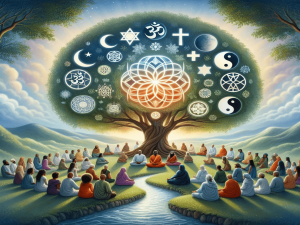
There are common themes that recur in many religions. Image in the public domain/AI-generated
So this is how Common Ground Interspiritual Fellowship describes interspirituality:
- It is NOT a new religion.
- It is NOT a replacement for your spiritual path.
- It is NOT a blending of all paths.
- It is NOT trying to identify who has the right belief.
- It is a willingness to find wisdom regardless of the label it is expressed within.
- It is an attitude of respect and appreciation for those who have traveled ahead of us.
- It is a focus on experiences of heart and unity consciousness rather than on creeds and beliefs.
- It is a recognition of a common mystical basis and experience within all the great wisdom traditions.
But how does that look?
The Moon and the Finger Pointing at the Moon
We are spending another month in Crestone, Colorado, which is home to numerous spiritual centers in various spiritual traditions. One day, we might be praying to Our Father at a Catholic Mass. The next day, we might be chanting to the Divine Mother at a Hindu ashram.
(I write about a Hindu fire ceremony here. This was a popular post, since many readers have never experienced a fire ceremony.)
If you read my book or my columns, you know that I recognize an Ultimate Reality, which some might call God or Source or the Universe. None of us know anything about Ultimate Reality. “The Tao that can be named is not the eternal Tao,” as the Taoists say.
I suspect that Ultimate Reality is probably not personal, possibly not supernatural, and perhaps not even intentional. In The Way, I ask whether we should think of God as the architecture of the universe (that which connects us), rather than the architect of the universe.
If God is NOT personal, if there is NOT a literal Father, and if there is NOT a divine intention, then what is the point of chanting or praying? There is a Buddhist saying that one should not confuse the finger pointing at the moon with the moon. Chanting and praying are pointers.
- Books like the Bible and the Bhagavad Gita are pointers.
- Concepts like “God” or “the Universe” are pointers.
- Practices like chanting and praying are pointers.
- Rituals like church services and fire ceremonies are pointers.
- And teachers like Buddha and Jesus are pointers.
Pointers prompt awe, gratitude, and reverence for living, without needing to know (or pretending to know) the Mystery behind the gift of life.
The moon looks like a flat disk when viewed from one perspective. But it shows itself to be a sphere when viewed from several perspectives. To me, the pointers from the various religions reveal a consistent picture in general. But they might not agree on the details.
The Guru, the Priest, and the Zen Master
Yesterday, I bought an interesting book in the ashram gift shop, Zen and the Mystic Impulse: Reflections on the Teachings of Willigis Jäger, Benedictine Monk, Mystic, and Zen Master by Arnie Lade. Why would a Hindu ashram carry a book about a priest and Zen master?
In the book, Lade pays homage to his three primary spiritual teachers:
- Haidakhan Babaji was a Hindu teacher, “a personification of what it means to be truly human, in communion with the Eternal.”
- Reverend Master Meiten was a Zen Buddhist teacher, a professor of psychology who once lived at an ashram.
- Willigis Jäger was a Catholic priest and Zen master.
All three were mystics, who drew insight and inspiration from several traditions.
Lade writes that Sufi mystic Hazrat Inayat Khan said, “No one can be a mystic and call himself a Christian mystic, a Jewish mystic or a Muhammedan mystic. For what is mysticism? Mysticism is something that erases from one’s mind all ideas of separation.”
And Lade explains that “Mysticism is all too frequently misunderstood and confused with lofty, ecstatic states and paranormal experiences… The aim is not some self-centered detached ecstasy but the recognition and union with the Eternal and becoming a whole person.”
Willigis Jäger wrote, “The mystic goes beyond Western dualistic thinking that separates God and the world, the natural and the supernatural, the human and the divine.” And he wrote, “In the willingness to surrender, the new can unfold, and the process of maturation takes place, a process of becoming totally whole in our lives. This experience led the Zen master Ummon to say: ‘Every new day is a good day.'”
There are Common Themes that Recur in Many Religions
In The Way, I discuss the perennial philosophy, a school of thought that recognizes the common themes across all traditions. Of course, Jäger recognized the perennial philosophy, and Lede wrote about it in his book.
There are many Christian and non-Christian communities that are less doctrinal, more inclusive, and less evangelical than conservative Catholic, Evangelical or Mormon churches. I belong to a Unity book club, and I lead a Christian deconstruction study group at a UU church. Weekly, I zoom with progressive Christians. Monthly, I attend Buddhist book club meetings, Quaker meetings, and Zen meditations.
Sometimes, I participate in Hindu fire ceremonies, Native American sweat lodges, Shinto purification ceremonies, and Sufi dhikrs. Recently, a Hindu ashram appointed my wife to the board of directors. The board recognized that her interspiritual perspective was valuable.
Do you see why an ashram bookstore carries a book about a Catholic priest and Zen master? Do you see why many people receive insight and inspiration from the “pointers” in several traditions that recognize an Ultimate Reality that cannot be contained in one tradition?
And do you see why many people seek wholeness in contemplative spiritual practices that focus on our interconnectedness, without promoting some of the speculative doctrine, supernatural beliefs or unkind practices that characterize some spiritual traditions?
There are common themes that recur in many religions, and they are consistent in general. Of course, they do not always agree on the details.
If you want to keep up with the latest from You Might Be Right, please subscribe.
The Way received a 2024 Nautilus Book Award.
If you enjoyed this article, please leave a comment at the bottom of this page.
Thanks for reading You Might Be Right!!
New Visions
More Voices
Education and Religion

About Larry Jordan
Larry Jordan is a follower of Jesus with a Zen practice. He wrote “The Way,” informed by the Eastern religions, the mystics, and the quantum physicists. "The Way" won a 2024 Nautilus Book Award. You can read more about the author here.
Previous Post

September 26, 2025
The Shrinking Church and the Shrinking Clergy
Next Post

October 19, 2025 Why Isn't the Church More Important to More People?
Recent Comments
"Thank you for your very insightful perspective on the Golden Rule.Ran across a comment earlier ..."
The Golden Rule Demands More than ..."
"Thanks, good to know. I'll check it out!!"
Reflections on My Spiritual Reconstruction
"Loved your deconstruction and reconstruction articles. thank youI have a Patheos column too - Lotus ..."
Reflections on My Spiritual Reconstruction
"We are all spiritually connected. It is a privilege to be pilgrims on journey at ..."
Reflections on Interspirituality
Browse Our Archives
Select a Category Uncategorized
Select a Month October 2026 September 2026 August 2026 July 2026 June 2026 May 2026 April 2026 March 2026 February 2026 January 2026 December 2025 November 2025 October 2025 September 2025 August 2025 July 2025 June 2025 May 2025 April 2025 March 2025 February 2025 January 2025 December 2024 November 2024 October 2024 September 2024 August 2024 July 2024 June 2024 May 2024 April 2024 March 2024 February 2024
Follow Us!
TAKE THE
Religious Wisdom Quiz
I challenged 450 prophets to call down fire from heaven, and theirs failed while mine consumed everything. Who am I?
Select your answer to see how you score.
Moses Elijah Samuel Elisha
Books by This Author Books by Larry Jordan
Related posts from You Might Be Right


Why I Practice in Many Spiritual Traditions, Not...

Reflections on My Religious Deconstruction
TRENDING AT PATHEOS History and Religion

The Iron Gates and the Lion of the...
Yesterday, I didn't finish my report about, well, yesterday. So I'll...

Dolly Parton’s Last Song Wins Dove Award with...
Bluegrass band The Grascals, speaking on the red carpet at the 57th...

The Image: On the Horror of Capitalism and...
The Image Then went the Pharisees, and took counsel how they might...

We are approaching the date of our new American national holiday: October...

Letters on Living the Faith by C.S. Lewis
Most of us met C.S. Lewis as a public intellectual. Mere Christianity....

When Halloween Unmasks Married Hearts
Written by Dr. David K. Ewen from Eternal Truth Bible College Behind...
view all History and Religion blogs
What Are Your Thoughts?leave a comment
Ad-Free & Subscriber Log-In Subscription Support
- About Us
- 2026 Calendar
- Videos
- Podcasts
- Library of World Religions
- Faith In Media Tracker
- Advertise With Us
- Write for Us
- Privacy Policy
- Terms of Service
- Do Not Sell My Data
- Contact Us
- Radiant Digital
- Manage Newsletter Subscriptions
- Unsubscribe From Notifications
- Sitemap
Copyright 2008-2026, Patheos. All rights reserved.
Subscription Support Ad-Free & Subscriber Log-In
Follow Patheos