
BuddhistCatholicContemplativeEvangelicalGeneral ChristianHinduJewishLatter-day SaintMuslimNew VisionsProgressive Christian
Beliefs
- Buddhist
- Catholic
- Contemplative
- Evangelical
- General Christian
- Hindu
- Jewish
- Latter-day Saint
- More Voices
- Muslim
- New Visions
- Pagan
- Progressive Christian
Topics
- Religion News
- Food and Religion
- Sports and Religion
- Religious Art
- Religious Music and Entertainment
- Religious Events
- History and Religion
- Style and Religion
- Politics and Religion
- Women in Religion
- Recreation Outdoors and Religion
- Business Finance and Religion
- Careers Workplace and Religion
- Education and Religion
- Family Parenting and Religion
- Health Fitness and Religion
- Home and Religion
- Relationships and Religion
- Technology and Religion
- Travel and Religion
Columnists
- Buddhist Columnists
- Business Finance and Religion Columnists
- Careers Workplace and Religion Columnists
- Catholic Columnists
- Contemplative Columnists
- Education and Religion Columnists
- Evangelists Columnists
- Family Parenting and Religion Columnists
- General Christian Columnists
- Health Fitness and Religion Columnists
- Hindu Columnists
- History and Religion Columnists
- Home and Religion Columnists
- Jewish Columnists
- More Voices Columnists
- Latter Day Columnists
- Muslim Columnists
- New Visions Columnists
- Nonreligious Columnists
- Pagan Columnists
- Politics and Religion Columnists
- Progressive Columnists
- Recreation Outdoors and Religion Columnists
- Relationships and Religion Columnists
- Religion News Columnists
- Religious Art Columnists
- Religious Events Columnists
- Religious Music and Entertainment Columnists
- Sports and Religion Columnists
- Style and Religion Columnists
- Technology and Religion Columnists
- Travel and Religion Columnists
- Women in Religion Columnists
Resource Library
- 2026 Calendar
- Library of World Religions
- The 100 Most Holy Places on Earth
- Patheos Answers
- Podcasts
- Videos
- Faith Leaders Database
- Anglican Episcopalian
- Bahai
- Baptist
- Buddhism
- Christianity
- Confucianism
- Eastern Orthodoxy
- Hinduism
- Holiness and Pentecostal
- ISKCON
- Islam
- Judaism
- Lutheran
- Methodist
- The Church of Jesus Christ of Latter-day Saints
- New Age
- Paganism
- Presbytarian and Reformed
- Protestantism
- Religion Behind the Scenes
- Roman Catholic
- Scientology
- Shia Islam
- Sikhism
- Sufism
- Sunni Islam
- Taoism
- Zen
- See all religions
Research Tools
 Ad-Free & Subscriber Log-In Subscription Support
Ad-Free & Subscriber Log-In Subscription Support
Follow Patheos 

- Trending:
- Forgiveness
- |
- Marriage
- |
- Consciousness
- |
- Death Penalty
- |
- Election
- |
- Halloween

- Home
- New Visions
- History and Religion
- Open-Hearted and Open-Minded Spirituality
Open-Hearted and Open-Minded Spirituality
Last updated on: November 8, 2024 at 6:47 pm by Larry Jordan
Open-Hearted and Open-Minded Spirituality 2024-11-08T18:47:57-06:00 Larry Jordan
Patheos Explore the world's faith through different perspectives on religion and spirituality! Patheos has the views of the prevalent religions and spiritualities of the world.
Spiritual inquiry requires open-heartedness and open-mindedness.
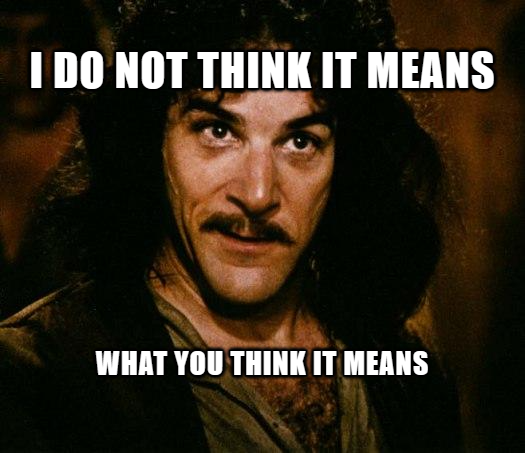
Inigo Montoya from The Princess Bride Image from imageresizer.com/meme-generator
My work is more reporting than apologetics or polemics. In my speaking and writing, I ask a lot of questions, and I leave a lot of room for differing interpretations and varying worldviews. Realizing that all religion is cultural and that all theology is speculation, I know one thing, namely that everyone is related, and everything is connected. I do NOT believe too many things.
Most people are asking questions themselves, and many seekers appreciate different interpretations and tolerate varying worldviews. Nobody knows the answers to the big questions.
Still, I hear often from militant atheists who say things like, “Get off the fence. You know that God does NOT exist and that spirituality is NOT productive. It’s all speculation and woo-woo stuff.” Honestly, if I knew that God did NOT exist, I would say so. For what it’s worth, I reject the same concept of God and the same speculative stuff and woo-woo that you reject.
Also, I hear often from militant theists who say things like, “Get off the fence. You know that God exists and that spirituality is the most productive thing that we can do. It’s factual, not fictional.” Honestly, if I knew that God exists, I would say so. For what it’s worth, I’m a deeply spiritual person. At the same time, I’m agnostic about most things, because NONE of this stuff is factual.
When I say that NONE of this stuff is factual, I do NOT mean that there is no such thing as Truth with a capital T. Of course, there are answers to the big questions; we just can NOT know them. That being the case, we should be honest enough with ourselves and others to characterize our positions as beliefs, not facts.
“I Do Not Think It Means What You Think It Means.”
In the famous line from the film The Princess Bride, swordsman Inigo Montoya utters the memorable line, “You keep using that word. I do not think it means what you think it means.”
In The Way, I quote The Red Book by psychologist Carl Jung. Jung asks Ammonius the Anchorite how he can read the Bible so many times without encountering monotony. The monk replies:
“A succession of words does not have only one meaning, but men strive to assign only a simple meaning to the sequence of words, in order to have an unambiguous language.… What you call ‘knowledge’ is an attempt to impose something comprehensible on life.… The word becomes your God, since it protects you from the possibilities of interpretation.… I’ve spent many years with the process of unlearning. Have you ever unlearned anything?”
Everyone thinks that they are reasonable, that reasonable people agree with them, and that their views are normative. We all assume that we mean the same thing when we use the same words. But what do we mean by words like “God,” “mysticism” or “spirituality”? (For that matter, what do we mean by words like “consciousness,” “energy” or “experience”?)
I use the term “Ultimate Reality,” which is found in the Eastern religions, to describe the indescribable. It is a placeholder for “what is,” irrespective of personal beliefs and speculative theories. Ultimate Reality is a neutral term, which is NOT necessarily personal and NOT necessarily supernatural. Am I an atheist or a theist? If we can define the terms, then I can answer the question.
If you believe in the God of the Bible, can you consider that Ultimate Reality might be larger and more mysterious than any narrow, specific, tribal description of the Indescribable, even yours?
I define “spirituality” as the belief in something greater than ourselves. I define “mysticism” as the way to access that something greater than ourselves. There is nothing inherently personal or supernatural about either of these definitions.
If you do NOT believe in spirituality, can you consider that it might NOT be personal (or even religious) that it focuses on an Ultimate Reality that might NOT be supernatural, but natural?
“Don’t Fall for the Binary Trap.”
Jim Palmer, a friend and mentor who wrote the foreword to my book, wrote about the false binary choices that come up in religious deconstruction here. Jim writes:
“Binary thinking, by definition, is thinking there are two sides, and you can only pick one. Also known as dichotomous thinking, this way of thinking becomes simple for us to process complex ideas and situations. The gray area in the middle of these complex issues is often ignored or goes unnoticed.
“There are a lot of false choices that come up in religious deconstruction. Here are a few:
- False Choice #1: The God of Christian fundamentalism (Christian Theism) OR no God at all (Atheism)
- False Choice #2: The Bible as the infallible and inerrant word spoken by God for all humankind OR the Bible is trash and worthless
- False Choice #3: Jesus as the divine Son of God, bodily raised from the dead and at the right hand of God in heaven OR Jesus didn’t exist
- False Choice #4: Religion as toxic fundamentalism OR all religion is worthless
“This binary thinking is not critical thinking, and often leads to the kind of fundamentalism I mentioned previously. The post-religion spiritual landscape is diverse, complex and nuanced.”
When I ask open-ended questions, I am NOT trying to complicate things or to straddle the fence. I am trying to suggest that these issues are diverse, complex and nuanced, as Jim Palmer writes. At the same time, I am suggesting that the world would be a better place if more people approached life in an open-hearted and open-minded way, rather than staking out extreme positions.
Spiritual inquiry requires open-heartedness and open-mindedness.
If you want to keep up with the latest from You Might Be Right, please subscribe.
The Way is a Silver winner in the 2024 Nautilus Book Awards.
If you enjoyed this article, please leave a comment at the bottom of this page.
Thanks for reading You Might Be Right!!
New Visions
More Voices
Education and Religion

About Larry Jordan
Larry Jordan is a follower of Jesus with a Zen practice. He wrote “The Way,” informed by the Eastern religions, the mystics, and the quantum physicists. "The Way" won a 2024 Nautilus Book Award. You can read more about the author here.
Previous Post

October 31, 2024
What Can We Learn from the Rise and Fall of Communities?
Next Post

November 14, 2024 Challenges of Religious Deconstruction
Recent Comments
"Thank you for your very insightful perspective on the Golden Rule.Ran across a comment earlier ..."
The Golden Rule Demands More than ..."
"Thanks, good to know. I'll check it out!!"
Reflections on My Spiritual Reconstruction
"Loved your deconstruction and reconstruction articles. thank youI have a Patheos column too - Lotus ..."
Reflections on My Spiritual Reconstruction
"We are all spiritually connected. It is a privilege to be pilgrims on journey at ..."
Reflections on Interspirituality
Browse Our Archives
Select a Category Uncategorized
Select a Month October 2026 September 2026 August 2026 July 2026 June 2026 May 2026 April 2026 March 2026 February 2026 January 2026 December 2025 November 2025 October 2025 September 2025 August 2025 July 2025 June 2025 May 2025 April 2025 March 2025 February 2025 January 2025 December 2024 November 2024 October 2024 September 2024 August 2024 July 2024 June 2024 May 2024 April 2024 March 2024 February 2024
Follow Us!
TAKE THE
Religious Wisdom Quiz
What New Covenant promise is found in Jeremiah?
Select your answer to see how you score.
God will write His law on their hearts God will destroy Egypt God will flood the earth God will raise a new king in Israel
Books by This Author Books by Larry Jordan
Related posts from You Might Be Right


Why I Practice in Many Spiritual Traditions, Not...

Reflections on My Religious Deconstruction
TRENDING AT PATHEOS History and Religion

In one sense walking into Westminster Abbey is like walking down the...

'Super Scam Me' Exposes AI Jon Bon Jovi...
Leslie Pickett believed she was in a relationship with Jon Bon Jovi....

The Brazilian Remake of Kendricks' 'Flywheel' Opens in...
“Flywheel,” the story that launched the Kendrick Brothers’ filmmaking career is getting...

The Dangers of Gradual Accommodation (Winking at Sin)
Recently, the “law of gradualness” resurfaced during the opening of a weeklong,...

The Iron Gates and the Lion of the...
Yesterday, I didn't finish my report about, well, yesterday. So I'll...

The Image: On the Horror of Capitalism and...
The Image Then went the Pharisees, and took counsel how they might...
view all History and Religion blogs
What Are Your Thoughts?leave a comment
Ad-Free & Subscriber Log-In Subscription Support
- About Us
- 2026 Calendar
- Videos
- Podcasts
- Library of World Religions
- Faith In Media Tracker
- Advertise With Us
- Write for Us
- Privacy Policy
- Terms of Service
- Do Not Sell My Data
- Contact Us
- Radiant Digital
- Manage Newsletter Subscriptions
- Unsubscribe From Notifications
- Sitemap
Copyright 2008-2026, Patheos. All rights reserved.
Subscription Support Ad-Free & Subscriber Log-In
Follow Patheos