
BuddhistCatholicContemplativeEvangelicalGeneral ChristianHinduJewishLatter-day SaintMuslimNew VisionsProgressive Christian
Beliefs
- Buddhist
- Catholic
- Contemplative
- Evangelical
- General Christian
- Hindu
- Jewish
- Latter-day Saint
- More Voices
- Muslim
- New Visions
- Pagan
- Progressive Christian
Topics
- Religion News
- Food and Religion
- Sports and Religion
- Religious Art
- Religious Music and Entertainment
- Religious Events
- History and Religion
- Style and Religion
- Politics and Religion
- Women in Religion
- Recreation Outdoors and Religion
- Business Finance and Religion
- Careers Workplace and Religion
- Education and Religion
- Family Parenting and Religion
- Health Fitness and Religion
- Home and Religion
- Relationships and Religion
- Technology and Religion
- Travel and Religion
Columnists
- Buddhist Columnists
- Business Finance and Religion Columnists
- Careers Workplace and Religion Columnists
- Catholic Columnists
- Contemplative Columnists
- Education and Religion Columnists
- Evangelists Columnists
- Family Parenting and Religion Columnists
- General Christian Columnists
- Health Fitness and Religion Columnists
- Hindu Columnists
- History and Religion Columnists
- Home and Religion Columnists
- Jewish Columnists
- More Voices Columnists
- Latter Day Columnists
- Muslim Columnists
- New Visions Columnists
- Nonreligious Columnists
- Pagan Columnists
- Politics and Religion Columnists
- Progressive Columnists
- Recreation Outdoors and Religion Columnists
- Relationships and Religion Columnists
- Religion News Columnists
- Religious Art Columnists
- Religious Events Columnists
- Religious Music and Entertainment Columnists
- Sports and Religion Columnists
- Style and Religion Columnists
- Technology and Religion Columnists
- Travel and Religion Columnists
- Women in Religion Columnists
Resource Library
- 2026 Calendar
- Library of World Religions
- The 100 Most Holy Places on Earth
- Patheos Answers
- Podcasts
- Videos
- Faith Leaders Database
- Anglican Episcopalian
- Bahai
- Baptist
- Buddhism
- Christianity
- Confucianism
- Eastern Orthodoxy
- Hinduism
- Holiness and Pentecostal
- ISKCON
- Islam
- Judaism
- Lutheran
- Methodist
- The Church of Jesus Christ of Latter-day Saints
- New Age
- Paganism
- Presbytarian and Reformed
- Protestantism
- Religion Behind the Scenes
- Roman Catholic
- Scientology
- Shia Islam
- Sikhism
- Sufism
- Sunni Islam
- Taoism
- Zen
- See all religions
Research Tools
 Ad-Free & Subscriber Log-In Subscription Support
Ad-Free & Subscriber Log-In Subscription Support
Follow Patheos 

- Trending:
- Forgiveness
- |
- Marriage
- |
- Consciousness
- |
- Death Penalty
- |
- Election
- |
- Halloween

- Home
- New Visions
- History and Religion
- An Introduction to Zen
An Introduction to Zen
Last updated on: June 20, 2024 at 12:40 pm by Larry Jordan
An Introduction to Zen 2024-06-20T12:40:19-05:00 Larry Jordan
Patheos Explore the world's faith through different perspectives on religion and spirituality! Patheos has the views of the prevalent religions and spiritualities of the world.
Buddhism embraces a different worldview than most Western religions.
Buddhism developed in response to Hinduism, which could be rigid and ritualistic. Siddhartha Gautama (now called the Buddha) was a seeker who found enlightenment under a bodhi tree, where he attained liberation from samsara, the cycle of suffering.
Buddhism is grounded in the Buddha, the dharma (teachings) and the sangha (community.) On his deathbed, the Buddha reportedly instructed his followers not to blindly follow any leader (even the Buddha) and to scrutinize any teachings (even the Buddha’s teachings.)
The Buddha is not a god, but a human being who realized his connection to everyone and everything. He developed a “middle way” between self-indulgence and self-mortification to alleviate suffering. Buddhism is based on impermanence, imperfection, and selflessness.
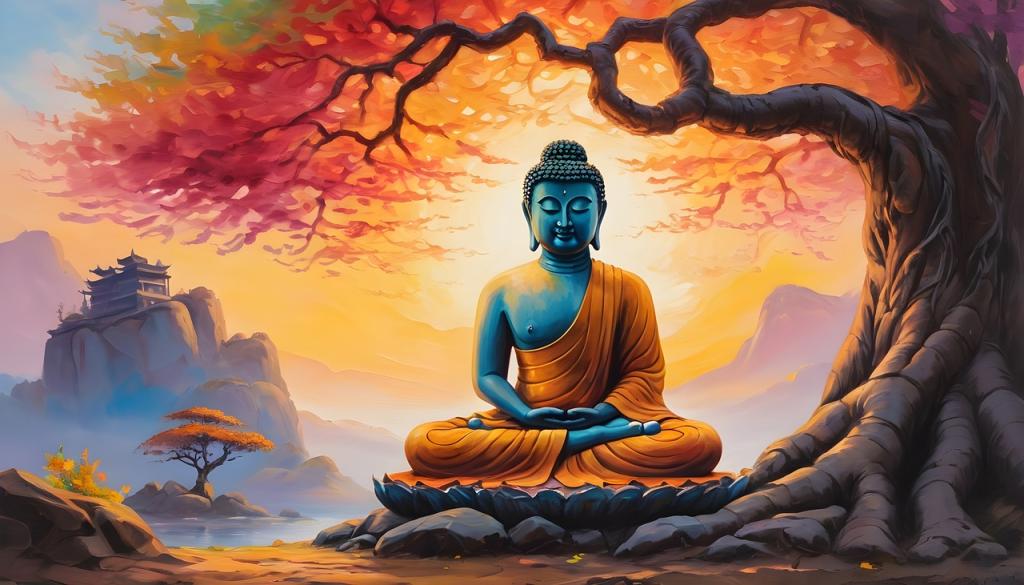
Buddhism embraces a different worldview than most Western religions. Zen is experiential, not intellectual. Image from Pixabay/jhollu7
Buddhism
The Buddha taught that everything is characterized by impermanence, so attachment produces suffering, primarily related to fear about the future and regret about the past. Here and now, the grass is growing and the sun is shining, despite our fears and regrets. Some might think that “detachment” means indifference. But, Buddhism is a compassionate tradition, and Buddhists care about all sentient beings.
Of course, we cannot change imperfection or eliminate the pains of death and illness and old age, but we can reduce the suffering associated with them. Buddhists reduce suffering by meditating, which involves clearing the mind, glimpsing the True Self (which is no-self), perceiving the Universe as it is, and recognizing our connection to the Universe.
In Buddhism, the idea of self is not central. Buddhists seek “no-self” or selflessness, avoiding attachment to the idea of a separate self and thereby reducing suffering. The notion of “emptiness” is related to the notion of no-self. When thinking about emptiness, it helps to define emptiness as “without distinction or separation,” rather than “without mass or energy.”
How can we have no-self when we live in different bodies, respond to individual names and occupy unique places in space and time? The egoic self is a construct, which is ephemeral, not eternal. In the East, some practice self-inquiry, realizing that we create images of our selves and others’ selves. As Christian mystic Thomas Merton wrote, “Most of us live lives of self-impersonation.”
This worldview is very different from the worldview of religions such as Christianity, where the idea of self is central. Here, God is personal. Christians hope to develop a personal relationship with God, to embrace personal responsibility and to attain personal salvation.
Some see Buddhism, particularly Zen, as a philosophy, not a religion. There are Buddhist Christians, Buddhist Jews and Buddhist humanists. For example, my Zen teacher is a former Jesuit priest and a well-known scholar of comparative religions. He is a practicing Catholic.
Dhyana, Chan, Zen
Buddhism (like many traditions) is practiced by different people in different ways. The lineage that became Zen began in India as dhyana, which refers to meditation. Buddhism migrated to China, where it absorbed influences from Confucianism and Taoism to become Chan. Then, it migrated to Japan, where it absorbed influences from the Samurai culture to become Zen.
In the last 100 years, Zen migrated to the West, where it is absorbing influences from Western culture to become relevant and timely here. Zen is still adapting to meet the needs of 21st century Western practitioners.
Many Eastern traditions rely on one-on-one transmission from teachers. A Zen teacher is primarily concerned with the student’s practice. Practice consists of meditation and (sometimes) koan study. Koans are paradoxical statements meant to prompt intuitive understanding. Zen practice is intended to help students to realize the connectedness of everyone and everything.
Zen is experiential, not intellectual. The Buddha was reportedly unconcerned with questions about God or the meaning of life or the afterlife, which he considered speculative. To the Buddha, we cannot know the answers to these questions, and we might not live our lives differently, even if we did know the answers.
Realizing, Not Attaining or Seeking
In Zen, there is a saying, “Do not seek the truth; only cease to cherish opinions.” Zen is about realizing, not believing or attaining or seeking. There is nothing to believe that is not speculation. There is nothing to attain, and there is nowhere to seek. So, we can ‘call off the search’ when we can let loose of our speculative beliefs, unchallenged doctrines, and untested presuppositions, to see things as they are.
This worldview is very different from the worldview of religions such as Christianity, which emphasize believing in speculative doctrines, attaining eternal salvation and seeking a personal relationship with God.
Buddhism embraces a different worldview than most Western religions. In coming weeks, we will explore the principles of Zen practice.
The Way is a Silver winner in the 2024 Nautilus Book Awards in the Religion/Spirituality of Other Traditions category.
If you want to stay up to date on the latest from You Might Be Right, simply subscribe with your email.
New Visions
More Voices
Education and Religion

About Larry Jordan
Larry Jordan is a follower of Jesus with Zen practice. Recently, he published his first book, “The Way,” which was informed by the Eastern religions, the mystics, and the quantum physicists. "The Way" was a Silver winner in the 2024 Nautilus Book Awards. You can read more about the author here.
Previous Post

June 14, 2024
Artificial Intelligence (AI) and Natural Intelligence
Next Post
June 27, 2024 Zen and the Self
Recent Comments
"Thanks, good to know. I'll check it out!!"
Reflections on My Spiritual Reconstruction
"Loved your deconstruction and reconstruction articles. thank youI have a Patheos column too - Lotus ..."
Reflections on My Spiritual Reconstruction
"We are all spiritually connected. It is a privilege to be pilgrims on journey at ..."
Reflections on Interspirituality
""that something has gone wrong, that human beings really are implicated in that rupture"So the ..."
Reflections on My Religious Deconstruction
Browse Our Archives
Select a Category Uncategorized
Select a Month October 2026 September 2026 August 2026 July 2026 June 2026 May 2026 April 2026 March 2026 February 2026 January 2026 December 2025 November 2025 October 2025 September 2025 August 2025 July 2025 June 2025 May 2025 April 2025 March 2025 February 2025 January 2025 December 2024 November 2024 October 2024 September 2024 August 2024 July 2024 June 2024 May 2024 April 2024 March 2024 February 2024
Follow Us!
TAKE THE
Religious Wisdom Quiz
How did the people show honor when Jesus entered Jerusalem on a donkey?
Select your answer to see how you score.
Sounded trumpets Laid down palm branches Built an altar Offered sacrifices
Books by This Author Books by Larry Jordan
Related posts from You Might Be Right

Why I Practice in Many Spiritual Traditions, Not...


Reflections on My Religious Deconstruction
TRENDING AT PATHEOS History and Religion

The Real AI Story Is Adoption Without Trust
Artificial intelligence has crossed a political threshold. It is no longer a...

A new article, written by Jeff Lindsay and Gale L. Pooley,...

Swimfan: Forgotten Aughts Pleasures
This is a recovery effort. In 2002, My Big Fat Greek Wedding...

Top Three Anti-Catholic Lies About Catholicism
This is my initial transcript for the video, "THE 3 WORST...

Pope Leo Celebrates Mass for Nurses & Docs...
I don't have any idea how he did it, but Pope Leo...

The Sermon on the Mount, Part I: Matthew...
The Sermon on the Mount, Part I (Matthew 4:12-5:12) St. Matthew moves...
view all History and Religion blogs
What Are Your Thoughts?leave a comment
Ad-Free & Subscriber Log-In Subscription Support
- About Us
- 2026 Calendar
- Videos
- Podcasts
- Library of World Religions
- Faith In Media Tracker
- Advertise With Us
- Write for Us
- Privacy Policy
- Terms of Service
- Do Not Sell My Data
- Contact Us
- Radiant Digital
- Manage Newsletter Subscriptions
- Unsubscribe From Notifications
- Sitemap
Copyright 2008-2026, Patheos. All rights reserved.
Subscription Support Ad-Free & Subscriber Log-In
Follow Patheos