
BuddhistCatholicContemplativeEvangelicalGeneral ChristianHinduJewishLatter-day SaintMuslimNew VisionsProgressive Christian
Beliefs
- Buddhist
- Catholic
- Contemplative
- Evangelical
- General Christian
- Hindu
- Jewish
- Latter-day Saint
- More Voices
- Muslim
- New Visions
- Pagan
- Progressive Christian
Topics
- Religion News
- Food and Religion
- Sports and Religion
- Religious Art
- Religious Music and Entertainment
- Religious Events
- History and Religion
- Style and Religion
- Politics and Religion
- Women in Religion
- Recreation Outdoors and Religion
- Business Finance and Religion
- Careers Workplace and Religion
- Education and Religion
- Family Parenting and Religion
- Health Fitness and Religion
- Home and Religion
- Relationships and Religion
- Technology and Religion
- Travel and Religion
Columnists
- Buddhist Columnists
- Business Finance and Religion Columnists
- Careers Workplace and Religion Columnists
- Catholic Columnists
- Contemplative Columnists
- Education and Religion Columnists
- Evangelists Columnists
- Family Parenting and Religion Columnists
- General Christian Columnists
- Health Fitness and Religion Columnists
- Hindu Columnists
- History and Religion Columnists
- Home and Religion Columnists
- Jewish Columnists
- More Voices Columnists
- Latter Day Columnists
- Muslim Columnists
- New Visions Columnists
- Nonreligious Columnists
- Pagan Columnists
- Politics and Religion Columnists
- Progressive Columnists
- Recreation Outdoors and Religion Columnists
- Relationships and Religion Columnists
- Religion News Columnists
- Religious Art Columnists
- Religious Events Columnists
- Religious Music and Entertainment Columnists
- Sports and Religion Columnists
- Style and Religion Columnists
- Technology and Religion Columnists
- Travel and Religion Columnists
- Women in Religion Columnists
Resource Library
- 2026 Calendar
- Library of World Religions
- The 100 Most Holy Places on Earth
- Patheos Answers
- Podcasts
- Videos
- Faith Leaders Database
- Anglican Episcopalian
- Bahai
- Baptist
- Buddhism
- Christianity
- Confucianism
- Eastern Orthodoxy
- Hinduism
- Holiness and Pentecostal
- ISKCON
- Islam
- Judaism
- Lutheran
- Methodist
- The Church of Jesus Christ of Latter-day Saints
- New Age
- Paganism
- Presbytarian and Reformed
- Protestantism
- Religion Behind the Scenes
- Roman Catholic
- Scientology
- Shia Islam
- Sikhism
- Sufism
- Sunni Islam
- Taoism
- Zen
- See all religions
Research Tools
 Ad-Free & Subscriber Log-In Subscription Support
Ad-Free & Subscriber Log-In Subscription Support
Follow Patheos 

- Trending:
- Forgiveness
- |
- Marriage
- |
- Consciousness
- |
- Death Penalty
- |
- Election
- |
- Halloween

- Home
- New Visions
- History and Religion
- No Self? No Soul? No Worries.
No Self? No Soul? No Worries.
Last updated on: June 25, 2024 at 10:43 am by Larry Jordan
No Self? No Soul? No Worries. 2024-06-25T10:43:31-05:00 Larry Jordan
Patheos Explore the world's faith through different perspectives on religion and spirituality! Patheos has the views of the prevalent religions and spiritualities of the world.
In the Eastern worldview, there are some people who believe that self is a construct, and soul is a fiction.
These are some of the most challenging and interesting ideas that we will encounter in our journeys. These ideas are difficult for Westerners, steeped in a culture that stresses individuality. Also, many Westerners consider psychology to focus on self-actualization and spirituality to focus on self-improvement. But, what if there is no self?
Psychologist Abraham Maslow outlined a hierarchy of needs, culminating in self-actualization. After he died, The Farther Reaches of Human Nature, was released. Here, Maslow proposed that we can transcend our narrative selves, devoting our lives to something larger than ourselves (such as service or spirituality) after we are self-actualized.

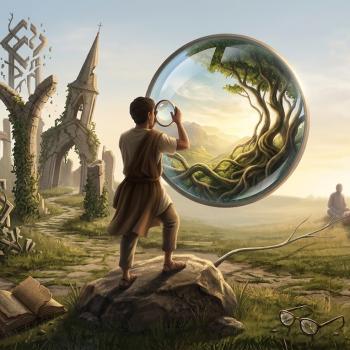
In the Eastern worldview, there are some people who believe that self is a construct, and soul is a fiction. Image from Pixabay/19361338
The Self
Personhood is cultural. In some languages, there is no first person singular (“I” or “me”) or no distinction between first person singular (“I” or “me”) and first person plural (“we” or “us.”) But, in the Western worldview, we think in personal terms. Our economy is based on personal gain. Our politics are based on personal responsibility, and our theology is based on personal salvation.
Ramana Maharshi, a Hindu sage, practiced self-inquiry. “Who am I?” is such an inquiry. We soon realize that whoever we think that we are (a conservative or a liberal, an introvert or an extrovert, a professional or a retiree) we are not eternally any of these things. Our selves are largely or wholly ephemeral. To ask, “Who am I?” is a simple, but profound, exercise.
Some believe that when we peel away everything that is ephemeral, then “I am,” pure “is-ness,” the ground of being, is all that is left. This may be Brahman in Hinduism, God in Christianity, the quantum field in physics, the universe in secular humanism and Yahweh in Judaism. “I am” means Brahman in the Upanishads, just as “I am” means God in the Hebrew Bible.
No-Self?
In many traditions, we die to the self, and “no-self” is one of the cornerstones of Buddhism. Osho, an Eastern mystic, wrote, “Either you can be in existence or you can be in the self…. To be in the self means to become an island…. To be in the self means to draw a distinction between ‘this I am’ and ‘this I am not.'”
Sometimes, Western people can be put off by terms such as “impersonal.” Thus, it can be helpful to think of “impersonal” as “impartial.” If we approach people impartially, we wipe the slate clean. We can see them clearly and compassionately, without predisposition or prejudice.
Thomas Merton, a Christian mystic, wrote, “Most of us live lives of self-impersonation,” conforming to the character that we expect of ourselves or that others expect of us. You might be thinking, “Yes, but we have souls that direct our actions and our thoughts. Surely, if we peel away the self, at the core, we find something (like an apple) not nothing (like an onion.)”
The Soul
Actually, our brains are networks, and scientists have not found a central controller there. Experiments suggest that our brains might be reporters, explaining actions after they happen, rather than controllers, determining actions before they happen. Our brains handle many processes, such as beating our hearts, digesting our meals, and working our lungs, without apparent direction.
In fact, the notion of the soul originated in philosophy, not religion. Aristotle believed that souls are the life forces that animate all beings:
- Nutritive souls governed growth in plants, animals, and people.
- Sensitive souls governed sensation in animals and people.
- Rational souls governed thought in humans.
No Soul?
As scientists have attributed growth and sensation to biology, chemistry, and physics, the first two notions of soul collapsed, and the third notion of soul is collapsing. If human beings evolved, then how and when did souls evolve? What is a soul? What does a soul do? Where is a soul found? Could we have damaged or missing souls, like some people have damaged or missing toes?
If our souls are not our bodies and brains or our personalities and thoughts, then what are souls? How do souls survive our physical deaths, what do they transport, and where do they travel? Also, how can a disembodied soul be rewarded or tormented?
Singer Tom Waits says that, “We are monkeys with money and guns.” Can we believe that we are the culmination of creation or that we were singularly created in the image of God if we suspect that only 50,000 years ago, homo sapiens were climbing trees for food, communicating in grunts, and copulating with Neanderthals?
Julien Musolino, a psychologist who wrote The Soul Fallacy, states:
“Notice that the conclusion, if we want to be intellectually honest, should not be that there is no soul, but rather, that there are no good reasons to believe that we have souls, and that there are very good reasons to believe that we do not have souls…. In the end, the soul, like the emperor’s new clothes, has exactly the properties that it should have if it did not exist.”
Where Do We Go from Here?
The notions of self and soul are deeply embedded in Western culture and Western religion, and it might be distressing to some people to even consider the possibility that they do not exist. In fact, the notion of the soul, because of its association with the notion of the afterlife, might be one of Western religion’s most precious, albeit most precarious, beliefs.
But all is not lost. Imagine that we are composed of matter; that matter, too, is energy; and that energy is neither created nor destroyed. Imagine that our energy is stirred into the Cosmic Soup, just like our bodies are stirred into the terrestrial soup; that our energy will merge with God or Ultimate Reality; and that our energy (like waves on the ocean) might reemerge in other matter.
In that scenario, we might have eternal life, but we might not have a separate identity. At that point, will I care if “I” am not me? What do you think?
If you want to stay up to date on the latest from You Might Be Right, simply subscribe with your email.
New Visions
More Voices
Education and Religion

About Larry Jordan
Larry Jordan is a follower of Jesus with Zen practice. Recently, he published his first book, “The Way: Meaningful Spirituality for a Modern World,” which was informed by the Eastern religions, the mystics, and the quantum physicists. You can read more about the author here.
Previous Post

February 23, 2024
Are We Separate from God and from Each Other?
Next Post

March 8, 2024 Christianity: Creeds, Exclusive Claims and Evangelization
Recent Comments
"Thanks, good to know. I'll check it out!!"
Reflections on My Spiritual Reconstruction
"Loved your deconstruction and reconstruction articles. thank youI have a Patheos column too - Lotus ..."
Reflections on My Spiritual Reconstruction
"We are all spiritually connected. It is a privilege to be pilgrims on journey at ..."
Reflections on Interspirituality
""that something has gone wrong, that human beings really are implicated in that rupture"So the ..."
Reflections on My Religious Deconstruction
Browse Our Archives
Select a Category Uncategorized
Select a Month October 2026 September 2026 August 2026 July 2026 June 2026 May 2026 April 2026 March 2026 February 2026 January 2026 December 2025 November 2025 October 2025 September 2025 August 2025 July 2025 June 2025 May 2025 April 2025 March 2025 February 2025 January 2025 December 2024 November 2024 October 2024 September 2024 August 2024 July 2024 June 2024 May 2024 April 2024 March 2024 February 2024
Follow Us!
TAKE THE
Religious Wisdom Quiz
What did Jesus say would happen if you build your house on the rock?
Select your answer to see how you score.
It would stand through storms It would sink It would get destroyed It would be fancy
Books by This Author Books by Larry Jordan
Related posts from You Might Be Right


Why I Practice in Many Spiritual Traditions, Not...

Reflections on My Religious Deconstruction
TRENDING AT PATHEOS History and Religion

When Halloween Unmasks Married Hearts
Written by Dr. David K. Ewen from Eternal Truth Bible College Behind...

Aristotle. He’s been called the father of logic, the father of the...

Methodist Central Hall and Westminster Abbey
Situated on the same square is Methodist Central Hall and Westminster Abbey. ...

57th Dove Awards Honor Dolly Parton, Crown New...
On gospel music’s biggest night, the 57th annual GMA Dove Awards honored...

The First Eucharistic Controversy: Christ’s Real Presence
For Catholics, the Eucharist is the source and summit of the Christian...

What a Stop Sign Can Teach Us About...
How to Make a Decision When You Can't Hear God Main point:...
view all History and Religion blogs
What Are Your Thoughts?leave a comment
Ad-Free & Subscriber Log-In Subscription Support
- About Us
- 2026 Calendar
- Videos
- Podcasts
- Library of World Religions
- Faith In Media Tracker
- Advertise With Us
- Write for Us
- Privacy Policy
- Terms of Service
- Do Not Sell My Data
- Contact Us
- Radiant Digital
- Manage Newsletter Subscriptions
- Unsubscribe From Notifications
- Sitemap
Copyright 2008-2026, Patheos. All rights reserved.
Subscription Support Ad-Free & Subscriber Log-In
Follow Patheos